
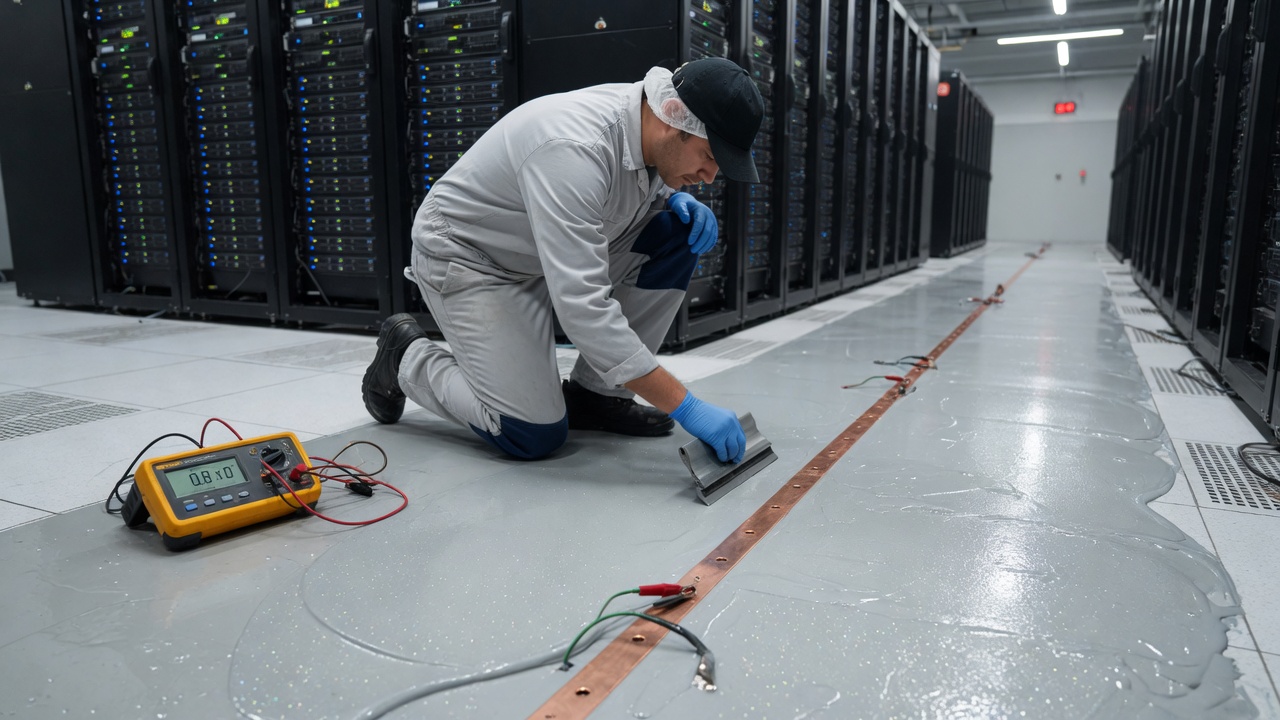
For most Atlanta data centers, server rooms, and electronics-handling floors, the answer is static-dissipative epoxy — a system engineered to hold surface resistance in roughly the 1×10⁶ to under 1×10⁹ ohm window. You reach for conductive (below 1×10⁶ ohms, down to about 2.5×10⁴) only when your ESD program requires faster charge decay to ground, typically around the most sensitive assembly or test operations. Both are installable as a seamless resinous system; the decision is driven by your equipment sensitivity and the resistance target your program sets, not by the coating chemistry alone. Once that target is fixed, the install path is a commercial epoxy flooring system detailed to it.
This guide is written for the facility engineer or data-center operations lead who already knows they need static-control flooring but needs to decide which system, and to hand a contractor a spec that will survive review. We will stay inside the two classes that ANSI/ESD S20.20 work actually uses, state the resistance windows that separate them, and cover the grounding and verification that turn an epoxy floor into a real ESD floor.
Static-Dissipative vs. Conductive: The Two Resistance Windows
The two classes are defined by surface resistance, measured in ohms. Static-dissipative material sits above conductive and below insulative — conductive enough to bleed charge to ground, resistive enough that the decay is controlled rather than instantaneous. Conductive material moves charge faster and at lower resistance.
| Class | Surface resistance (ohms) | Typical use |
|---|---|---|
| Static-dissipative | ~1×10⁶ to under 1×10⁹ (commonly specified 1×10⁷–109) | Most data centers, server rooms, electronics handling and assembly |
| Conductive | Under 1×10⁶, down to ~2.5×10⁴ | Operations requiring faster, lower-resistance charge decay to ground |
The practical read: dissipative is the default for data-center and electronics environments because it dissipates charge to ground in a controlled way without creating a fast, low-resistance path. Published guidance commonly recommends specifying a dissipative floor in the 1×10⁷ to 109 ohm range rather than hugging the 1×10⁶ boundary, so the floor keeps its dissipative character over its service life (Construction Specifier). Conductive is the right call where your program’s process requirements — or the sensitivity of the devices being handled — call for the faster decay a lower-resistance floor provides.
S20.20 Is a Program Standard — The Floor Is One Element
This is the point most “anti-static epoxy” marketing skips. ANSI/ESD S20.20 is a standard for an ESD control program — the administrative and technical requirements to establish, implement, and maintain static control across a facility (StaticWorx; Construction Specifier). It is not a flooring specification. The floor is one qualified element in that program, and it is qualified in combination with grounded personnel footwear, not in isolation.
The standard’s personnel-grounding requirement is a floor-plus-footwear system: both the resistance limit and the body-voltage limit must be met. The ultimate performance measure is that a person walking the floor does not accumulate and discharge 100 volts or more (Construction Specifier). That is why a conductive floor alone is not compliance — you can install a perfectly conductive floor and still fail the walking body-voltage test if the footwear, grounding, or program discipline around it is wrong. Spec the floor as part of the system, and make clear in your documents that the floor is qualified against the program, not sold as a standalone certification.
Grounding: No Continuity, No ESD Floor
A dissipative or conductive resin layer is electrically inert until it is tied to ground. The charge that the floor collects has to have somewhere to go, and that path is built in during installation: embedded copper grounding strips (or straps) laid into the system and bonded to the building’s earth ground (StaticWorx references grounding through copper strips).
Two things matter in the spec. First, the floor must be continuously connected — the conductive network under or within the coating has to actually reach every area that will be tested, so larger floors use multiple ground points rather than a single tie, sized and placed so no zone is electrically stranded. Second, the ground connection must land on a verified building earth ground, confirmed by the electrical contractor, not an assumed one. A floor with the correct resistance reading on its surface but no continuity to ground will pass a point-to-point test and fail a point-to-ground test — which is exactly why both tests exist.
Verification: RTT and RTG Are the Proof Step
The line between a real ESD floor and epoxy merely labeled “anti-static” is testing. ANSI/ESD STM7.1 defines the floor-material measurements: point-to-point resistance (RTT), electrode-to-electrode across the floor surface, and point-to-groundable-point resistance (RTG), from the surface to the floor’s ground connection (StaticWorx). STM97.1 then measures the combined footwear-and-flooring system resistance. The governing upper limit for the floor is under 1×10⁹ ohms.
Build the testing into the spec in two places:
- At install / acceptance: RTT and RTG readings across a defined grid of the finished floor, documented against the target window, before the space is accepted.
- On a recurring audit cadence: periodic re-testing as part of the ESD program, because surface resistance drifts over the floor’s life.
Require the readings as a deliverable. A floor without an install-acceptance resistance report is not a qualified ESD floor — it is an epoxy floor you are hoping is one.
How to Actually Spec It: What Your Contractor Needs From You
A contractor cannot select the system for you from “we need static control flooring.” To get a defensible spec and an accurate price, give these inputs up front:
- Equipment sensitivity / resistance target: the required surface-resistance window (dissipative vs conductive) your program sets for the space — this is the single most important input.
- Program reference: whether the floor is being qualified against an ANSI/ESD S20.20 program, and which test standards (STM7.1 / STM97.1) your ESD coordinator will verify against.
- Substrate condition: the age, moisture situation, and existing coatings on the concrete — prep and moisture mitigation are real cost and schedule drivers.
- Uptime / shutdown constraints: for a live data center or active line, which zones can go offline, when, and for how long — this dictates phasing and the entire schedule.
Installing in a Live Data Center or Active Line
You rarely get to shut the whole room down, so the install is sequenced around the operation. The practical model is phased: the floor is divided into zones, equipment and traffic are shifted off a zone, that zone is prepped, coated, grounded, cured, and resistance-tested, then returned to service before the next zone is taken. Resinous systems need cure time between coats and before load return — that cure window, not the application itself, usually sets the per-zone downtime. Grounding continuity has to be maintained across the phase boundaries so a half-finished floor does not leave an active zone ungrounded. Plan the phasing with your ops team before the contractor mobilizes; it is the part of the job most likely to collide with uptime commitments.
Lifespan, Recoat, and Why Resistance Drifts
An ESD epoxy system is durable, but its electrical performance is not permanent. Surface resistance can drift over time from contamination — films, residues, and the wrong cleaning chemistry — and from wear in high-traffic lanes. A floor that passed at acceptance can read out of its window a few years later without any visible damage. That is the reason for the recurring RTG/RTT audit cadence above, and it is why maintenance and cleaning protocol are part of keeping the floor compliant, not an afterthought. When readings trend toward the edge of the window, a recoat or targeted repair restores the system — far cheaper than discovering the drift through a static-related equipment event.
Budgeting: Published Cost Context
Use these as planning bands only. Published industry figures put ESD epoxy and urethane flooring at roughly $3.34–$13.55 per square foot installed, with the range driven mostly by project size (Craftsman Concrete Floors, 2026 pricing guidance): smaller floors under 5,000 sf run higher per foot, while floors over 20,000 sf fall to the bottom of the band. A separate 2026 guide lists ESD/static-dissipative flooring at roughly $8–$15 per square foot for electronics and data-center work (Summit Industrial Flooring). Both are published industry figures, cited 2026, planning estimates — not a SECOMM quote. The spread is driven by system class (conductive systems generally cost more than dissipative), total square footage, substrate prep and moisture mitigation, and the testing and grounding scope — which is why the dissipative-vs-conductive label alone does not set the price.
Where SECOMM Fits
SECOMM installs and verifies ESD commercial epoxy flooring systems to the resistance target and program your engineer or ESD coordinator specifies — including the embedded grounding and the point-to-point and point-to-ground resistance testing documented at acceptance. What SECOMM does not do is certify ANSI/ESD S20.20 compliance. S20.20 is a program standard, and compliance sign-off belongs to your facility’s ESD coordinator or program owner, who qualifies the floor-plus-footwear system against the full program. We build and prove the floor element to spec; your program certifies the whole.
If you have your resistance target and program reference in hand, that is enough to scope an accurate ESD epoxy flooring install for your Atlanta facility — and if you are still deciding between dissipative and conductive, start from your equipment sensitivity and work back to the window.
Frequently asked questions
Static-dissipative or conductive ESD flooring for a data center?
For most data centers and electronics-handling spaces, static-dissipative is the default. It holds surface resistance in roughly the 1×10⁶ to under 1×10⁹ ohm range, dissipating charge to ground in a controlled way. Conductive flooring (below 1×10⁶ ohms, down to about 2.5×10⁴) is used where the ESD program requires faster, lower-resistance charge decay. Your required resistance target drives the choice, not the coating type.
Does installing a conductive epoxy floor make my facility ANSI/ESD S20.20 compliant?
No. ANSI/ESD S20.20 is a standard for an ESD control program, not a flooring specification. The floor is one qualified element, and it is qualified in combination with grounded personnel footwear, where both a resistance limit and an under-100-volt body-voltage limit must be met. A floor alone, no matter how conductive, is not compliance.
Why does an ESD floor need copper grounding strips?
The charge an ESD floor collects needs a path to ground, and that path is built from embedded copper grounding strips bonded to the building’s earth ground. Without continuity to ground, the dissipative or conductive layer is electrically inert. Larger floors use multiple ground points so no zone is electrically stranded, and the connection must land on a verified building ground.
What is RTT and RTG testing?
RTT is point-to-point resistance measured across the floor surface, and RTG is point-to-ground (point-to-groundable-point) resistance from the surface to the floor’s ground connection, both defined under ANSI/ESD STM7.1. They are the proof step that separates a real ESD floor from epoxy merely labeled anti-static. Readings should be documented at install acceptance and re-run on a recurring audit cadence.
Can you install ESD flooring without shutting down our data center?
Yes, typically through a phased install. The floor is divided into zones, each taken offline in turn to be prepped, coated, grounded, cured, and resistance-tested before being returned to service. Cure time between coats usually sets the per-zone downtime, so the phasing is planned around your uptime constraints before work starts.
Why does ESD floor resistance change over time?
Surface resistance drifts from contamination, such as cleaning-chemistry residues and films, and from wear in high-traffic areas. A floor that passed at acceptance can read out of its window years later with no visible damage. That is why the ESD program includes recurring resistance audits, and why the correct cleaning protocol is part of keeping the floor within spec.