
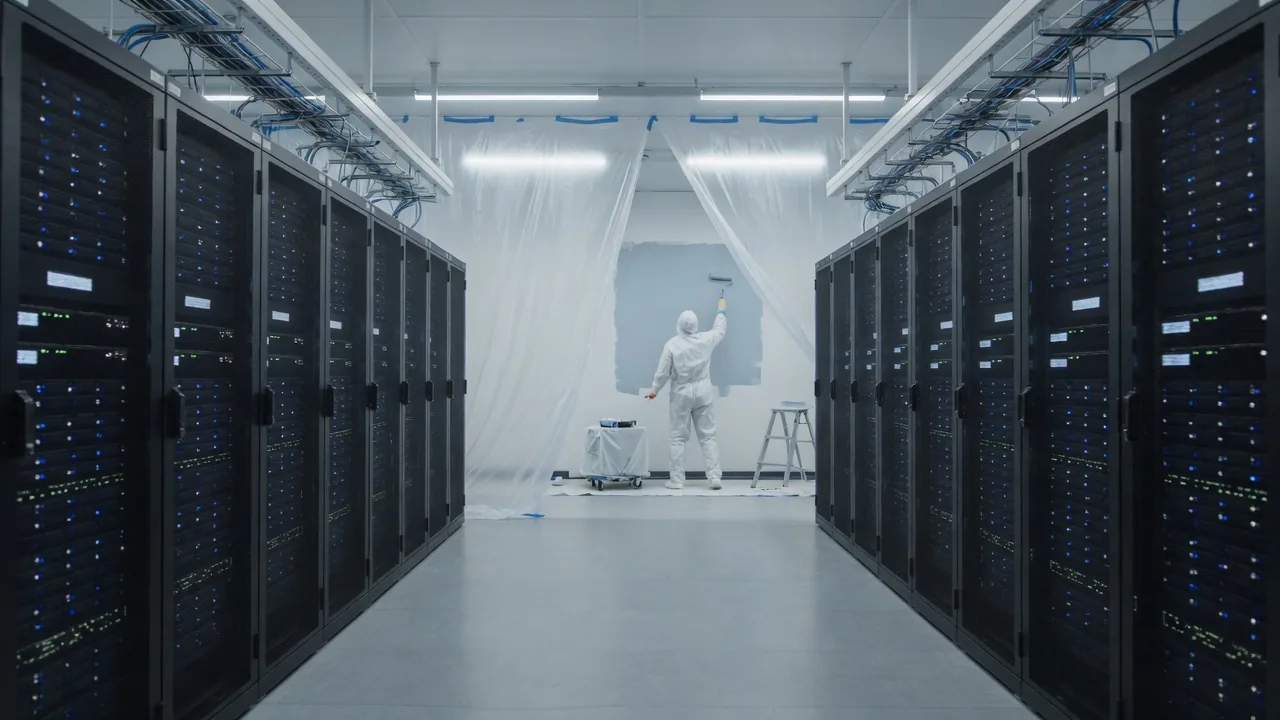
You can paint and coat inside an operating data center without shutting anything down, but almost none of it happens the way ordinary commercial painting does. Work in the data hall runs under dust containment, HEPA-filtered negative air, low-VOC and low-odor coatings, and brush-and-roller application instead of spray. The bulk of the scope — corridors, offices, electrical and generator rooms, loading — happens outside the white space entirely.
That is the short version. Atlanta sits in the top five U.S. data-center metros, and the crews that work these buildings well are the ones that understand the room they are standing in before they open a can. The rest of this covers why a live data hall changes the job, how a crew keeps particulate off your equipment, what belongs outside the white space, and how the work fits inside your change-freeze and security rules.
Why painting in a live data hall is different
A data hall is not a room you paint. It is a controlled airflow environment full of running equipment, and every assumption from normal commercial work has to be checked against that. Three things drive the entire approach.
Particulate is the enemy of the equipment
Servers pull enormous volumes of air through their intakes, and whatever is in that air ends up on boards, in fans, and across heat sinks. Sanding dust, drywall dust, and dried overspray are exactly what the room's filtration exists to keep out. Published cleanliness guidance for these spaces — ISO 14644 particulate classes and ASHRAE TC9.9 environmental guidelines, as of 2026 — treats airborne particulate as a monitored condition, not an afterthought. A painting method that generates dust in occupied white space works against the room's entire reason for being.
Uptime is not negotiable
The facility runs continuously and it is expected to keep running while you work. There is no "we'll shut the hall down for a weekend." The work has to happen in live, occupied, energized conditions, which means the method has to be quiet on the air, quiet on the power, and reversible if a reading moves the wrong way. A crew that needs the room offline to do its job is the wrong crew for a data hall.
Static and outgassing are real concerns
Electrostatic discharge damages hardware, and some coatings continue to release volatile compounds as they cure — outgassing that a sensitive environment does not want near open equipment. Product selection has to account for both. That is a different conversation than picking a durable wall paint for a warehouse, and it is one of the first things a competent crew raises on the walkthrough.
Low-particulate, dust-controlled methods
Everything about the method exists to keep particulate out of the air and off the equipment. This is where a data-center-aware crew looks nothing like a standard paint crew.
Containment and negative air
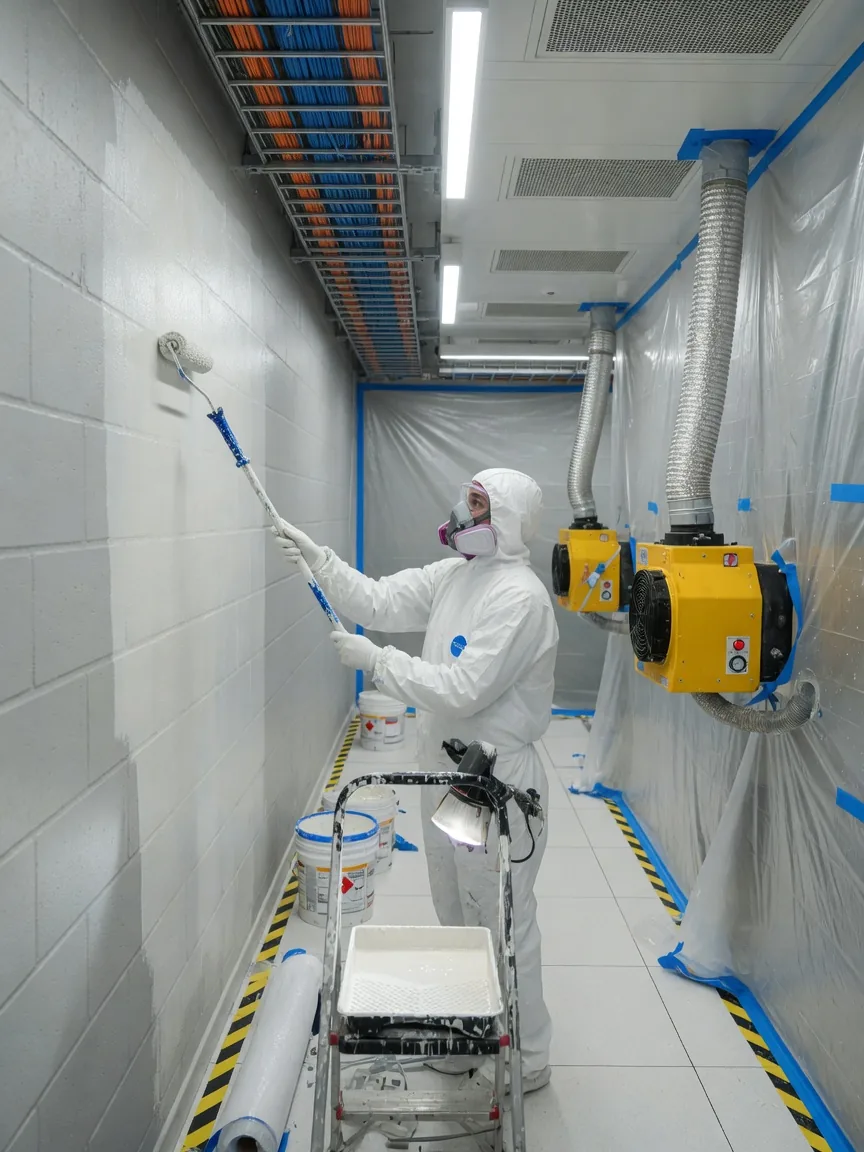
Any work area inside or adjacent to the white space gets sealed off with rigid containment — real barriers, not plastic taped to a rack row. HEPA-filtered negative-air machines hold the work zone at lower pressure than the surrounding hall so air flows into the containment and gets filtered, never out toward the equipment. The goal is simple: whatever the work generates stays inside the bubble and leaves through a filter.
No spray, no aerosol overspray
Spray application is off the table in and near live white space. Atomized coating is airborne coating, and airborne coating finds server intakes. Work is done by brush and roller, which keeps the coating on the surface and out of the airstream. It is slower. It is also the only responsible way to put a finish on a wall a few feet from running hardware.
Low-VOC, low-odor coatings
Product matters as much as method. Low-VOC and low-odor coatings — measured against published VOC thresholds current as of 2026 — reduce both the fumes staff breathe and the compounds released near equipment. Low odor also matters for the humans: the operations team is in that room around the clock, and a solvent-heavy coating makes their shift miserable even when it is technically within limits.
Surface prep without dust
Prep is where dust usually comes from, so prep is where the discipline shows. Where sanding is unavoidable, it is done with vacuum-shrouded tools inside containment, not open sanding in the hall. Debris is bagged and removed rather than swept. The crew that skips this step is the crew that leaves a fine gray film on the tops of your cabinets — which is exactly the outcome the room is built to prevent.
Scope, method, and product for a live data center depend entirely on your facility's own standards and a walkthrough with your critical-facilities team — the approach below is the general playbook, not a fixed spec.
Working around hot-aisle/cold-aisle and CRAC airflow
The data hall's airflow is engineered, and painting cannot be allowed to disturb it. Hot-aisle/cold-aisle containment separates the cold supply air feeding the server intakes from the hot exhaust the equipment throws off. Break that separation and you create hot spots — the exact thermal event the design exists to prevent.
Practically, that means containment barriers and drop cloths cannot block a CRAC or CRAH unit's supply or return, cannot lean against or unseat aisle-containment panels, and cannot obstruct perforated floor tiles feeding cold air up to the racks. Materials get staged so they never sit in an airflow path. Before anything goes up, the crew maps the room's supply and return so the containment they build helps the job without fighting the room's own air handling. This is coordinated with your facilities team, not guessed at.
What should be done outside the white space
Here is the part that surprises people: most of a data center's painting scope has nothing to do with the data hall. The buildings are large, and the areas outside the raised floor are where the majority of the square footage — and the majority of the paint — lives.
The areas that carry the bulk of the work
Support corridors, MEP and telecom rooms, staging and loading areas, break rooms, and the office and NOC space all get painted under normal commercial conditions. This is standard commercial painting — durable coatings on high-traffic corridor walls, clean finishes in the office and administrative areas, and the fast turns those spaces can tolerate because there is no equipment to protect.
Electrical and generator rooms
Electrical rooms, switchgear rooms, and generator and fuel-storage areas have their own rules — energized-equipment clearances, specific coating requirements on some surfaces, and coordination with the electrical team on what can be worked near and when. These are treated as their own scope, not lumped in with general painting. The point of separating white-space work from everything else is that the vast majority of the building can be painted efficiently and normally, reserving the slow, contained method only for where it is genuinely required.
ESD-safe and low-outgassing product selection
Inside and adjacent to the white space, the coating itself has to earn its place. Where static control matters, ESD-safe or static-dissipative coatings and floor finishes are specified so the surface does not hold a charge that could discharge into equipment. Low-outgassing products are chosen so the finish is not still releasing compounds into the room days after it is applied.
The exact products depend on your facility's engineering standards — many operators have their own approved-materials list, and a good crew works to it rather than around it. The right move is to bring product submittals to your critical-facilities team for sign-off before anything is ordered, not after it is on the wall. Our Atlanta commercial painting team handles that submittal-and-approval step as part of planning, because in this environment the product decision is the facility's call, not the painter's.
Scheduling around change-freeze windows and zero downtime
Data centers run formal change management, and painting is a change like any other. Most operators enforce change-freeze windows — periods around peak demand, audits, or major deployments when no non-essential work touches the environment. The work has to be planned around those freezes, submitted through the facility's change process, and scheduled into the windows the operations team approves.
Because the hall never comes down, the work is done in live conditions in small, contained sections — one zone at a time, cleared and verified before moving to the next. There is no downtime because the method is built around there being none. Loud or dust-heavy prep, where it cannot be avoided, gets scheduled into approved low-activity windows. The schedule bends to the facility's change calendar, not the reverse, and that calendar gets mapped on the walkthrough before a date is ever proposed.
Badging, security, and escort realities
A data center is a secured facility, and the crew has to fit the security posture. That means background-checked workers, badging or visitor credentialing through your process, and — in many halls — a facility escort for anyone on the raised floor. Tool and material inventories in and out, camera and photography restrictions, and access limited to the specific areas of scope are all normal.
None of this is an obstacle to a crew that has worked secured environments; it is just part of the job. The relevant question when you evaluate a contractor is whether they treat your security and change-management rules as the framework they plan inside, or as friction to push against. The first kind is who you want on your floor.
Planning painting inside a live Atlanta data center
The through-line is that a data center is two jobs, not one. Outside the white space is efficient, conventional commercial painting across the largest share of the building. Inside and adjacent to the data hall is slow, contained, ESD-aware, dust-controlled work that protects your uptime and your equipment, executed inside your change-management and security rules.
The most useful next step is a walkthrough with your critical-facilities team. We see the actual room, map the airflow and the areas of scope, work to your approved-materials list, and build a plan around your change-freeze calendar and your security process — so the work happens without a single minute of downtime. Request a walkthrough and we will scope it around your facility staying live.
Frequently asked questions
Can you paint inside a live data hall?
Yes, in live, occupied conditions and without downtime. The work is done in small contained sections under HEPA-filtered negative air, by brush and roller rather than spray, using low-VOC and low-odor coatings. Scope and method are set with your critical-facilities team and run through your change-management process first.
How do you keep dust off the servers?
Rigid containment seals the work area and HEPA-filtered negative-air machines hold it at lower pressure than the hall, so air flows into the containment and leaves through a filter instead of drifting toward equipment intakes. No spray is used near white space, and any sanding is done with vacuum-shrouded tools inside the containment.
Do you need to shut anything down?
No. The method is built for zero downtime — the hall stays live and the equipment stays running while the crew works one contained zone at a time. Nothing is powered down, and the room's airflow and hot-aisle/cold-aisle containment are kept intact throughout.
What coatings are safe near IT equipment?
Low-VOC, low-odor, and low-outgassing coatings, plus ESD-safe or static-dissipative finishes where static control matters. Selections are measured against published VOC thresholds and cleanliness guidance (ISO 14644, ASHRAE TC9.9) current as of 2026, and submitted to your facility's engineering team for approval against your own approved-materials list before anything is ordered.
Can you work within our change-freeze and security rules?
Yes — that framework is where the planning starts. Work is submitted through your change-management process and scheduled into approved windows around any change freeze. Crews are background-checked and badged through your process, escorted on the raised floor where required, and kept to the specific areas of scope.