
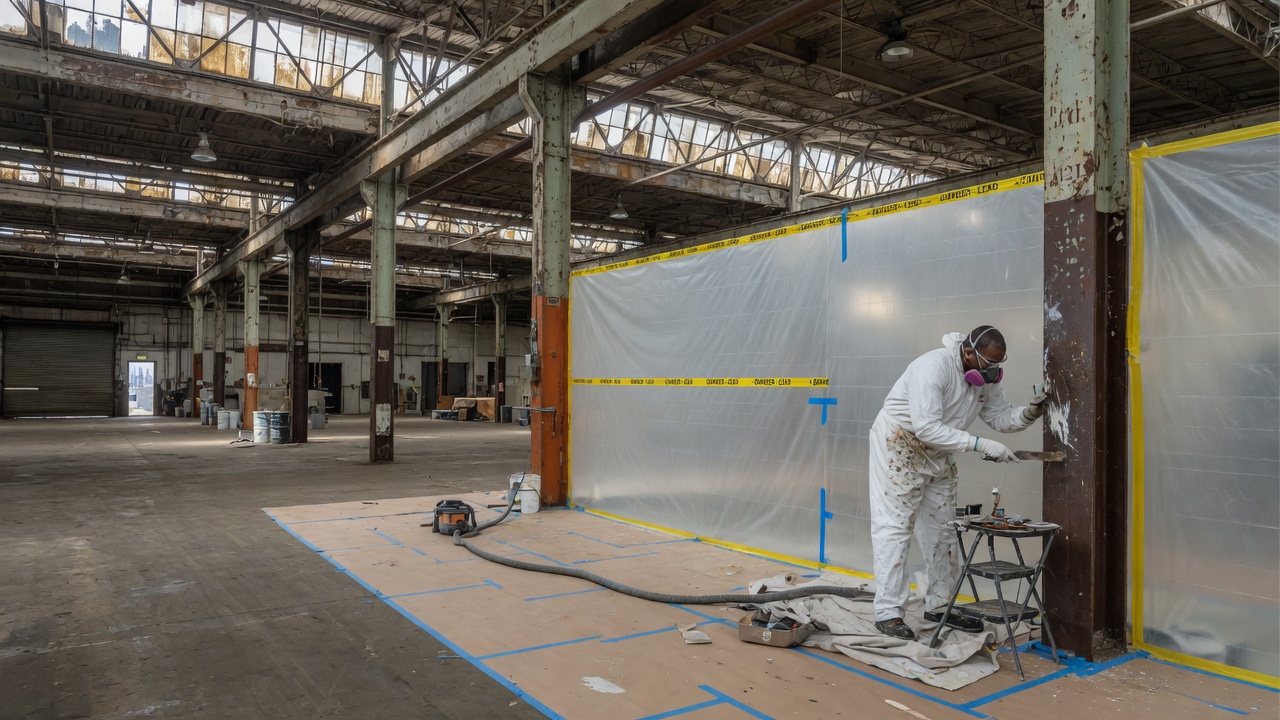
If your Atlanta warehouse or industrial property was built before 1978, you cannot responsibly scope a repaint until the existing coatings have been tested for lead. You cannot tell by looking, and disturbing lead paint without controls triggers worker-exposure and waste-handling obligations under OSHA and the EPA. A compliant painting contractor tests first, works to the applicable OSHA lead standard (29 CFR 1926.62 for construction-type work, 29 CFR 1910.1025 in general industry), contains the dust and debris, and documents how disturbed material is handled. Southeast Commercial Services is the industrial painting contractor that tests for and works safely around lead to meet those requirements — not your compliance authority. This article is not legal or compliance advice, but it will show you what a contractor who does this correctly actually does differently, and what to ask one to prove.
Why a pre-1978 facility changes the whole scope
Age is the trigger. Lead-based coatings were in wide commercial and industrial use for decades, and they were common on exactly the surfaces a warehouse repaint touches: structural steel, high-bay walls and deck, mezzanine framing, guardrails, dock equipment, and exterior metal and masonry. Paint manufactured for consumer use was restricted in 1978, but a pre-1978 facility may carry multiple coating layers applied over many years — and lead can sit under newer, lead-free topcoats.
You cannot identify lead paint by looking at it. Color, sheen, chalking, and condition tell you nothing about lead content. The only way to know is to test. Lead in existing coatings is identified by XRF (X-ray fluorescence) field testing — the primary field method in HUD's Lead-Based Paint Guidelines (Chapter 7) — with laboratory analysis of paint-chip samples as the backup when XRF is inconclusive. HUD and EPA classify paint as lead-based at or above 1.0 mg/cm² by XRF, or 0.5% lead by weight by lab analysis. Those benchmarks are housing-derived recognized testing methodology, not a warehouse legal trigger — but they are the accepted way a qualified tester establishes whether lead is present before anyone disturbs a surface.
Until that result is in hand, a repaint cannot be scoped responsibly, because the test result determines the prep method, the worker protections, the containment, the waste handling, and in some cases whether removal is even on the table.
That is the core point for an owner or facility manager: on an older property, the lead test is not a formality bolted onto the quote. It is the input that decides what the job is. A credible industrial repainting contractor treats it that way.
The two OSHA regimes, in plain terms
Once lead-containing paint is disturbed — sanded, scraped, blasted, cut, or burned — the dust and fume become a worker-exposure issue, and OSHA's lead standards apply to the people doing the work. There are two standards, and which one governs depends on the nature of the work:
- 29 CFR 1926.62 — the lead standard for construction, which covers repainting, surface preparation, demolition, and renovation activity that disturbs lead-containing coatings.
- 29 CFR 1910.1025 — the lead standard for general industry, which covers ongoing operations and maintenance exposure inside a facility.
A repaint that disturbs old coatings generally falls under the construction standard. The distinction matters because it defines the contractor's obligations, not the owner's day-to-day operations — but as the property owner or FM, you want to know your contractor is working to the right one.
Both standards are built around two exposure numbers: the action level and the permissible exposure limit (PEL). Under OSHA's lead standards (29 CFR 1926.62 for construction, promulgated as an interim final rule on May 4, 1993, and 29 CFR 1910.1025 for general industry), the PEL is 50 µg/m³ as an 8-hour time-weighted average and the action level is 30 µg/m³ (8-hr TWA). In practice, the PEL is the ceiling on how much airborne lead a worker may be exposed to over an 8-hour shift, and the action level is the lower trigger point: at or above 30 µg/m³, ancillary provisions kick in — exposure monitoring, medical surveillance, and training before work begins and annually, along with respiratory protection and hygiene facilities. A contractor who treats a lead-disturbance job like an ordinary repaint is skipping all of that.
For the FM, the takeaway is narrow and important: the moment the old coating is disturbed, worker-exposure controls and air monitoring are the contractor's responsibility, and a contractor who cannot describe that program is telling you something.
Where the EPA RRP Rule fits — and where it doesn't
The EPA's Renovation, Repair, and Painting Rule — the RRP Rule — requires firms that disturb lead-based paint to be EPA-certified and to use certified renovators following lead-safe work practices: contained work areas, dust-minimizing methods, thorough cleanup, and cleaning verification. It is built around firm certification and trained renovators, not a general promise to “be careful.”
Here is the honest nuance, and it is the most important point in this article for an industrial owner: the EPA's RRP Rule (40 CFR Part 745) applies to “target housing” (most pre-1978 housing) and “child-occupied facilities” — and per EPA it does NOT apply to commercial or industrial buildings unless they qualify as child-occupied facilities. For a pure industrial or warehouse repaint, the RRP Rule generally does not apply. The binding federal worker-protection requirement is OSHA's lead standard, not RRP. (There are also de minimis thresholds within RRP where it does apply — interior work disturbing 6 square feet or less per room, or exterior work of 20 square feet or less, is exempt.)
RRP becomes relevant to a facility only if part of it qualifies as a child-occupied facility — for example, an on-site daycare. Do not let a contractor wave “RRP” around as a catch-all badge for warehouse work, and do not assume it never matters — the right answer depends on the structure and how it is used. What stays true regardless of RRP's reach is the OSHA worker-exposure obligation above, and the general duty not to create an uncontrolled lead-dust hazard. A compliant contractor can tell you which rules apply to your property and why.
Containment and controls: what a compliant job actually looks like
This is where the difference between a compliant contractor and a cheap repaint becomes visible on the floor. The whole game on a lead-disturbance job is keeping lead dust and debris from going airborne and from spreading beyond the work area.
- Surface prep that minimizes airborne lead. Uncontrolled abrasive blasting and open power-sanding are the fastest way to turn intact lead paint into a facility-wide dust problem. Controlled methods — wet methods, HEPA-shrouded tools, vacuum-assisted prep, or chemical approaches where appropriate — are chosen specifically to limit what becomes airborne.
- Physical containment. The work zone is isolated with sheeting and barriers so dust and chips stay inside it, with attention to floor protection, air movement, and keeping adjacent operating areas clean.
- Cleanup and verification. HEPA vacuuming and wet cleaning, not dry sweeping, followed by a cleanup check appropriate to the job.
- Waste handling. Lead-containing debris is not swept into the facility dumpster. Under the EPA's RCRA toxicity-characteristic rule (40 CFR 261.24), lead paint debris is not automatically hazardous waste — the controlling test is the Toxicity Characteristic Leaching Procedure (TCLP). Waste that leaches lead at or above 5.0 mg/L is a RCRA toxicity-characteristic hazardous waste (code D008) requiring hazardous-waste handling: storage limits, manifests, licensed transport, and permitted disposal. Commercial and industrial-source lead debris is not exempt the way household waste can be, so it gets characterized and disposed of accordingly.
Ask to see this described before the job, not after. A contractor who does this routinely can walk you through it without hesitation.
Abatement vs. encapsulation vs. repainting over intact coating
There is not one right answer — the test result and the condition of the existing coating drive the decision. Three broad paths, framed honestly:
| Approach | What it is | When it fits |
|---|---|---|
| Repaint over intact coating | Prep and recoat where lead paint is sound and not being meaningfully disturbed | Coating is stable and adherent; minimal disturbance; controls still used for whatever prep is required |
| Encapsulation | A specialized coating system applied to seal lead-containing paint in place, using products meeting ASTM E1795 (non-reinforced liquid coating encapsulants — Type I interior, Type II exterior, Type III both) or ASTM E1797 (reinforced) | Lead paint is intact and a managed-in-place approach is appropriate for the surface and use |
| Abatement / removal | Removing the lead-containing coating (or the component) under controlled conditions | Coating is deteriorated, failing, or a repaint cannot proceed without significant disturbance; or removal is otherwise required |
Encapsulation is not “just painting over it.” An encapsulant is a specific engineered system defined by ASTM E1795 / E1797 — ordinary paint applied over lead is not encapsulation. Which path your facility takes depends on the test results, the surface, how the space is used, and the condition of what is already there. A contractor who recommends one path before testing is guessing.
What the owner is actually liable for — and why “just paint over it” backfires
The instinct on an older property is understandable: get a clean new coating up, cover the old paint, keep the facility moving. On a pre-1978 building, that instinct is the expensive mistake.
“Just paint over it” usually means someone sands, scrapes, or blasts to get a sound surface first — which disturbs the lead and creates exactly the airborne hazard the regulations exist to control. The exposure then lands on the workers (and potentially your facility's own staff nearby), the dust lands on your floor and equipment, and the debris becomes regulated waste that was handled as ordinary trash. The costs that follow — worker-exposure liability, improper disturbance, and improper disposal of lead waste — are far larger than the price difference between a cheap repaint and a compliant one. A contractor who skips the test and skips the controls is, in effect, transferring that risk onto your property.
The cheaper bid that ignores lead is not cheaper. It is unpriced.
Keeping an operating warehouse running during the work
Compliance and uptime are not mutually exclusive — containment is what makes phased work in a live facility possible. Because a compliant job already isolates the work zone, that same containment is used to zone off one area at a time while the rest of the facility keeps operating. Work can be sequenced bay by bay, scheduled after-hours or across shifts, and staged so dock operations, racking, and production areas stay clear of the disturbance zone.
The planning conversation with a competent contractor covers which areas get contained and when, how air and foot traffic are managed around the zone, and how the schedule maps to your operating hours — so a lead-aware repaint does not mean shutting the facility down. SECOMM scopes industrial repaints around live operations as a matter of routine.
What to ask a painting contractor to prove they handle lead correctly
Treat these as the qualifying questions before you let anyone prep a surface on a pre-1978 property:
- “Will you test for lead before scoping the job?” The right answer is yes, and the result should shape the scope — not a line item that gets skipped to win the bid.
- “Show me your written exposure-control and containment plan.” A contractor who does lead work has one. Air monitoring to the OSHA action level and PEL, prep method, containment, cleanup verification, and waste handling should all be written, not improvised. OSHA's exposure obligations always apply once lead is disturbed, regardless of whether RRP is in scope.
- “If any part of my site is a child-occupied facility, are you an EPA Lead-Safe Certified Firm with certified renovators?” Where the RRP Rule applies, the firm must be an EPA Lead-Safe Certified Firm and assign EPA-certified renovators trained by EPA-accredited providers (40 CFR 745.89 / .90). For a pure industrial job this may not be legally required — but OSHA's lead-exposure obligations are not optional either way, so frame the question around both.
- “How will you handle the lead-containing waste?” You want to hear TCLP characterization and regulated disposal, not “it goes in the dumpster.”
- “How will you keep the rest of my facility operating?” Containment and phasing should be part of the answer, not an afterthought.
If a contractor cannot answer these plainly, that is your answer. For broader facility upkeep that does not involve coatings disturbance, the same single-contractor logic applies to routine commercial facility maintenance — but anything touching old paint on a pre-1978 property belongs in a scoped, lead-aware industrial painting conversation.
Frequently asked questions
Do I have to test for lead before repainting an old warehouse?
On a pre-1978 facility, you cannot scope the repaint responsibly without knowing the lead status, because you cannot identify lead paint by looking at it. The recognized methods are XRF (X-ray fluorescence) field testing — the primary field method in HUD's Lead-Based Paint Guidelines (Chapter 7) — with laboratory analysis of paint-chip samples as the backup when XRF is inconclusive. The result drives the prep method, worker protections, containment, and waste handling, so a contractor who skips the test is guessing at the scope.
Does OSHA's lead rule apply to a warehouse repaint?
Yes, once the work disturbs lead-containing coatings. Under OSHA's lead standards (29 CFR 1926.62 for construction, 29 CFR 1910.1025 for general industry), the permissible exposure limit is 50 µg/m³ as an 8-hour time-weighted average and the action level is 30 µg/m³. At or above the action level, ancillary provisions trigger: exposure monitoring, medical surveillance, and training. Repainting and surface prep that disturb old paint generally fall under the construction standard. For a pure industrial repaint, OSHA's lead standard — not the EPA RRP Rule — is the binding federal worker-protection requirement.
Can you just paint over lead paint in a warehouse?
Not the way the phrase implies. Getting a sound surface usually means sanding, scraping, or blasting first, which disturbs the lead and creates an airborne hazard — so “painting over it” is really a disturbance job that needs controls, containment, and regulated waste handling. Done without those, it creates worker-exposure and disposal liability that costs far more than doing it correctly.
What's the difference between abatement and encapsulation?
Abatement removes the lead-containing coating (or the component) under controlled conditions. Encapsulation seals intact lead paint in place using a product meeting ASTM E1795 (non-reinforced liquid coating encapsulants) or ASTM E1797 (reinforced) — it is not ordinary paint applied over lead, and it only fits when the existing coating is sound. Which path your facility takes depends on the test results and the condition and use of the surface.
Does the EPA RRP Rule apply to a commercial warehouse?
Generally no. The EPA's RRP Rule (40 CFR Part 745) applies to target housing (most pre-1978 housing) and child-occupied facilities, and per EPA it does not apply to commercial or industrial buildings unless they qualify as child-occupied facilities (for example, an on-site daycare). For a pure industrial or warehouse repaint, the RRP Rule generally does not apply, and the binding federal worker-protection requirement is OSHA's lead standard. RRP becomes relevant only if part of the facility is a child-occupied facility.
How is lead paint debris supposed to be disposed of?
Lead paint debris is not automatically hazardous waste. Under the EPA's RCRA toxicity-characteristic rule (40 CFR 261.24), the controlling test is the Toxicity Characteristic Leaching Procedure (TCLP); waste that leaches lead at or above 5.0 mg/L is a RCRA toxicity-characteristic hazardous waste (code D008) requiring hazardous-waste handling — storage limits, manifests, licensed transport, and permitted disposal. Commercial and industrial-source lead debris is not exempt the way household waste can be, so it is characterized and disposed of accordingly rather than swept into the facility dumpster.
Can a lead-aware repaint be done without shutting down my facility?
Usually, yes. The same containment that keeps lead dust controlled also makes it possible to zone off one area at a time and phase the work bay by bay, after-hours, or across shifts while the rest of the facility operates. The scheduling and zoning plan should be part of the scoping conversation up front.