
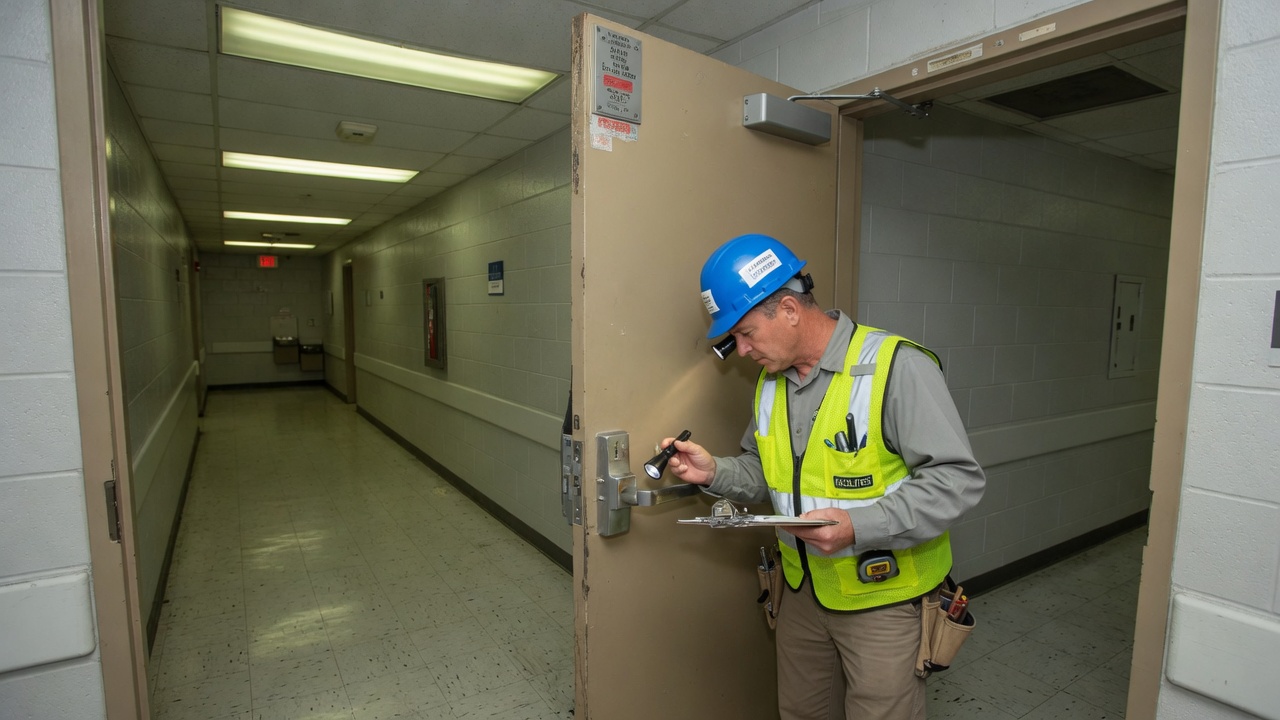
If you manage a commercial, institutional, or multi-tenant building in metro Atlanta, the fire doors in your stairwells, corridors, and separation walls carry a maintenance obligation most facility teams underestimate. The short answer: commercial fire door assemblies must be inspected and tested at least once a year. That requirement comes from NFPA 80, the Standard for Fire Doors and Other Opening Protectives, which calls for fire door assemblies to be inspected and tested not less than annually and for a written record to be kept and made available to the authority having jurisdiction. This isn’t a visual walk-by, and it isn’t satisfied by the doors “looking fine.” Below is what the rule actually requires, who can perform it, what the inspection has to cover, and where corrective door work fits in — written for the person who has to be ready when the fire marshal arrives.
How often must a commercial fire door be inspected?
Annually. Under NFPA 80, fire door and window assemblies are required to be inspected and tested not less than once a year, and a written record of the inspection is required to be kept and made available to the AHJ. Facilities-management coverage of the standard notes that this annual-inspection mandate for fire doors has been in force for well over a decade — it is not a new or discretionary expectation.
A few clarifications that matter for a real building. “Annually” is a floor, not a ceiling: a high-traffic opening that gets abused daily can warrant more frequent checks, and newly installed assemblies carry their own acceptance inspection. The requirement applies to the assembly — door, frame, hardware, and all the components that make it a rated opening — not just the door leaf. And it applies to rated openings specifically, which is why this is a commercial and institutional concern: offices, schools, healthcare, warehouses, and multi-tenant buildings have fire-rated assemblies protecting exits and separations, while ordinary residences do not.
Who is allowed to inspect a fire door?
NFPA 80 assigns the work to a “qualified person.” The standard’s own definition, at Section 3.3.96, is “a person who, by possession of a recognized degree, certificate, professional standing, or skill, and who, by knowledge, training, and experience, has demonstrated the ability to deal with the subject matter, the work, or the project.” Read that closely: it is a competence standard, not a license requirement. NFPA 80 does not mandate a particular certification, so the annual inspection can be performed by trained in-house facilities staff or by an outside vendor — provided that person is genuinely qualified to do it.
In practice, the line between “qualified” and “not” is where disputes happen, which is why a recognized credential carries weight. The Door and Hardware Institute (DHI) offers fire-door inspector training and a recognized inspector credential, and many facilities — and many AHJs — treat that credential as the practical benchmark of a qualified inspector even though NFPA 80 does not legally require it. If your in-house team does the inspection, the burden is on you to show their training and experience meet the qualified-person bar; a credentialed third party removes that argument.
What the inspection has to cover — and why a visual look isn’t enough
This is the part facility teams most often get wrong. An NFPA 80 fire door inspection is a functional test, not a visual survey. Two operational checks sit at the center of it: the self-closing device must be tested to confirm it completely closes the door when activated from the full-open position, and the latching hardware must be checked to confirm it secures the door when it is in the closed position. A fire door only works if it closes and latches on its own, with no one holding it — so the inspection has to prove that by operating the door, not by looking at it.
Around those functional checks, the inspection runs through the condition of the whole assembly: labels, frame, door leaf, hardware, clearances, gasketing and edge seals where required, and any field modifications. NFPA 80 inspection guidance is commonly organized as a multi-point checklist covering exactly these items, opening by opening. The thread running through all of it is the same question: in a fire, will this specific assembly close, latch, and hold the way its rating says it will?
The deficiencies that fail a fire door
Most failures fall into a short list of recurring problems, and almost all of them are maintenance and repair issues rather than reasons to replace the door:
| Deficiency found | Why it fails | Typical corrective work |
|---|---|---|
| Painted-over or missing fire-rating label | The label is how the assembly’s rating is verified; paint over it or a missing label means the rating can’t be confirmed | Restore label legibility / re-label per an approved method; stop painting over labels going forward |
| Door won’t self-close or latch | A door that doesn’t close and latch on its own cannot hold back fire or smoke — the core function fails | Adjust/replace the closer, repair the latch, correct binding so the door closes and latches reliably |
| Damaged or missing door closer | No functioning closer means no self-closing — an automatic inspection failure | Replace with a correctly sized, rated closer and verify full closure from full-open |
| Field modifications (drilled holes, added hardware) | Unrated holes or site-added hardware void the assembly’s listing | Fill/repair to a listed method or replace affected components with rated hardware |
| Clearances out of tolerance | Gaps outside NFPA 80’s tight limits (roughly 1/8 in. at edges, up to ~3/4 in. at the bottom) let fire and smoke pass | Adjust the door/frame, hardware, or bottom condition to bring clearances back in range |
One Atlanta-specific pattern worth calling out: the painted-over label. It’s a surprisingly common deficiency in buildings that have been repainted over the years, because a well-meaning paint crew coats the door edge and buries the rating label. If you’re planning commercial painting in a building with rated openings, protect the fire-door labels before the work starts — it’s far cheaper than re-establishing them after an inspector flags them.
What documentation the fire marshal actually wants
The written record is the compliance deliverable. NFPA 80 requires that inspection records be kept and made available to the authority having jurisdiction, and facilities-management guidance is explicit that the AHJ will request these documents when it conducts an inspection of the facility. In metro Atlanta, the AHJ is your local fire marshal.
A defensible record is organized per opening — a separate line or page for each fire door — and typically captures the door location or opening ID, door type and fire rating, the inspection date, the inspector’s name (and signature), the deficiencies found, and the corrective action taken. The reason to keep it that granular is simple: when a fire marshal asks about a specific stairwell door, you want to hand over that door’s history, not a vague building-wide attestation. A clean, per-opening record is what turns an inspection from a scramble into a formality.
What happens when the inspection finds problems
Deficiencies don’t sit on a list until next year. NFPA 80’s posture is that identified defects be corrected without undue delay — in practical terms, as quickly as possible — and that the corrective action be documented alongside the original finding so the record shows the loop was closed. For a facility manager, that means the inspection isn’t the end of the job; the repair and the re-documentation are.
The good news, again, is that most corrective work is exactly that — corrective. Re-establishing self-closing and latching, replacing a failed closer with a correctly sized rated unit, restoring a legible label, correcting an out-of-tolerance clearance, or repairing an unrated field modification are all repairs, not full replacements. Full door-and-frame replacement is reserved for assemblies that are too far gone or were never properly rated to begin with. This is corrective door work we handle as part of commercial door installation & repair, and it slots naturally into broader commercial facility maintenance when a building has a run of openings to bring back to condition.
How this fits an Atlanta facility’s annual compliance cycle
Put together, the fire-door obligation is a yearly loop: inspect and functionally test every rated opening, document each one, correct the deficiencies without delay, re-document the fixes, and have that record ready when the fire marshal asks. Buildings that treat it as a once-a-year scramble tend to discover a backlog of dead closers and painted-over labels the week before a review; buildings that treat it as a standing maintenance line item walk into the inspection with the paperwork already done.
One boundary worth stating plainly, because it protects you: the inspection determines condition against the standard, and the AHJ determines compliance. SECOMM does the door work — the corrective repairs that bring a rated opening back to NFPA 80 condition — and we document what we did. We do not issue the authority-having-jurisdiction ruling; that sits with the fire marshal. Keeping those two roles distinct is part of a defensible program: a contractor who claims to “certify” your doors as code-compliant is overstepping the role. The right posture is condition-to-standard work, documented, ready for the AHJ’s review.
Frequently asked questions
How often do commercial fire doors have to be inspected?
At least once a year. NFPA 80, the Standard for Fire Doors and Other Opening Protectives, requires that fire door assemblies be inspected and tested not less than annually, and that a written record be kept for the authority having jurisdiction. In practice that means a documented annual inspection of every rated opening in a commercial or institutional building, with corrective work done when deficiencies are found.
Who is allowed to inspect a commercial fire door?
A “qualified person.” NFPA 80, Section 3.3.96 defines a qualified person as one who, by possession of a recognized degree, certificate, professional standing, or skill, and who, by knowledge, training, and experience, has demonstrated the ability to deal with the subject matter. NFPA 80 does not require a specific certification, so the inspection can be done by trained in-house staff or an outside vendor. The Door and Hardware Institute (DHI) offers a recognized fire-door inspector credential that many facilities and AHJs treat as the practical benchmark of “qualified.”
Is a visual check enough, or is functional testing required?
Functional testing is required — a visual look is not enough. Under NFPA 80 the inspection includes operating the door: the self-closing device must be tested to confirm it fully closes the door from the full-open position, and the latching hardware must be checked to confirm it secures the door when closed. A fire door that looks correct but does not close and latch on its own will not perform in a fire, which is exactly what the functional test is there to catch.
What documentation does the fire marshal want for fire doors?
A written inspection record. NFPA 80 calls for records to be kept and made available to the authority having jurisdiction (AHJ). A defensible record identifies each opening and typically lists the door location/ID, type and fire rating, inspection date, the inspector’s name, the deficiencies found, and the corrective action taken. The AHJ — in metro Atlanta, the local fire marshal — will ask for these documents during a facility inspection.
What are the most common reasons a fire door fails inspection?
The recurring failures are a painted-over or missing fire-rating label; a door that no longer self-closes or latches; a damaged or missing door closer; field modifications such as drilled holes or added hardware that were never rated; and clearances outside NFPA 80’s tight tolerances (roughly 1/8 inch at the edges and up to about 3/4 inch at the bottom). Most of these are maintenance and repair items, not full door replacements.
What happens if a fire door inspection turns up deficiencies?
The deficiencies have to be corrected without undue delay — NFPA 80’s position is that identified defects be repaired as soon as possible — and the repair should be documented alongside the original finding. For most openings the fix is corrective work: re-establishing self-closing and latching, replacing a failed closer, restoring a legible label, or correcting clearances. The door work and the re-documentation are what a facility carries into its next fire-marshal review.