
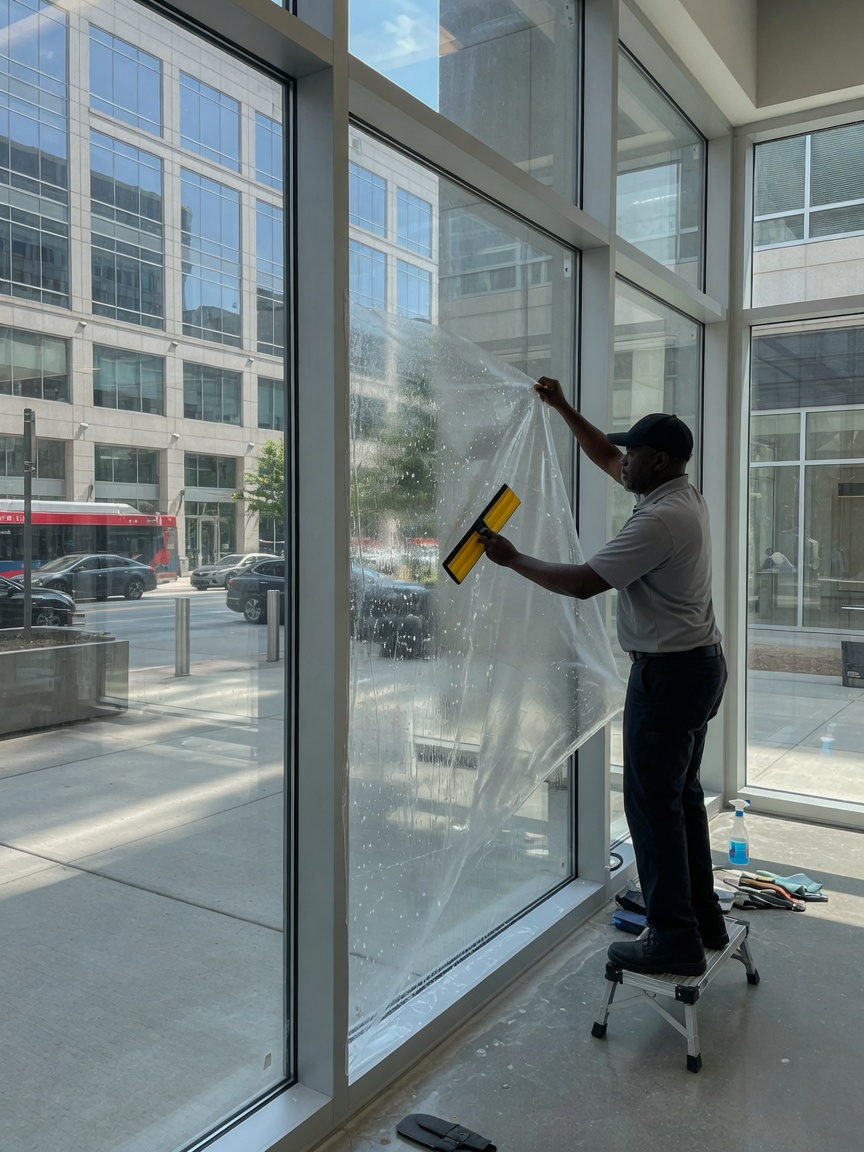
For most commercial buildings in metro Atlanta, 4-mil safety film meets the impact-safety baseline that the code looks for in hazardous glazing locations, while forced-entry and smash-and-grab protection generally starts at 8-mil and heavier. Security window film is a clear, impact-rated layer bonded to the inside of the glass that holds a shattered pane in place — so a struck window spiderwebs and stays in the frame instead of collapsing, which slows an intruder and buys response time. It is a different product category from the solar and privacy films covered on our commercial window tinting service, and the right thickness depends entirely on the threat you are hardening against.
Below is how the product works, what the code actually references, how the thickness tiers map to real use cases, and where a specifier-installer like SECOMM fits versus where the code authority and the manufacturer’s certification sit.
What is security window film, and how is it different from solar or privacy film?
Solar film manages heat and glare. Privacy film manages sightlines. Security film manages what happens when the glass is struck — it is engineered to keep a broken pane intact and anchored rather than to control light or visibility.
The mechanism is simple and physical. A thick, tear-resistant polyester layer is bonded to the interior face of the glass with an aggressive adhesive. When the glass fails, the film holds the fragments together as a single sheet, so the opening stays sealed and an intruder has to defeat the film and the glass repeatedly instead of clearing the pane in one hit. That delay is the entire point: it converts a one-swing breach into a sustained, noisy effort.
Because it is optically clear, security film can be combined with solar-control or privacy properties in a single product, but the defining job — holding shattered glass together and delaying entry — is what separates it from the films most buildings already have.
What code applies to safety glazing, and can film satisfy it?
Under the International Building Code, glazing in “hazardous locations” — think entrance doors and sidelights, glazing near floor level, and other high-traffic impact zones — must meet an impact-safety standard. The IBC references ANSI Z97.1 and CPSC 16 CFR 1201 as the governing safety-glazing standards for those locations.
Film tested to those standards can satisfy that impact-safety requirement. In other words, applying a film rated to ANSI Z97.1 or CPSC 16 CFR 1201 to a qualifying pane is a recognized path to meeting the impact-safety expectation the code sets for hazardous glazing — provided the specific product, glass type, and installation match what the standard was tested against.
One boundary to be clear about up front: the code determination for your specific building is made by your authority having jurisdiction, not by the installer. SECOMM specifies and installs film rated to these standards; the ruling on whether a given opening is a “hazardous location” and what it must meet is the jurisdiction’s call.
CPSC Category I vs Category II — what’s the difference?
CPSC 16 CFR 1201 splits safety glazing into two categories by the size of the glazed product and the severity of the impact test it must survive.
- Category I applies to smaller glazed products — those under 9 square feet — and is tested to a lower-impact threshold.
- Category II applies to glazed products of unlimited size and is the more stringent of the two.
These categories are method-equivalent to the classifications under ANSI Z97.1: CPSC Category II corresponds to ANSI’s Class A, and CPSC Category I corresponds to ANSI’s Class B. For most commercial storefront and entrance glazing — which is large — Category II / Class A is the relevant target.
| CPSC Category I | CPSC Category II | |
|---|---|---|
| Product size | Under 9 sq ft | Unlimited size |
| Impact severity | Lower threshold (~150 ft-lb) | More stringent (~400 ft-lb) |
| ANSI Z97.1 equivalent | Class B | Class A |
| Typical commercial fit | Small panes, limited lights | Storefronts, entrance systems, large glazing |
How does the impact test actually work?
At a high level, both standards evaluate safety glazing by swinging a weighted impactor into the glass and checking how it fails. ANSI Z97.1 and CPSC 16 CFR 1201 each use a roughly 100-pound impactor dropped from a specified height; the pane either has to not break or has to break in a way that doesn’t produce dangerous shards.
The difference between the categories and classes is in the drop height and the pass threshold — the more stringent classification is tested at a higher-energy impact. Under CPSC 16 CFR 1201 and ANSI Z97.1, the lower tier (Category I / Class B) is tested with the 100-pound impactor at roughly an 18-inch drop, which corresponds to about 150 ft-lb of impact energy, while the more stringent tier (Category II / Class A) is tested at roughly a 48-inch drop, corresponding to about 400 ft-lb. That is the concrete reason Category II / Class A is the harder target, and why it is the one that matters for large storefront glazing.
The practical takeaway for a facility buyer: when a film is rated to a given category or class, that rating reflects a defined, repeatable impact test — not a vendor claim. That is why specifying to the standard matters more than specifying to a marketing label.
4-mil vs 8-mil: which thickness do I need?
“Mil” is the film’s thickness in thousandths of an inch, and it is the single biggest lever on performance. The split most commercial buyers care about is 4-mil versus 8-mil and heavier.
- 4-mil is rated to the ANSI Z97.1 / CPSC Category II impact-safety level for accidental breakage, seismic events, and windborne debris. It is the common specification for schools, retail interiors, and general office glazing where the job is keeping broken glass intact and meeting the safety-glazing requirement.
- 8-mil and heavier is selected where the threat is deliberate — forced entry, smash-and-grab, and elevated-impact attack. This is the tier for storefronts, entry points, government and institutional lobbies, and financial facilities, where the film needs to resist sustained, repeated blows rather than a single accidental impact.
| Film tier | Rated for | Typical use case |
|---|---|---|
| 4-mil | Accidental breakage, seismic, windborne debris (ANSI Z97.1 / CPSC Cat II impact-safety) | Schools, retail interiors, offices — general safety glazing |
| 8-mil + | Forced entry, smash-and-grab, elevated-impact attack | Storefronts, entrance glazing, government lobbies, financial facilities |
The common mistake is buying thickness for the wrong threat — paying for 8-mil where 4-mil meets the requirement, or specifying 4-mil at a storefront that is a repeat smash-and-grab target. The thickness decision should start from the threat profile of the specific opening, not a blanket building-wide spec.
What about blast and higher-threat standards?
Above the smash-and-grab tier, there is a ladder of more demanding performance standards you should know exist so you can specify to them when the threat warrants:
- ASTM F1642 is the standard test method for glazing and glazing systems subjected to airblast loadings — it establishes a glazing system’s hazard rating under blast.
- ASTM F2912 is the companion standard specification that assigns the blast-hazard rating from that testing; the graded performance levels (including GSA and DoD conditions) are defined there, using the data from F1642 testing.
- GSA performance conditions define the graded “condition” levels used for federal and high-security facilities.
These standards sit above everyday safety and forced-entry film, and they typically involve the full glazing system — not just the film. SECOMM specifies and installs film products rated by their manufacturers to the appropriate standard; we do not certify a building’s blast threat level or issue the performance rating ourselves. That certification lives with the manufacturer’s testing and your security engineering.
Film alone vs film plus an attachment system
For accidental-breakage safety, film bonded to the glass is often the whole answer. For forced entry, it usually is not — because a determined intruder can defeat a filmed pane by pushing the intact-but-shattered glass out of the frame entirely.
That is why forced-entry performance frequently depends on an attachment system — a structural anchoring method (wet-glaze, a mechanical batten, or an attachment profile) that bonds the filmed glass edge to the frame so the whole assembly resists being pushed through. Film plus attachment keeps the pane anchored under sustained attack in a way film alone cannot.
When the entry point is a glazed door or a storefront entrance, the glass and the door are really one system, and hardening one without the other leaves a gap. That is often the point to look at the door and frame alongside the glazing — see our commercial door installation and repair service for the entry-point side of the same problem.
How do I choose for my Atlanta commercial building?
Start from the opening, not the building. Walk the glazing and sort it by threat profile:
- General safety glazing — hazardous-location panes, interior lights, school and office glass: 4-mil to meet the ANSI Z97.1 / CPSC Category II impact-safety requirement.
- Deliberate-threat glazing — street-level storefronts, after-hours retail, cash-handling and financial glazing, government and institutional entrances: 8-mil-plus, and consider an attachment system at the primary entry points.
- High-security or blast-exposed glazing — this is where ASTM F1642 / F2912 and GSA conditions come into the conversation, specified with your security engineering.
Most commercial properties end up with a mixed spec — 4-mil across general glazing, heavier film with attachment at the entrances and street-facing panes. If you are coordinating film as part of a broader facility-hardening or maintenance scope, it folds naturally into a larger plan; our commercial handyman service covers that broader facility-hardening work.
Where SECOMM fits
SECOMM specifies and installs manufacturer-rated safety and security window film to the correct CPSC category and mil thickness for your use case, across commercial and institutional properties in metro Atlanta. We walk the glazing, match the product to the threat profile opening by opening, and install the rated film — with an attachment system where forced-entry performance calls for it.
What we do not do, and want to be explicit about: we do not issue the code ruling on whether a given opening is a hazardous location, and we do not certify a blast or threat rating. Those determinations belong to your authority having jurisdiction, your security engineering, and the manufacturer’s standard testing. Our job is to specify and install the correct rated product to meet them. Start on our commercial window tinting page or request a quote to have us walk your glazing.
Frequently asked questions
Does security window film actually meet building code for safety glazing?
It can. Under the International Building Code, glazing in hazardous locations must meet an impact-safety standard, and the IBC references ANSI Z97.1 and CPSC 16 CFR 1201 for that. Film tested to those standards can satisfy the impact-safety requirement when the product, glass, and installation match the tested condition. The determination for your specific opening is made by your authority having jurisdiction, not the installer.
What’s the difference between 4-mil and 8-mil security film?
4-mil film is rated to the ANSI Z97.1 / CPSC Category II impact-safety level for accidental breakage, seismic events, and windborne debris — the common spec for schools, offices, and retail interiors. 8-mil and heavier is selected for deliberate threats like forced entry and smash-and-grab, which is why it’s used on storefronts, entrances, and financial and government facilities. The right choice depends on whether the opening faces accidental or deliberate impact.
What is the difference between CPSC Category I and Category II?
Under CPSC 16 CFR 1201, Category I applies to glazed products under 9 square feet and is tested to a lower-impact threshold (roughly a 150 ft-lb impact), while Category II applies to glazed products of unlimited size and is more stringent (roughly a 400 ft-lb impact). The two are method-equivalent to ANSI Z97.1’s Class B and Class A respectively. Most large commercial storefront and entrance glazing falls under Category II / Class A.
Will security film stop a smash-and-grab?
Security film is designed to delay and deter forced entry, not to make glass unbreakable. It holds a shattered pane together so an intruder has to defeat the glass and film repeatedly — converting a single swing into a sustained, noisy effort. For smash-and-grab resistance, 8-mil-plus film is the starting point, and an attachment system that anchors the filmed glass to the frame materially improves forced-entry performance.
Is film alone enough for forced-entry protection?
Often not on its own. A determined intruder can push an intact-but-shattered filmed pane out of its frame, so forced-entry performance frequently depends on an attachment system — a structural anchoring method that bonds the filmed glass edge to the frame. Film plus attachment resists sustained attack in a way film alone cannot, which is why entry points are usually specified with both.
What about blast-rated glazing — can SECOMM certify that?
No. Standards like ASTM F1642 and F2912 and GSA performance conditions govern blast and high-security glazing, and that certification belongs to the manufacturer’s testing and your security engineering — not the installer. Southeast Commercial Services specifies and installs film products rated by their manufacturers to the appropriate standard; we do not certify a building’s threat level or issue the performance rating ourselves.