
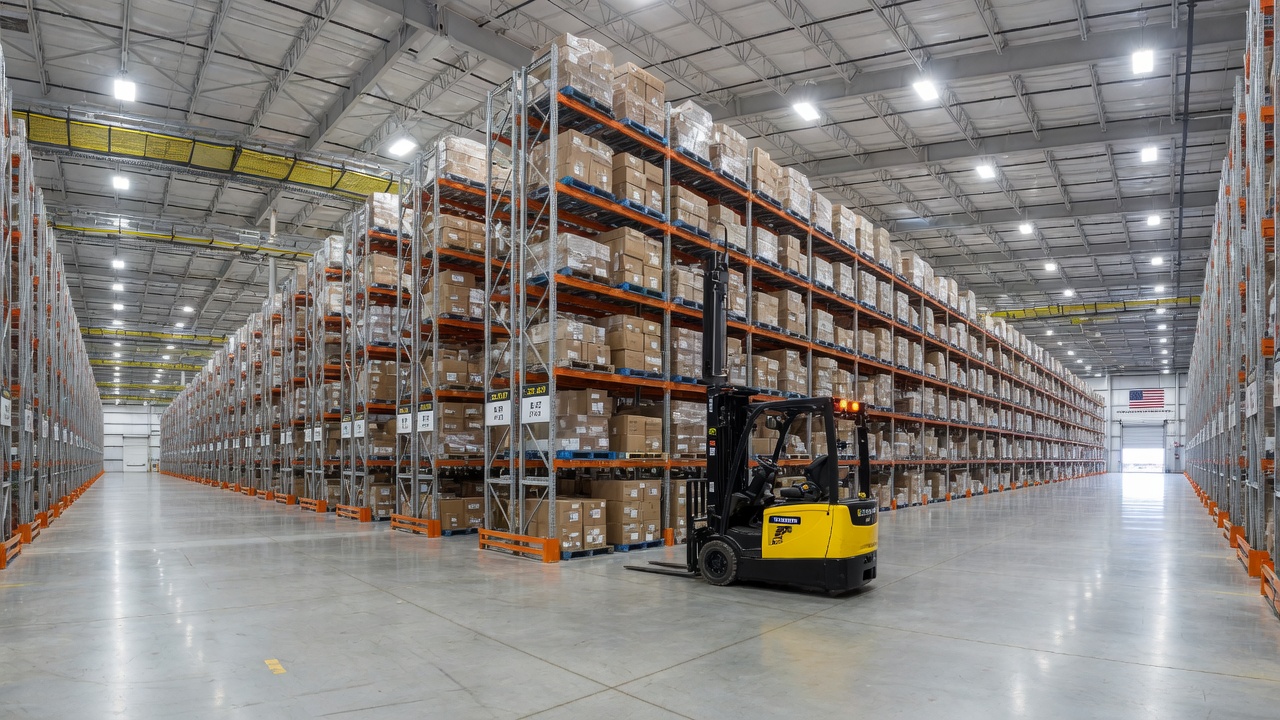
A warehouse high-bay LED retrofit typically costs roughly $150–$600 per fixture, and roughly $3–$8 per square foot installed, according to 2026 lighting-industry guides (retrieved 2026). A 200W LED high-bay — the unit that usually replaces a 400W metal-halide — runs around $175 per fixture in those same published ranges. Energy savings land between 40% and 70% versus HID or fluorescent, which puts typical payback at 2–4 years. For a warehouse or distribution center running 24/7, that window compresses hard: some facilities break even in roughly 4–9 months, because payback in this vertical is driven almost entirely by run-hours.
What Does a High-Bay LED Fixture Actually Cost Per Unit?
Per fixture, published 2026 lighting-industry ranges put LED high-bays at roughly $150–$600 (retrieved 2026). The spread is wide because “high-bay” covers everything from a basic 150W linear unit over a single-shift storage aisle to a 240W+ fixture with integrated controls over a 40-foot rack. Wattage, lumen output, optics, driver quality, and whether the fixture ships with occupancy sensing all move the number.
The most common warehouse swap is a 200W LED high-bay replacing a 400W metal-halide. That unit typically lands around $175 per fixture in those published ranges (retrieved 2026), and it does the job on roughly half the connected wattage. The fixture price is only part of the installed cost, though — labor, lift equipment for 30-foot mounting, disposal of the old HID lamps and ballasts, and any control wiring are the rest of it.
That is why the more useful planning number is the installed figure: roughly $3–$8 per square foot, per 2026 lighting-industry guides (retrieved 2026). Where a project falls in that band depends on mounting height, fixture density, whether existing circuits and junction boxes get reused, and how much control layer gets added. A straight one-for-one fixture swap sits at the low end; adding a networked controls system with daylight harvesting pushes toward the high end. This is the scope our commercial LED lighting retrofit crews plan around before quoting a facility.
Why Do Warehouses Specifically Make Sense for LED?
High-bay warehouse and distribution-center spaces are close to the ideal LED retrofit case, for reasons that have little to do with the light itself and everything to do with how the building runs. Three factors compound.
First, mounting height. Fixtures at 25–40 feet are expensive to reach and expensive to relamp. HID lamps degrade and need periodic replacement; every one of those trips means a lift, a technician, and often a partial aisle shutdown. Quality LED high-bays are typically rated for 50,000+ hours (per 2026 lighting-industry guides, retrieved 2026), which effectively removes relamping from the maintenance schedule for years. In a 30-foot high-bay, avoided maintenance is a real line item, not a rounding error.
Second, the HID warm-up and restrike problem. Metal-halide and other HID sources need several minutes to reach full output on start, and if power blips, they will not restrike until they cool — leaving a dark aisle for 10–15 minutes. LED is instant-on and instant-restrike. For a facility that dims or cycles lighting by zone, or that recovers from a power event mid-shift, that alone changes how the space can be operated.
Third, controls. Because LED handles unlimited on/off cycling without lamp wear, it pairs with occupancy and daylight-harvesting controls that HID never could. In a warehouse where aisles are occupied intermittently, occupancy-based dimming stacks 20–50% additional savings on top of the base fixture efficiency, per 2026 lighting-industry guides (retrieved 2026). That is the difference between the 40% and the 70% end of the savings range.
How Fast Does a Warehouse LED Retrofit Pay Back?
Payback is a run-hours question first and a fixture-count question second. Two buildings with identical fixtures can have paybacks a year apart purely on operating schedule. Published 2026 lighting-industry ranges put typical commercial LED payback at 2–4 years, and 24/7 operations at roughly 4–9 months (retrieved 2026).
The logic is straightforward: the retrofit saves a fixed amount of energy per operating hour, so the more hours the lights run, the faster the savings recover the install cost. A single-shift warehouse lit ~50 hours a week accumulates savings at a fraction of the rate of a distribution center lit around the clock.
| Facility type | Typical run-hours | Where savings come from | Published payback range |
|---|---|---|---|
| Single-shift warehouse | ~50 hrs/week | Fixture efficiency, reduced relamping | ~2–4 years |
| Two-shift / extended-hours | ~80–100 hrs/week | Efficiency + occupancy controls | ~1–2 years |
| 24/7 distribution center | ~168 hrs/week | Maximum run-hours + controls | ~4–9 months |
The table shows why the same conversation lands differently depending on the building. For a 24/7 DC, the retrofit is closer to a working-capital decision than a capital project — the savings recover the outlay before the fiscal year is out. For a single-shift building, it is a legitimate multi-year efficiency investment, and the incentives below matter more to the case.
What Rebates and Tax Incentives Apply in Georgia?
Incentives fall into two buckets: utility rebates that lower the up-front cost, and a federal tax deduction that improves the after-tax return.
On the utility side, published 2026 lighting-industry ranges put commercial lighting rebates at roughly $20–$80 per fixture (retrieved 2026). In the Atlanta market specifically, Georgia Power operates a Commercial Energy Efficiency Program with prescriptive per-lamp and per-fixture lighting rebates, plus custom performance-based incentives for larger projects (georgiapower.com). Prescriptive amounts, qualifying-product lists, and per-project caps change by program year, so it is worth confirming current terms directly with the program before scoping. Treat any per-fixture figure as an industry range to verify, not a fixed Georgia Power amount.
On the federal side, the Section 179D Energy Efficient Commercial Buildings Deduction lets qualifying building owners deduct the cost of energy-efficient improvements, including lighting. For 2026 the deduction reaches roughly $3.00–$5.94 per square foot when a project meets prevailing-wage and apprenticeship requirements, and roughly $0.59–$1.19 per square foot without them, per the IRS and U.S. Department of Energy 179D program (retrieved 2026). The exact figure depends on the energy-savings level achieved, so the qualification path should be confirmed with a tax advisor against current IRS guidance. The point for a capital planner is that 179D can materially change the net cost of a facility-scale retrofit — it is not a trivial deduction.
Stacked together, a utility rebate that trims the install cost and a 179D deduction that improves the after-tax basis can pull an already-strong payback forward by months.
What Does the Retrofit Involve on the Floor?
For most warehouse retrofits, the existing wiring and mounting infrastructure carry over. A one-for-one fixture swap reuses the circuits, junction boxes, and mounting points already serving the old HID fixtures, which is a large part of why installed costs stay in the $3–$8 per square foot band (per 2026 lighting-industry guides, retrieved 2026) rather than climbing higher.
New wiring generally only enters the picture when the retrofit adds a networked control layer — occupancy sensors, daylight harvesting, or zone scheduling — that needs low-voltage control runs or additional circuits. That scope is a decision, not a requirement: a facility can retrofit fixtures first and add controls later, or do both together. Where controls are added at the same time, the incremental labor is often justified by the additional 20–50% in savings they unlock in an intermittently-occupied warehouse (per 2026 lighting-industry guides, retrieved 2026).
Sequencing matters at facility scale. A warehouse retrofit is typically staged aisle-by-aisle or zone-by-zone so operations keep running — lifts work one section while the rest of the floor stays lit and productive. That is usually coordinated around shift schedules and, in a DC, around inbound/outbound dock activity, so the swap happens without a full shutdown.
Frequently asked questions
How much does one high-bay LED fixture cost?
Published 2026 lighting-industry ranges put LED high-bay fixtures at roughly $150–$600 each (retrieved 2026), with the price driven by wattage, lumen output, optics, and whether controls are integrated. The common warehouse case — a 200W LED replacing a 400W metal-halide — typically runs around $175 per fixture in those ranges. Installed cost, which includes labor and 30-foot lift work, is better planned at roughly $3–$8 per square foot.
How long until a warehouse LED retrofit pays for itself?
Typical commercial payback is 2–4 years per 2026 lighting-industry guides (retrieved 2026), but the number is driven by run-hours. A single-shift warehouse sits at the longer end, while a 24/7 distribution center can break even in roughly 4–9 months because the lights are saving energy around the clock. Utility rebates and the 179D deduction pull that window forward further.
Do utility rebates and the 179D deduction really apply to my building?
Often, yes, but both require confirmation against current terms. Georgia Power runs a Commercial Energy Efficiency Program with prescriptive per-fixture lighting rebates and custom incentives (georgiapower.com), with eligibility and caps that change by program year, so terms should be verified before scoping. The federal Section 179D deduction reaches roughly $3.00–$5.94 per square foot for 2026 when prevailing-wage and apprenticeship requirements are met (IRS / U.S. Department of Energy 179D program, retrieved 2026), subject to efficiency thresholds your tax advisor should confirm.
Is a retrofit worth it for a single-shift warehouse?
It can be, though the case is different than for a 24/7 facility. With fewer run-hours, energy payback stretches toward the 2–4 year end of the published range (per 2026 lighting-industry guides, retrieved 2026), so reduced relamping of hard-to-reach high-bay fixtures and captured incentives carry more of the argument. A single-shift building often benefits most from stacking the Georgia Power rebate and the 179D deduction to shorten the net payback.
Do I need new controls or new wiring?
Usually not for a basic fixture swap — most warehouse retrofits reuse the existing circuits and mounting points, which keeps installed cost in the $3–$8 per square foot range (per 2026 lighting-industry guides, retrieved 2026). New low-voltage wiring generally only comes in when you add occupancy or daylight-harvesting controls, and that is optional. Controls add cost but can unlock another 20–50% in savings in an intermittently-occupied space, so many facilities add them where the run-hours justify it.
Can the retrofit be done without shutting the warehouse down?
Yes. Facility-scale retrofits are typically staged aisle-by-aisle or zone-by-zone so operations keep running while crews work one section at a time. The sequencing is coordinated around shift schedules and dock activity, so the swap happens during normal operations rather than requiring a full shutdown.