
Call Now for Fast Service
(470) 458-2322
We coat the storage tanks your operation depends on — aboveground petroleum, fuel, water, and process tanks — with blasted, primed, and engineered coating systems that stop corrosion inside and out. Southeast Commercial Services is a licensed, insured commercial and industrial coatings contractor working commercial and industrial only.
Tell us about your tanks and facility — we typically reply within the hour (Mon–Fri).
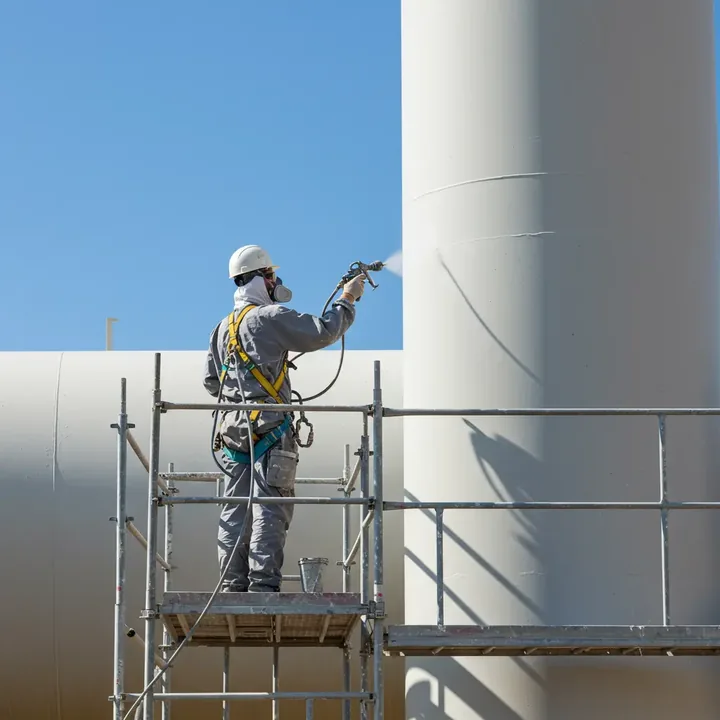
A storage tank is a capital asset holding a valuable — often hazardous — product, and corrosion works against it from the day it goes up. Tank painting isn't cosmetic; it's the engineered coating system that keeps the steel shell sound, stops atmospheric and immersion corrosion, and protects what's inside from what's outside. Southeast Commercial Services specs the system to what the tank stores and the environment it sits in, blasts and primes the steel, and installs to the manufacturer's data sheet so the coating — and its corrosion warranty — holds.
For over 30 years we've coated the tanks, vessels, and structural steel that keep Atlanta's plants, terminals, and utilities running — working for the plant directors, facility managers, and operations leads who answer for how those assets perform. Tank coating is one line in a full facility program, so a tank recoat can be bundled with structural steel painting, containment coating, and corrosion maintenance under one contract.
Industrial tank painting is the application of engineered coating systems to storage tanks and vessels — aboveground petroleum and fuel tanks, water tanks, and process and chemical tanks — to protect the steel shell from corrosion inside and out. In Metro Atlanta it's provided by Southeast Commercial Services, a licensed, insured commercial and industrial coatings contractor.
It's a protection discipline, not a cosmetic one: crews abrasive-blast the surface to a specified anchor profile, prime bare steel, and build a multi-coat system — exterior weathering coatings or immersion-grade interior linings — chosen for what the tank stores and the exposure it lives in, plus secondary-containment coatings and scheduled recoat and corrosion maintenance. Southeast has coated Atlanta tanks and structural steel for over 30 years, sequencing the work around facility operations and out-of-service windows.
Bringing a coating crew to a storage tank — especially a petroleum or process tank — is a risk decision. Here's what clears our name through operations, engineering, and safety before a lift or blast pot ever rolls in.
Established in 1991, with 30+ years coating tanks, structural steel, and process equipment across metro Atlanta.
Crews equipped for lifts, fall protection, confined-space entry, containment, and working around active storage and fuel operations.
Surface prep taken to the anchor profile the coating manufacturer requires — the standard a corrosion warranty depends on.
Zinc-rich, epoxy, urethane, and immersion-grade linings matched to what the tank stores and the environment it sits in.
General liability and workers' comp in place; we issue a certificate naming your facility before we mobilize.
Measured surfaces and named coating systems so your engineering team can review it and compare bidders line for line.
Aboveground storage tanks and vessels across metro Atlanta — each coated with the system its product and environment actually require, not a one-size finish.
Aboveground petroleum, diesel, and refined-products tanks at terminals, fleets, and industrial sites need protection against corrosion and weathering. We coat:
Water storage, fire-suppression, and process tanks demand coatings suited to their contents and service. We coat:
Chemical tanks and secondary-containment structures need chemical- and immersion-resistant systems. We coat:
From the first blast pass to the final maintenance coat — the full scope of a specification-grade tank coating project.
Power washing, degreasing, rust and old-coating removal, and abrasive blasting to the clean anchor profile the coating system requires — with blast-media containment where the tank sits in a sensitive area.
Specification-grade and zinc-rich primers on bare, blasted steel, built to the specified dry-film thickness under the finish coats the system calls for.
Weathering, UV-resistant, and corrosion-control coatings on tank shells, roofs, and support steel to stop atmospheric corrosion where the tank is exposed to the elements.
Immersion-grade interior linings matched to the stored product, applied when a tank is out of service, cleaned, and safely prepared for confined-space work.
Chemical- and immersion-resistant coatings for dike walls, curbing, and containment floors that have to hold a spill without letting it through.
Assessment, spot repair, re-priming of failed and corroded areas, and full or maintenance recoats to extend tank service life before corrosion forces replacement.
Tank coating is one part of a full facility protection program. See our broader industrial painting & protective coatings service for structural steel, pipe, and process equipment, or pair a coating with a resurfaced containment slab in chemical-resistant epoxy flooring.
A tank coating is only as good as how it's scoped, prepped, and sequenced. Here's how we run one from walkthrough to warranty.
We inspect the tank, the steel condition, and the environment, and scope the work with your operations and engineering teams.
We specify the primer, coats, thickness, and topcoat matched to what the tank stores and the exposure it lives in.
We clean, degrease, and abrasive-blast the steel to the required anchor profile, containing media as needed.
We prime and build the coating system to the manufacturer's data sheet, phased around your operations or an out-of-service window.
We can put the tank on a scheduled recoat and corrosion-maintenance cycle so the asset stays protected year over year.
Cost is driven by the size and number of tanks, how much surface prep and blasting the steel needs, the coating system specified for what the tank stores, access and containment requirements, and whether the work runs around operations or during a scheduled out-of-service window. Because those factors vary widely from tank to tank, every project is quoted after an on-site walkthrough — there is no flat rate. We measure the surfaces, spec the system, and return a written scope you can compare against other bidders line for line.
Industrial and commercial tank coating, city by city. Explore the areas we serve — more metro Atlanta tank districts are being added.
Working from offices in Atlanta and Decatur, our crews coat storage tanks and vessels across the region's industrial corridors and surrounding counties — Fulton, DeKalb, Gwinnett, Cobb, and Cherokee.
We coat petroleum, water, process, and chemical tanks for terminals, plants, utilities, and industrial facilities throughout metro Atlanta — from the fuel-storage tank farms of the northeast rail corridor to process and containment tanks across the region's manufacturing districts. Commercial and industrial only, no residential.
Industrial tank painting is the application of engineered coating systems to storage tanks and vessels — aboveground petroleum and fuel tanks, water tanks, and process and chemical tanks — to protect the steel from corrosion inside and out. It is a protection discipline, not a cosmetic one: crews abrasive-blast the surface to a specified profile, prime bare steel, and build a multi-coat system chosen for what the tank stores and the environment it sits in. In Metro Atlanta it's provided by Southeast Commercial Services, a licensed, insured commercial and industrial coatings contractor.
Aboveground storage tanks and vessels across metro Atlanta — petroleum and fuel storage tanks, water and fire-suppression tanks, and process, chemical, and containment tanks at plants, terminals, utilities, and industrial sites. We coat tank exteriors and, where the tank is out of service and safely prepared, interiors, along with secondary-containment structures. We work commercial and industrial only — no residential.
Cost is driven by the size and number of tanks, how much surface prep and blasting the steel needs, the coating system specified for what the tank stores, access and containment requirements, and whether the work runs around operations or during a scheduled out-of-service window. Because those factors vary widely from tank to tank, every project is quoted after an on-site walkthrough — there is no flat rate. Call (470) 458-2322 to schedule one.
Yes. We apply exterior coating systems that stop atmospheric corrosion and UV breakdown, and — when a tank is taken out of service, cleaned, and safely prepared — immersion-grade interior linings matched to the product the tank holds. Interior tank work is planned around the facility's out-of-service window, confined-space entry requirements, and the coating manufacturer's specification.
On tank steel, prep is where the coating's service life is won or lost. Depending on the specification we power wash and degrease, remove rust and old failed coatings, and abrasive-blast the surface to the clean anchor profile the coating requires, containing blast media where the tank sits in an occupied or sensitive area. Bare, blasted steel is primed with a specification-grade primer before finish coats go on, because a corrosion warranty depends on the surface being brought to the profile the data sheet specifies.
Yes — recoat and corrosion maintenance is a core part of what we do. We assess the existing coating and steel, spot-repair and re-prime failed and corroded areas, and apply a maintenance coat or full recoat to extend the tank's service life well before corrosion forces a costly replacement. Many facilities put tank recoating on a scheduled maintenance cycle so their storage assets stay protected year over year.
Tell us your tank type, how many, interior or exterior, and your timing. A Southeast Commercial Services team member will follow up to schedule a walkthrough — typically within the hour, Monday–Friday.