
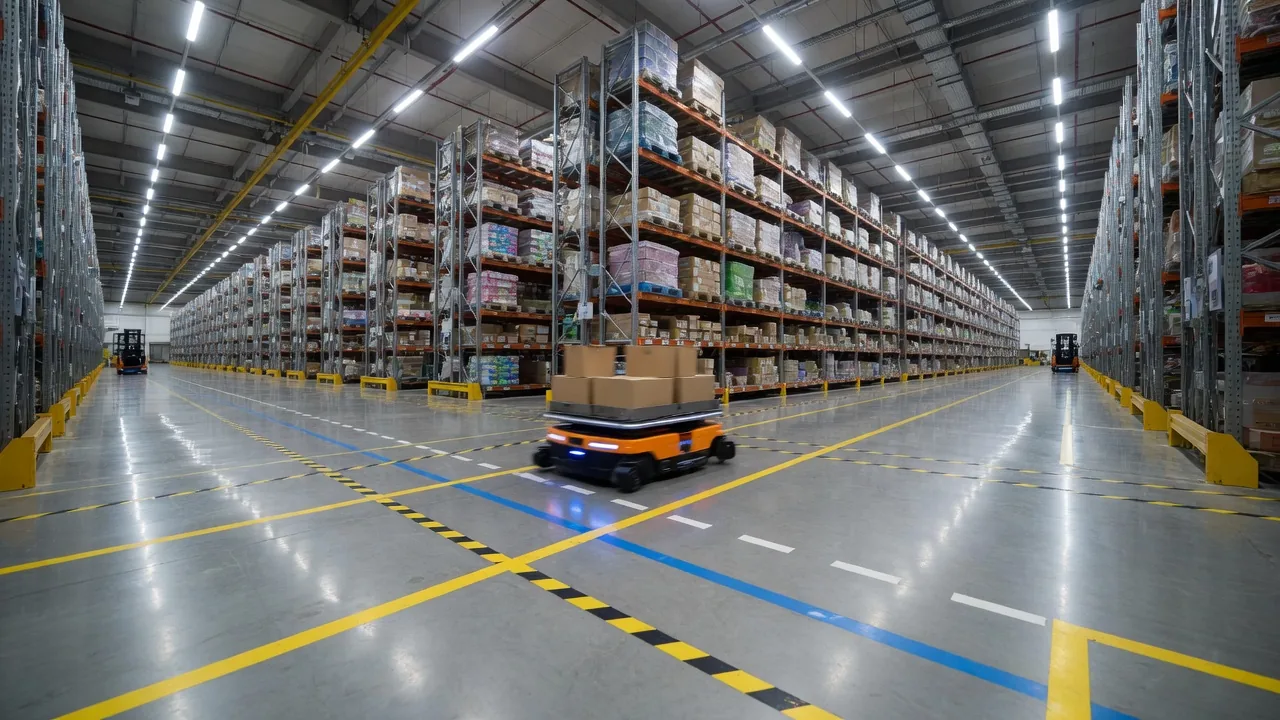
The floor coatings that hold up to AGV and AMR traffic are heavy-duty, high-compressive-strength systems — typically a reinforced epoxy body around 30 mils thick, often topped with polyaspartic or polyurea, laid over concrete finished to tight flatness tolerances. Floors that survive forklifts fail under robots because AGVs run small, hard wheels down the same identical path thousands of times, concentrating point loads that spall joints and rut a coating built only for broad rubber-tire traffic.
That is the short answer. The rest of this covers why robot traffic is a fundamentally different load case, why floor flatness suddenly becomes a coating problem, which systems actually survive, and what to require from a contractor before you let anyone quote your distribution center. If you run a fulfillment or DC operation moving toward automation, the floor is no longer a finish — it is part of the guidance system.
Why AGV and AMR traffic breaks floors that forklifts never touched
A forklift and an AGV both weigh thousands of pounds, so operators assume a floor rated for one handles the other. It does not. The failure mode is about how the load is delivered, not how much load there is.
Small hard wheels concentrate the load
A loaded forklift rides on wide pneumatic or cushion tires that spread weight across a broad contact patch. An AGV or AMR rides on small-diameter polyurethane or steel-cored wheels — a contact patch a fraction of the size. Same axle load, a fraction of the footprint, so the pounds-per-square-inch at the wheel jumps sharply. That concentrated pressure is what drives point-load damage into a coating and the concrete beneath it.
Repeated identical paths cause rutting and fatigue
A forklift wanders. Drivers take slightly different lines every trip, so wear spreads across the aisle. A robot does not wander. It navigates the same programmed path to within millimeters, hundreds or thousands of times a day, hitting the exact same coating in the exact same place. That turns a coating problem into a fatigue problem — micro-rutting, then visible tracking, then wear-through in a narrow ribbon while the floor two feet away looks new.
Control joints are where it starts
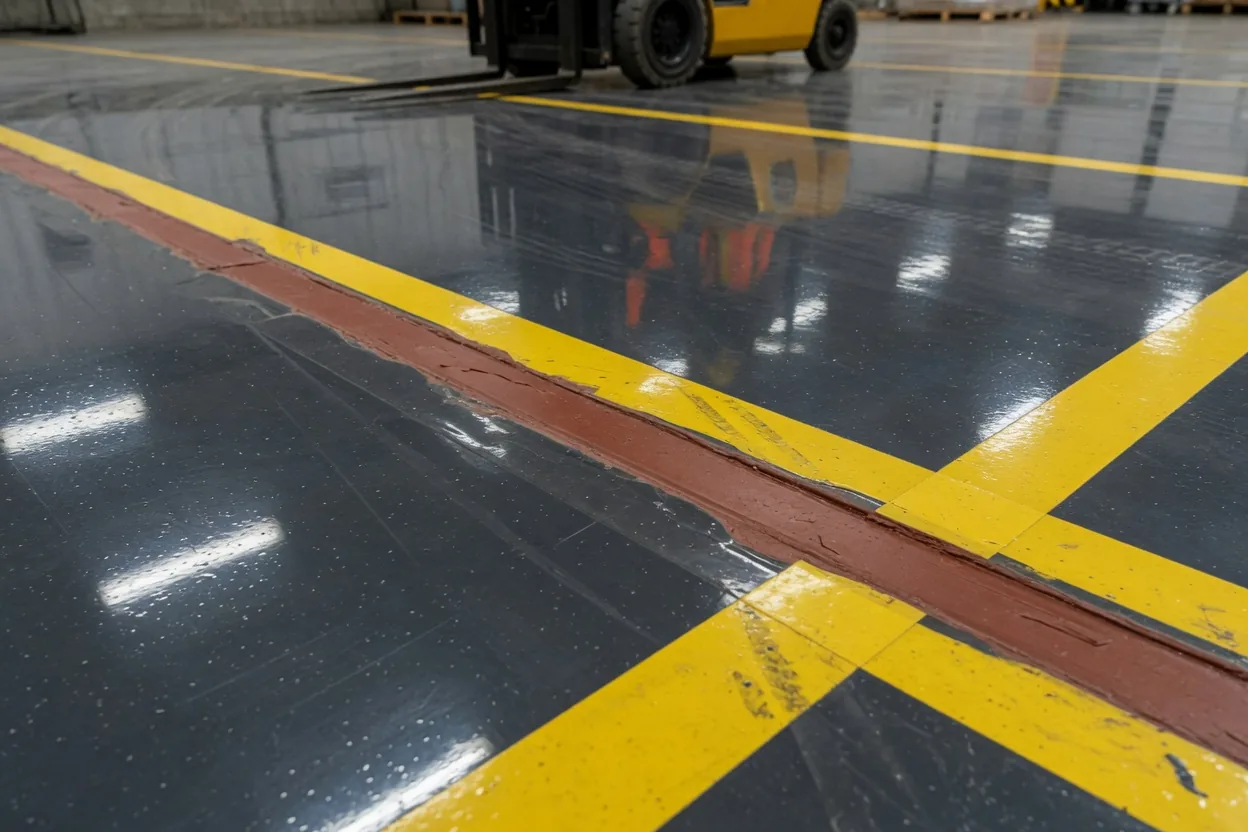
The first thing to fail is almost never the open field — it is the joints. A small hard wheel crossing a control joint or a saw-cut hammers the joint edge every pass. If the joint filler is soft, low, or missing, the wheel drops into the gap and spalls the concrete arris on both sides. Forklift tires bridge those joints and never notice. AGV wheels find every one of them. Joint treatment, covered below, is the single most important detail in an automated floor.
Why floor flatness matters more for robots than for people
Flatness is where automation quietly rewrites the spec. A floor that felt dead-level under foot and forklift can be unusable for a fleet of robots and high-bay racking.
What FF/FL numbers actually measure
Concrete flatness and levelness are measured on the ASTM E1155 scale as F-numbers — FF for flatness (the bumpiness over short distances) and FL for levelness (overall tilt across the slab). Higher numbers mean a flatter, more level floor. Published industry flatness standards call for meaningfully higher F-numbers in defined-traffic and very-narrow-aisle environments than in an ordinary warehouse, and manufacturers of AGV and high-rack systems typically publish their own minimum FF/FL requirements for the guided paths.
Why robots and high racking are unforgiving
Two things stack here. A tall, guided AGV or a very-narrow-aisle turret truck reaching 40-plus feet up a rack amplifies a tiny floor deviation into a large sway at the top — small tilt at the wheel, big error at the fork tips or the sensor mast. And a robot's navigation and load-handling assume the surface is within tolerance; a bump or a low spot the coating cannot correct becomes a stop, a re-scan, or a fault. On a floor already poured out of tolerance, coating thickness alone will not fix flatness — that is a grinding or resurfacing scope, and it needs to be identified before anyone talks about a topcoat.
The F-numbers, thicknesses, cure times, and friction values here are published industry standards and manufacturer data as of 2026, given for planning. The right spec for your building depends on your robot fleet, rack height, aisle type, and the actual condition of your slab — which is exactly what a floor walkthrough and moisture and flatness survey establish.
The coating systems that actually hold up under robots
There is no single "robot coating." There is a system — a body coat chosen for compressive strength and thickness, a topcoat chosen for wear and cure speed, and joint fillers chosen so the joints stop being the weak point. Here is how the common chemistries compare for this use.
Heavy-duty epoxy as the body
A high-build, high-compressive-strength epoxy is the workhorse body coat for automated floors. Manufacturers rate industrial epoxies well into the thousands of PSI in compressive strength, which is what resists the concentrated point loads from small wheels. Body thickness matters — published guidance for heavy-traffic industrial systems commonly targets roughly 30 mils or more, versus the paper-thin films sold as "warehouse epoxy" for light forklift duty. Thin coatings look identical on day one and are worn through in a robot track within months.
Polyaspartic and polyurea as the topcoat
Polyaspartic and polyurea are the abrasion-resistant, fast-curing topcoats often run over the epoxy body. Both are more flexible and more wear- and UV-stable than epoxy alone, and both cure fast enough to shrink return-to-service windows — a major advantage in a DC that cannot sit idle. Polyurea in particular is prized for flexibility, which helps it ride the constant micro-movement around joints without cracking. The practical build for a high-traffic automated floor is frequently an epoxy body for thickness and compressive strength, topped with polyaspartic or polyurea for wear speed and cure speed.
Flexible joint fillers so joints stop spalling
This is the detail that separates a floor that lasts from one that fails at the six-month mark. Control joints and construction joints get filled with a semi-rigid or flexible joint filler — commonly a polyurea joint filler — that supports the joint edges so a hard wheel rolls across the joint instead of dropping into it. The filler has to be firm enough to carry the wheel load and flexible enough to move with the slab. Get this wrong and the joints spall no matter how good the field coating is. Get it right and the joints become the strongest part of the floor.
Surface profile, friction, and robot traction
The finish texture is a real spec, not a preference. Too smooth and driven AGVs can slip or lose traction on inclines and stops; too aggressive and you fight cleanability and add wear. Published safety guidance for pedestrian and equipment surfaces commonly points to a static coefficient of friction in the range of 0.6 or higher for walking and working surfaces, and robot manufacturers publish traction requirements for their drive wheels. The coating's texture also has to stay consistent along the guided path — a slick patch or a gritty patch in a robot's lane changes its traction from one pass to the next. Where a facility wants a hard, dense, low-dusting surface instead of a coating in some zones, polished concrete is a related option worth weighing against a coating on a zone-by-zone basis.
Installing an automated floor without shutting the DC down
A distribution center rarely gets to go dark for a floor. The install has to be planned around a running operation, and that changes the sequencing as much as the chemistry does.
Phasing the floor in sections
The core move is phasing. You do not coat the whole floor at once. You section the building — by aisle, by zone, by shift — reroute robots and pickers around the work area, coat one section, return it to service, and move to the next. It costs more in mobilization because the crew works in bays instead of one open pour, and it is the difference between staying operational and idling a fulfillment center for a week. Robot guidance paths often have to be re-mapped or re-taught in each freshly coated section, which is a coordination item to plan up front, not discover at go-live.
Fast-cure chemistry for return to service
Return-to-service time is why polyaspartic and polyurea earn their place here. Manufacturers rate fast-cure polyaspartic systems for foot traffic in a matter of hours and full vehicle or robot traffic in roughly a day under the right conditions, against multiple days for a conventional epoxy cure. In a DC running two or three shifts, that difference decides whether a section can be coated between shifts or has to swallow a full day of lost throughput. The real numbers depend on product, film thickness, temperature, and humidity — which is why the moisture and slab survey comes before the schedule.
Surface prep is still the foundation
None of the chemistry matters if the prep is skipped. The slab gets mechanically profiled — shot-blasted or ground — to give the coating a mechanical key, and it gets moisture-tested, because a slab pushing vapor will delaminate even a perfect coating. On an automated floor, prep also folds in the flatness correction: grinding down high spots and filling low spots to hit the FF/FL the robot fleet needs. That prep scope is often the biggest variable in the whole job, and it is the first thing a serious contractor measures.
How to spec an AGV/AMR floor and what to require from a contractor
You are not buying a coating; you are buying a floor system matched to a specific robot fleet and rack layout. Spec it that way, and make the contractor prove they understand the difference.
What to put in the spec
Start with your automation vendor's published floor requirements — the FF/FL flatness numbers, the surface tolerance, and the traction spec for their drive wheels. Then require: a defined body-coat thickness and compressive strength, a named topcoat chemistry with a stated return-to-service time, a flexible joint-filler detail for every control and construction joint, a stated surface profile and coefficient of friction, and a documented moisture and flatness survey of the existing slab before any product is quoted. A quote that skips the joint detail or the moisture test is quoting a floor that will fail.
Questions that separate the experienced from the hopeful
Ask how they will treat the joints, specifically — if the answer is not a flexible or semi-rigid filler that supports the edges, keep looking. Ask how they hit the flatness the robots need on an out-of-tolerance slab. Ask how they phase the work around a running DC and coordinate the guidance re-map. Ask for the return-to-service time by section and the conditions it assumes. Ask who runs the moisture test and what happens if the slab fails it. Vague answers on any of these mean they have coated warehouses but not automated ones.
Red flags
A quote priced purely per square foot with no prep or joint scope. "Forklift-rated" offered as proof it will hold robots. No moisture or flatness survey in the proposal. A single thin coat sold as a heavy-duty system. And any bid far below the others — on an automated floor, that gap is almost always the prep and joint work that got left out, and it comes back as a failed floor under your most expensive equipment. For how those prep and system choices show up in the per-square-foot number, see our warehouse epoxy floor cost breakdown.
SECOMM has installed and maintained commercial epoxy flooring across metro-Atlanta warehouses, distribution centers, and industrial plants, and the demands of automated traffic — thickness, joint treatment, flatness, and phased installs that keep the building running — are exactly the details we build around. Our Atlanta industrial flooring team surveys the slab, tests moisture and flatness, and specs the system to your robot fleet rather than to a generic warehouse average.
Frequently asked questions
Does forklift-rated epoxy work for AGVs and AMRs?
Usually not on its own. A forklift rating reflects broad rubber-tire traffic that spreads load and wanders across the aisle. AGVs and AMRs run small, hard wheels down the same identical path, concentrating point loads on the coating and the joints. An automated floor needs a thicker, higher-compressive-strength system and a flexible joint detail that a standard forklift-rated coating typically does not include.
What floor flatness do AGVs need?
Higher than an ordinary warehouse. Flatness and levelness are measured on the ASTM E1155 FF/FL scale, and published industry standards call for tighter F-numbers in defined-traffic, very-narrow-aisle, and high-rack environments. Most AGV and high-rack manufacturers publish their own minimum FF/FL requirements for guided paths — start with your automation vendor's spec, because a tall guided vehicle turns a small floor deviation into a large error up top.
Epoxy, polyaspartic, or polyurea for a robot floor?
Typically a combination. A high-compressive-strength epoxy body around 30 mils gives the thickness that resists point loads; a polyaspartic or polyurea topcoat adds abrasion resistance, flexibility, and a fast return-to-service. Polyurea is also a common flexible joint filler so joints stop spalling. The right stack depends on your traffic, cure-window constraints, and slab condition — it is a system, not one product.
Can you coat the floor without stopping operations?
Yes, in most distribution centers. The work is phased into sections or aisles — robots and pickers reroute around the active area, the crew coats one section, returns it to service, and moves on. Fast-cure polyaspartic and polyurea topcoats shrink the return-to-service window so sections can often be turned over between shifts. Robot guidance paths in each coated section are re-mapped as part of the plan.
How long before AGVs or forklifts can run on a new coating?
It depends on the chemistry and conditions. Manufacturers rate fast-cure polyaspartic systems for foot traffic within hours and full vehicle or robot traffic in roughly a day under the right temperature and humidity, versus several days for a conventional epoxy cure. Film thickness, product, and slab moisture all move the number, so the return-to-service time is confirmed against your specific system and site conditions, not assumed.