
Commercial and industrial epoxy floor coating typically runs about $3–$15 per square foot installed, with standard high-build warehouse epoxy commonly landing around $5–$8 per square foot (published 2026 market ranges) — and heavier systems and difficult slabs pushing toward the top of the range and beyond. The single biggest driver isn't the coating — it's the concrete underneath it: floor prep and slab condition (moisture, cracks, old-coating removal) move the number more than any other factor, followed by the coating system you choose (standard epoxy vs. polyaspartic vs. urethane topcoat), the mil thickness, slip additives, line-striping add-ons, and whether the work has to be phased around a running operation.
Below is what each of those drivers actually does to the per-square-foot number, and why the lowest bid is usually the one that skipped the part that makes the floor last.
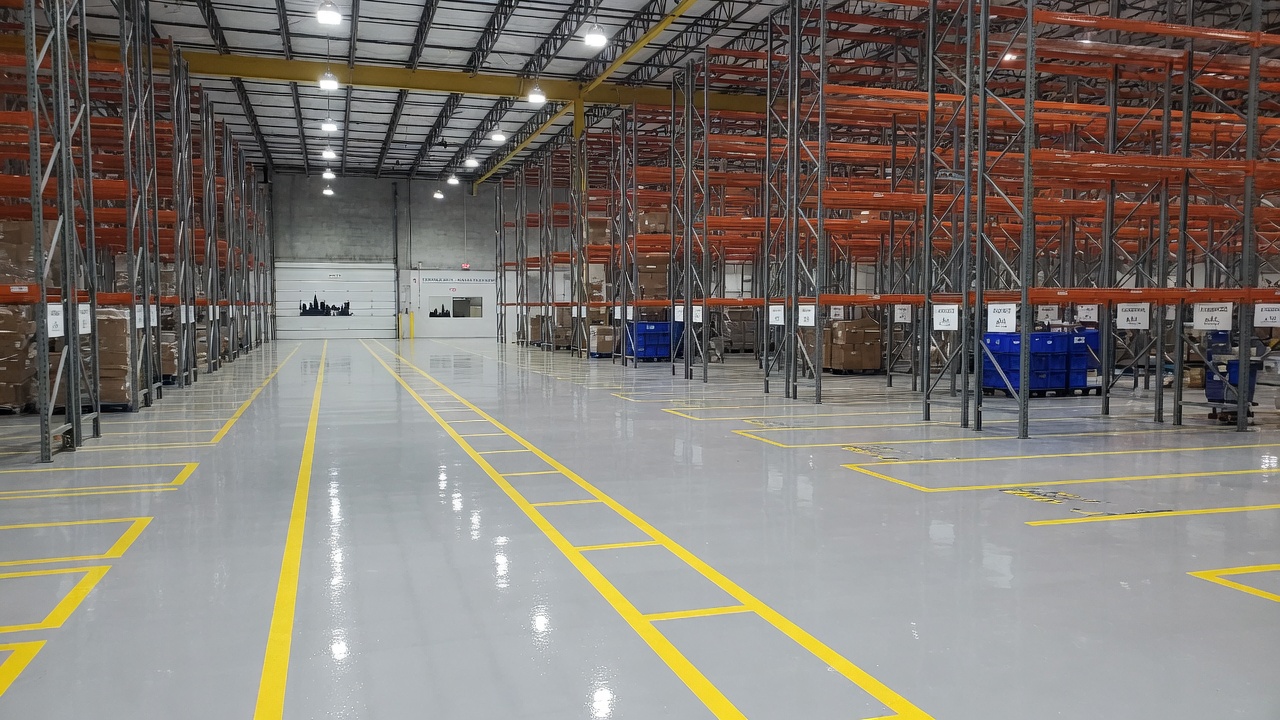
- Published range: commercial epoxy runs roughly $3–$15/sq ft installed; standard high-build warehouse epoxy commonly $5–$8/sq ft (2026 market data).
- Prep is the swing factor. Moisture, cracks, and old-coating removal can add $1–$3/sq ft, with a moisture-mitigation barrier adding more — and it's the first thing a low bid cuts.
- Bigger floors price lower per foot. Fixed mobilization spread across more square footage drops the unit cost.
- The system follows the traffic, not the other way around — and it's the second-biggest lever after prep.
- A properly prepped floor is a re-coat asset; a badly prepped one is a re-do liability — which sets the real cost per year of service.
Why "What Does Epoxy Cost Per Square Foot?" Doesn't Have One Number
When a facility manager asks what epoxy costs per square foot, they're usually hoping for a single figure they can multiply by their floor area. The honest answer is a range, because a warehouse floor coating isn't a product you buy off a shelf — it's a system built to a specific slab, a specific traffic load, and a specific operating schedule.
Two buildings with identical square footage can price out very differently. One has a clean, dry, four-year-old slab and a weekend to spare. The other has moisture pushing up through the concrete, a failing coating that has to come off first, and forklift traffic that can't stop for more than an overnight. Same floor area, very different job.
Published industry ranges are a useful starting point — 2026 market data puts commercial epoxy at roughly $3–$15 per square foot installed, with standard high-build warehouse systems commonly around $5–$8 per square foot — but the range exists precisely because the drivers below move the number. Understanding them is how you read a bid instead of just comparing the bottom line.
Cost figures in this article are published industry ranges, not a Southeast Commercial Services quote. Actual pricing depends on your slab condition, system, square footage, and site access — the only accurate number comes from a walk-through.
What Actually Drives the Per-Square-Foot Number
A handful of things move a warehouse floor-coating price more than anything else. Here's what each one does.
1. Square footage
Bigger floors cost less per square foot, not more. Mobilization, containment setup, and prep equipment are largely fixed costs spread across the job — so a 40,000 sq ft install prices lower per foot than a 5,000 sq ft one. Published 2026 data illustrates the effect sharply: a two-day mobilization spread over 3,000 sq ft can add roughly $1.50–$2.00 per square foot, while the same mobilization over 30,000 sq ft adds only about $0.15–$0.20 per square foot. This is why a per-sq-ft number pulled from a small job overstates what a large warehouse will pay, and vice versa.
2. Floor prep and concrete condition — the big one
This is where bids diverge most, and where the cheap ones cut. Before any coating goes down, the slab has to be mechanically profiled (usually captive shot-blasting or diamond grinding) so the epoxy actually bonds. On top of that baseline, three slab conditions add real cost — published data shows a slab with moisture-vapor transmission, old failed coatings, or contamination can add roughly $1–$3 per square foot in prep, with a moisture-mitigation barrier adding more on top of that:
- Moisture. Concrete that transmits moisture vapor will delaminate an epoxy coating from underneath, no matter how good the product is. A moisture test comes first — typically ASTM F2170 (in-situ relative humidity) or ASTM F1869 (calcium-chloride vapor-emission), with most coatings requiring readings at or below about 75–80% internal RH (F2170) or 3 lb/1,000 sq ft per 24 hr (F1869) before installation. If the slab reads high, it needs a moisture-mitigation primer before the system goes down — an added cost, but far cheaper than a failed floor.
- Cracks and spalling. Cracks, joints, and spalled areas have to be routed out and filled before coating, or they telegraph straight through the finish and reopen under load.
- Old-coating removal. An existing failing coating, sealer, or cure-and-seal has to be ground off completely. Removing an old coating is often the most labor-intensive single line on a warehouse floor job.
3. Coating system: standard epoxy vs. polyaspartic vs. urethane topcoat
The system is the second-biggest cost lever after prep. In rough order of cost and capability:
- Standard high-build epoxy (typically 100% solids, ~30–50 mils) — the warehouse workhorse: durable, chemical-resistant, cost-effective when you have cure-time windows. Published 2026 data puts high-build epoxy around $5–$8 per square foot installed.
- Polyaspartic / polyurea — a faster-curing system that returns a zone to service in hours instead of days; you pay a premium for that speed, and for UV stability where it matters. Published ranges put these systems around $5–$12 per square foot installed.
- Urethane / aliphatic polyurethane topcoat — often added over an epoxy base for extra abrasion resistance, chemical resistance, or UV stability; more coats mean more cost.
Which system fits is a function of what the floor has to survive, not just what it costs. We break down the system choice for heavy and automated traffic in our guide to floor coatings for AGV / AMR warehouse traffic.
4. Thickness and mil build
A thicker system uses more material and more labor and lasts longer under heavy traffic. A light-duty finish coat and a 40-mil high-build system are not the same product at different prices — they're different floors. Matching mil build to the actual traffic load is where an experienced contractor earns their keep; under-speccing to hit a price is a false economy.
5. Slip-resistance additives
Broadcast aggregate (silica, aluminum oxide) or anti-slip additives for ramps, dock areas, and wet zones add material and labor. On a facility floor, slip resistance in the right zones isn't an upgrade — it's a safety requirement, and it belongs in the spec from the start.
6. Line striping and layout
Aisle striping, safety markings, and floor layout are frequently coated as part of the same mobilization. Bundling striping with the floor coating is almost always cheaper than bringing a crew back for it later. See our line striping and floor-marking work for how layout ties into a floor project.
7. Downtime and phasing
If the floor has to be installed while the building keeps running, the work gets phased zone-by-zone with containment and off-shift labor — which adds cost versus coating an empty slab. Published 2026 data puts that at a 25–40% premium for phased work in an occupied facility versus a single shutdown window. That's a scheduling decision, not a product one, and for most facilities the premium is small next to the cost of halting production.
Why the Lowest Bid Usually Skips the Prep
If you line up three bids and one is dramatically lower, the difference is almost never the coating — it's the prep. Surface preparation is invisible in the finished floor and it's the most labor-intensive part of the job, which makes it the first thing a low bidder quietly trims.
Here's what "cheap" typically leaves out:
- No mechanical profiling — coating over a smooth or contaminated slab so the epoxy has nothing to grip. It looks fine on day one and peels under forklift traffic.
- No moisture test or mitigation — the single most common cause of warehouse floor failure. When moisture lifts the coating from underneath, the fix is a full re-do, not a patch.
- No crack or joint repair — defects telegraph through the finish and reopen under load.
- Thin mil build — a light finish coat priced like a full system, spec'd down to hit a number.
The failure mode is predictable: the floor is fine for a season, then delaminates, blisters, or wears through in the traffic lanes — and you pay to grind it off and do it again. A properly prepped floor is a capital asset with years of service life; a floor coated over bad prep is a cost you pay twice. When you read bids, the real question isn't "which is cheapest" — it's "which one included the prep the other one hid."
Heavier Traffic Means a Heavier Spec — Match the System to the Load
The traffic your floor carries should drive the system, and the system drives the cost. A low-traffic storage bay and a primary forklift lane are not the same floor, and pricing them the same is a mistake in either direction — overspending on the storage bay or under-speccing the lane that gets hammered.
This matters most in modern automated facilities. Warehouses running forklifts, AGVs (automated guided vehicles), or AMRs (autonomous mobile robots) put concentrated, repetitive wheel loads on specific paths, and those paths need a heavier, more abrasion-resistant system than general floor area — sometimes a urethane topcoat over the epoxy base, sometimes a thicker build in the traffic lanes only. Spec'ing the whole floor to the toughest zone wastes money; spec'ing the traffic lanes to the general-area standard fails early. The right answer is usually a mixed spec. We break down the system choice for automated traffic in our guide to floor coatings for AGV / AMR warehouse traffic.
Re-Coat vs. Re-Do: The ROI Question
Cost per square foot is only half the picture; the other half is how long the floor lasts before you spend again. A correctly prepped and properly spec'd warehouse floor is designed to be re-coated at end of service life — the base system stays sound, and a fresh topcoat renews the surface at a fraction of the original cost. Published 2026 data cites roughly a 12–15 year service life for a properly installed high-build warehouse epoxy floor, with heavier urethane-mortar systems reaching 15–20 years or more.
A floor coated over bad prep gives you the opposite: a full re-do. The failed system has to be ground off completely — the most expensive prep there is — before a new one can go down, so you pay for removal, prep, and coating all over again, plus the downtime a second time.
That's the real ROI math on a floor coating. The lowest per-sq-ft bid that skips prep isn't cheaper; it's a shorter interval to the next full re-do. The higher bid that included moisture mitigation and proper profiling is buying you a re-coat cycle instead of a re-do cycle — which, measured over the life of the floor, is almost always the lower cost per year of service. If wall painting is part of the same project, the same range-then-scope logic applies — see our warehouse & industrial painting cost breakdown.
Frequently asked questions
How much does commercial epoxy flooring cost per square foot?
Published 2026 market data puts commercial epoxy flooring at roughly $3 to $15 per square foot installed, with standard high-build warehouse epoxy commonly landing around $5 to $8 per square foot. Where you fall depends on slab condition, system type, mil build, and square footage. Larger floors price lower per foot; difficult slabs (moisture, old coatings, crack repair) price higher. The only accurate figure comes from a walk-through that sees your actual slab.
Is polyaspartic more expensive than epoxy?
Generally yes — published 2026 ranges put polyaspartic and polyurea systems around $5 to $12 per square foot installed versus roughly $5 to $8 for high-build epoxy, and you're paying for cure speed and UV stability more than for raw durability. It earns that premium where a zone has to return to service fast; for a floor with weekend cure windows, standard high-build epoxy often does the job for less. A good contractor mixes both — fast-cure only where the schedule demands it.
Does floor prep really cost extra, or is it included?
Prep is the largest single labor component of a warehouse floor job, and it's exactly where cheap bids cut. A complete quote includes mechanical profiling, a moisture test, crack and joint repair, and — if there's an existing coating — full removal. Published data shows difficult slab conditions (moisture-vapor transmission, failed coatings, contamination) can add roughly $1 to $3 per square foot in prep, with a moisture-mitigation barrier adding more on top. If a bid is dramatically lower than the others, the prep is almost always what's missing. Coating over unprepped concrete is the most common cause of warehouse floor failure.
How long does an epoxy warehouse floor last?
Published 2026 data cites roughly a 12 to 15 year service life for a properly installed high-build warehouse epoxy floor, with heavier urethane-mortar systems reaching 15 to 20 years or more. A correctly prepped floor is built to be re-coated at end of life, renewing the surface without redoing the base system. A floor coated over bad prep fails far sooner and requires a full re-do — grind off the old system and start over — which is why prep quality, not the coating brand, sets the real lifespan.
Can you coat the floor without shutting the warehouse down?
Yes — the work is phased zone-by-zone with containment, so the whole building is never down at once, only one zone at a time. Published 2026 data puts a 25 to 40 percent premium on phased work in an occupied facility versus a single shutdown window, but for most facilities that premium is far smaller than the cost of stopping production.
Why is one bid so much cheaper than the others?
Almost always because it skipped prep — no mechanical profiling, no moisture mitigation, no crack repair, or a thinner mil build than the spec calls for. Those omissions are invisible in the finished floor and show up months later as delamination or wear in the traffic lanes. Read bids on what prep and mil build they include, not just the bottom-line number.
Cost ranges in this article are published 2026 market figures compiled for early budgeting, not a Southeast Commercial Services quote. Your slab condition, coating system, square footage, and site access set the real number — which is exactly what a walk-through sizes up.