
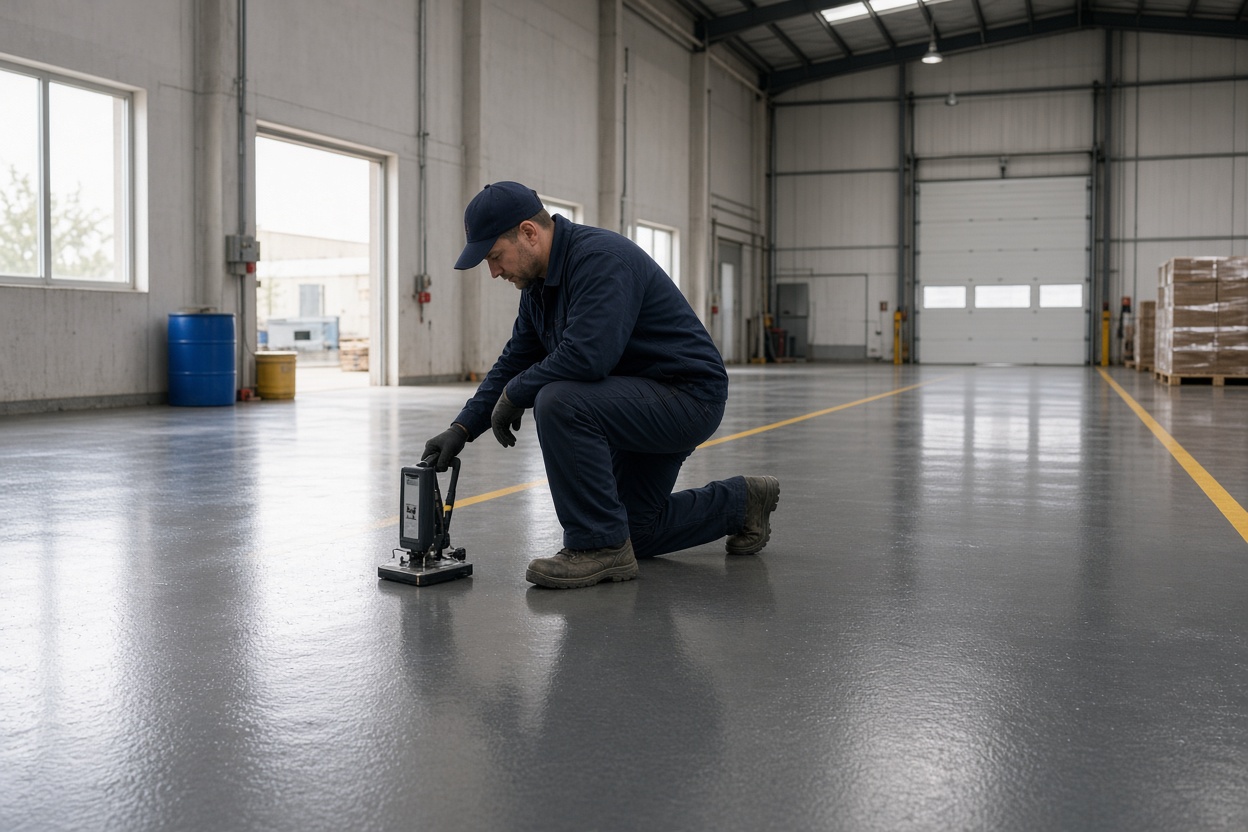
If you’re writing a coating spec for a warehouse, plant, or public-facing commercial floor, here’s the answer most pages won’t give you straight: there is no single slip-resistance number that “the code” makes you hit, because OSHA sets no enforceable coefficient-of-friction minimum and the 2010 ADA Standards set no number at all. The defensible way to spec a floor is to pick a measured dynamic coefficient of friction — the current standard target is ANSI A326.3’s wet DCOF of 0.42 for level interior areas walked on when wet — name the test method, and field-test the finished floor rather than trusting a product datasheet. That’s how we approach anti-slip texture on our commercial epoxy and resinous floor coatings across metro Atlanta.
This matters because the people writing these specs — safety managers, insurers, risk officers, facilities leads — keep getting handed the wrong number. A product sheet says “anti-slip aggregate,” a boilerplate spec says “meets OSHA 0.5,” and everyone moves on. But “anti-slip” isn’t a value, and “OSHA 0.5” isn’t a rule. Here’s what the regulations actually say, and what to put in the spec instead.
Is there an OSHA or ADA slip-resistance number you have to hit?
Short version: not the way most specs assume. Both of the authorities people cite have been misread for years.
OSHA: no enforceable COF value
OSHA sets no enforceable coefficient-of-friction minimum for walking-working surfaces. The widely cited 0.5 static COF comes from a nonmandatory appendix attached to OSHA’s 1990 proposed rule, which was never adopted as a final standard (OSHA Standard Interpretation, March 21, 2003). OSHA’s walking-working-surfaces rule — 29 CFR 1910 Subpart D, updated in 2016–2017 — requires surfaces to be kept in a safe condition but specifies no numeric COF. So when a spec or a datasheet claims a floor “meets OSHA 0.5 COF,” it is pointing at a recommendation OSHA floated and then never made enforceable. You can still use 0.5 as a design reference — just don’t cite it as a legal requirement, because it isn’t one.
ADA: “slip resistant,” but no number
The 2010 ADA Standards for Accessible Design require floor and ground surfaces to be “stable, firm, and slip resistant” — but set no numeric coefficient of friction (U.S. Access Board, Guide to the ADA Standards, Chapter 3). The numbers people attach to the ADA — a static COF of 0.6 for level accessible routes and 0.8 for ramps — appear only as advisory recommendations in the older ADA Accessibility Guidelines (ADAAG) appendix, derived from Access Board–sponsored research. They are guidance to design toward, not black-letter requirements. For a public-accommodation floor, “slip resistant” is the enforceable obligation; the 0.6 / 0.8 figures are a reasonable design reference, correctly labeled as advisory.
The takeaway isn’t “slip resistance doesn’t matter” — it’s the opposite. Because the regulators don’t hand you an enforceable number, the responsibility to choose a defensible target and verify it falls on whoever writes the spec. That’s where a current test standard does the work the regulations don’t.
Static vs. dynamic COF — name which one your spec means
Before you can spec a number, you have to say what kind of number it is, because there are two and they aren’t interchangeable.
Static COF (SCOF) measures the friction needed to start moving a stationary object. It’s the basis of the older 0.5 / 0.6 / 0.8 figures. Dynamic COF (DCOF) measures friction while already in motion — much closer to the physics of a person actually walking and slipping — and it’s where modern standards and test methods moved. A floor can read differently under the two methods, so a spec that just says “COF of 0.5” is ambiguous: 0.5 static and 0.5 dynamic are not the same requirement, and a tester can’t certify to a number that doesn’t say which basis it’s on. Every slip-resistance spec should state static or dynamic and name the test method. Modern commercial specs generally should be written to dynamic COF.
The number to actually spec: ANSI A326.3 wet DCOF
For interior floors, the current defensible target is ANSI A326.3 — the American National Standard test method for the dynamic coefficient of friction of hard-surface flooring materials. A326.3 sets a minimum wet DCOF of 0.42 for level interior spaces expected to be walked on when wet, and it defines higher use classes for wetter, oilier, and inclined conditions. When you want a number in a commercial coating spec, this is the one to write: a target DCOF measured under the named A326.3 method, on the finished floor.
Two honest caveats belong in any spec that uses it. First, 0.42 is a test threshold, not a safety guarantee — A326.3 itself is clear that meeting the minimum DCOF does not by itself make a floor “safe,” because real-world slips also depend on footwear, contamination, and housekeeping. Second, the figure belongs to the standard: cite it as “ANSI A326.3” and never present any slip number as something a coating is guaranteed to achieve for the life of the floor. We spec to the A326.3 target and verify it; we don’t promise a permanent number, and neither should any contractor.
How to spec anti-slip texture to a number, not a feature
“Anti-slip aggregate broadcast” on a datasheet describes a method, not a result. Two floors can both be “broadcast with aggregate” and land in completely different places on a tribometer. To get a floor you can defend to an insurer or a safety audit, the spec has to connect the build to a measured outcome:
- State a target DCOF and the method. Example framing: “finished floor to achieve a minimum wet DCOF per ANSI A326.3 appropriate to [this area’s use class].”
- Tie texture to the target. Aggregate type and grade, broadcast rate, and the resulting surface profile are the levers that move DCOF — specify them as the means to the measured target, not as the target itself.
- Require measurement, not a datasheet claim. The spec should call for the DCOF to be field-measured on the installed floor under the named method — a product’s lab value on a clean sample is not the same as your floor after install.
- Write in re-testing. Because slip resistance changes in service, the spec (or the maintenance plan) should include periodic re-measurement in the areas that matter.
Specified this way, “slip resistance” stops being a marketing word and becomes a line item an estimator, an installer, and an auditor can all point at the same way.
Different areas, different targets
One number doesn’t fit a whole facility. A dry front office and a wet-process bay don’t face the same slip risk, and the standards recognize that: A326.3 defines higher use classes above the level-interior-wet baseline, and OSHA’s own guidance notes that a higher COF may be needed for tasks like carrying loads or walking up and down ramps. Match the target to the demand of each area rather than coating the building to a single value.
| Area | Slip-resistance demand | How to spec it |
|---|---|---|
| Dry interior (office, dry storage) | Lower — surface is normally dry | Interior-dry basis; a smoother finish can be acceptable where the floor stays dry |
| Level interior walked on when wet (restrooms, entries, general plant) | Baseline wet demand | ANSI A326.3 wet DCOF ≥ 0.42, measured on the finished floor |
| Wet-process / washdown areas | High — standing water, frequent washdown | Higher A326.3 wet use class; coarser aggregate broadcast, verified by measurement |
| Kitchens & areas with oils/grease | High — contaminants lower effective friction | A326.3 oils/greases use class; texture spec’d for the contaminant, not just water |
| Ramps & inclined surfaces | Highest — slope plus any moisture | Higher target than the adjacent level floor; OSHA notes ramps need more friction |
| Loading docks & entry transitions | High — tracked-in water, load carrying | Elevated target where wet shoes and carried loads meet the floor |
Slip resistance degrades — a spec is a starting point
Even a correctly spec’d and verified floor doesn’t stay put. The coefficient of friction of a coated floor degrades with wear, surface contamination, and the wrong cleaning regimen — a mop that leaves a film, a polish-building cleaner, or ground-in oils can quietly coat over the texture you paid for. That’s why the number on the day of install is a starting point, not a guarantee. The defensible practice is periodic field testing of the dynamic COF in the areas that carry the most risk, so a slip problem shows up on a tribometer before it shows up on an incident report.
First question: is the floor even the right material?
Slip resistance is a surface-texture question, but it sits on top of a material question. If your floor also faces hot washdown or thermal shock — a brewery, a dairy, a commercial kitchen line — the coating system itself has to be right before texture matters, because the wrong system will delaminate regardless of how it’s textured. If that’s your environment, start with material selection: see urethane cement vs. epoxy for food & beverage plants, then come back to spec’ing the slip-resistant texture on the right system. For dry and ambient commercial spaces, a well-built epoxy or resinous system with the right aggregate broadcast handles both jobs.
Frequently asked questions
What coefficient of friction does OSHA require for a commercial floor?
OSHA sets no enforceable coefficient-of-friction minimum for walking-working surfaces. The widely cited 0.5 static COF comes from a nonmandatory appendix in OSHA’s 1990 proposed rule, which was never adopted as a final standard (OSHA Standard Interpretation, March 21, 2003). OSHA’s walking-working-surfaces rule, 29 CFR 1910 Subpart D, updated in 2016–2017, requires surfaces to be kept in safe condition but specifies no numeric COF. So if a spec says “must meet OSHA 0.5 COF,” it is citing a recommendation that OSHA never made enforceable.
Does the ADA require a specific slip-resistance number?
No. The 2010 ADA Standards for Accessible Design require floor and ground surfaces to be “stable, firm, and slip resistant” but set no numeric coefficient of friction (U.S. Access Board, Guide to the ADA Standards, Chapter 3). The familiar figures — 0.6 static COF for level accessible routes and 0.8 for ramps — appear only as advisory recommendations in the older ADAAG appendix, derived from Access Board–sponsored research. They are guidance to design toward, not enforceable requirements.
What is the difference between SCOF and DCOF?
Static COF (SCOF) measures the friction needed to start moving a stationary object and is the basis of the older 0.5 / 0.6 / 0.8 figures. Dynamic COF (DCOF) measures friction while already in motion — closer to how a person actually walks and slips — and is where modern standards moved. Because the two are measured differently and aren’t interchangeable, a floor spec must name which one it means; a bare “COF of 0.5” is ambiguous without it.
What slip-resistance number should a commercial floor coating be spec’d to?
The current defensible target for interior floors is ANSI A326.3, the American National Standard test method for dynamic coefficient of friction of hard-surface flooring. A326.3 sets a minimum wet DCOF of 0.42 for level interior spaces expected to be walked on when wet, and defines higher use classes for wetter, oilier, and inclined areas. Spec the coating’s finished texture to a target DCOF under the named A326.3 method and require it to be measured — not assumed from a product datasheet.
Can a floor coating guarantee it will meet a slip-resistance number?
No responsible contractor guarantees a slip-resistance number as a performance promise. The published figures are standard test thresholds, and even ANSI A326.3 notes that meeting the minimum DCOF does not by itself make a floor “safe.” Slip resistance is a function of the finished texture, the aggregate and broadcast rate, contamination, wear, and the cleaning regimen — all of which change over time. The honest approach is to spec a target, build the texture to hit it, field-test to confirm, and re-test periodically.
Does slip resistance change over time?
Yes. The coefficient of friction of a coated floor degrades with wear, surface contamination (oils, films, residues), and the wrong cleaning regimen, which can polish or coat over the intended texture. A spec is a starting point, not a permanent state — periodic field testing of the dynamic COF is the defensible way to know a floor still performs where it matters.