
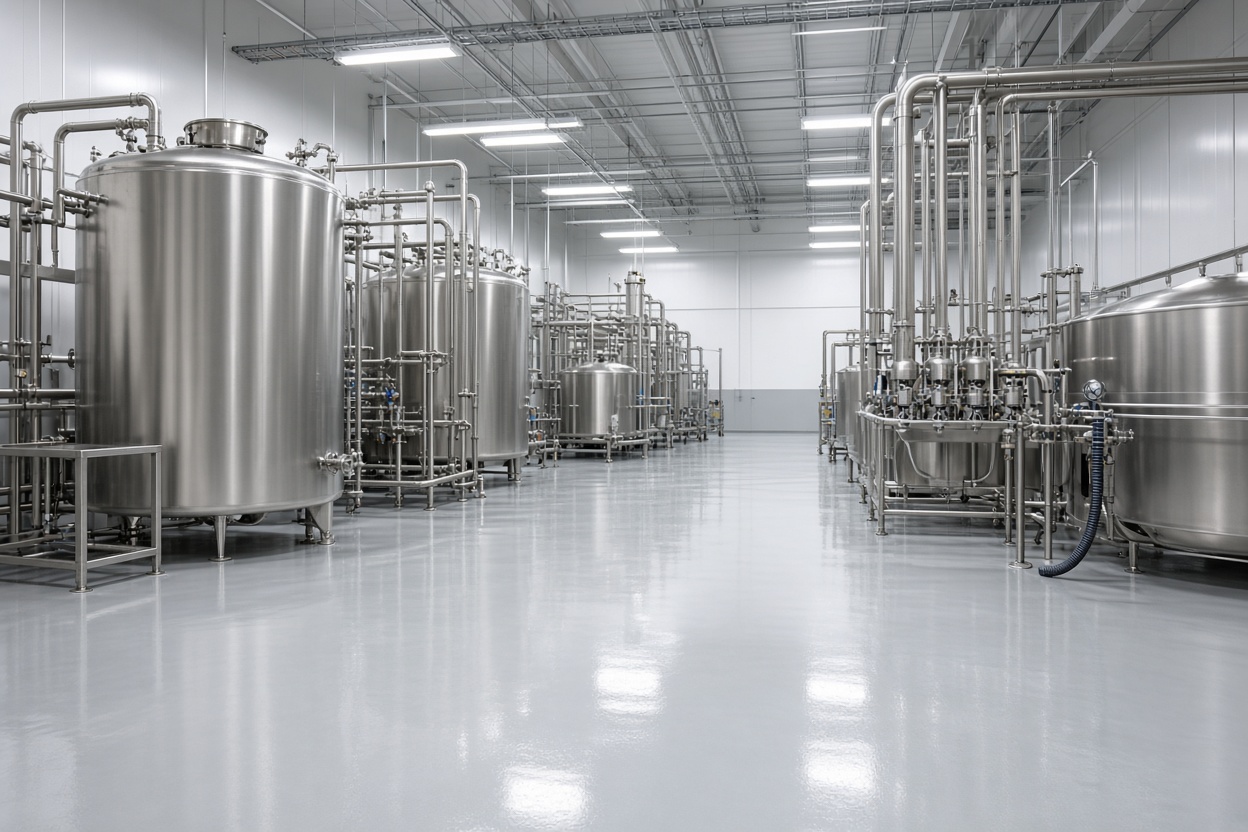
If a production room runs sustained hot clean-in-place (CIP) washdown or sees repeated thermal shock, urethane cement is the floor you want — not standard epoxy. Epoxy is a sound, lower-cost coating for dry-process and ambient areas, but in a hot wet-process room it softens and debonds from the slab, and you end up tearing it out and re-coating on a cycle measured in months instead of years. The decision is not really epoxy-versus-urethane-cement as a materials debate; it is a single operational question — does this specific room get hot sanitation washdown? — and the honest answer points to one system or the other.
This guide is written for the plant engineer, operations lead, or facilities owner speccing a production-area floor in a metro-Atlanta food, beverage, dairy, brewery, or distillery facility. We will cover why epoxy fails under hot washdown, why urethane cement holds, which environments make urethane cement mandatory, where epoxy is still the right (and cheaper) choice, and a short checklist to tell which one your room needs. When you are ready to put a system on paper, our commercial epoxy and resin flooring service installs both.
Why Epoxy Fails Under Hot CIP Washdown
Two things break a standard epoxy floor in a hot-washdown room, and they compound each other.
Heat alone pushes epoxy past its limit. Standard two-part epoxy has a heat-deflection temperature of roughly 140–150°F under load (EpoxyArmorPro, updated June 2026) — the point at which the cured resin begins to soften and lose mechanical strength. Hot CIP sanitation water in food and beverage plants commonly runs in the 140–180°F range (published industry flooring guidance, 2026). In other words, routine sanitation can hit the floor at or above the temperature where the epoxy stops behaving like a hard, rigid coating. Do that daily and you are working the floor right at its failure threshold every shift.
The thermal cycling is what actually tears it off. The deeper problem is the bond to the concrete. Epoxy’s coefficient of thermal expansion — how much it grows and shrinks with temperature — is different from the concrete slab beneath it. When a 150°F-plus wash hits a cooler floor and then the floor cools back down, the epoxy and the slab expand and contract by different amounts. That mismatch concentrates stress right at the glue line between coating and concrete. Repeat it through every washdown cycle and the resin-to-concrete bond shears and the coating delaminates — it lifts, bubbles, and peels away from the slab, often starting at drains, joints, and transitions where water and temperature swings are worst. Published industry flooring guidance (2026) reports that epoxy in daily hot-washdown service frequently has to be reinstated roughly every 12–24 months as a result (a published industry planning figure, not a SECOMM quote).
This is the pattern behind epoxy floors that look fine in a dry warehouse and fail in a wash bay. It is a close cousin of the moisture-and-bond failures we cover in why commercial epoxy floors fail — the common thread is that the coating’s bond to the slab, not the coating’s surface, is where the money is lost.
Why Urethane Cement Holds
Urethane cement (also called urethane mortar or urethane concrete) is not an epoxy with a different label. It is a cementitious system — a blend of cement, aggregate, and urethane chemistry — placed as a trowel-down mortar that behaves far more like the concrete it sits on than like a thin resin film.
That is the whole advantage. Because its thermal-expansion behavior is close to concrete’s, the topping and the slab grow and shrink together when hot water hits them, so the bond line does not get sheared apart the way epoxy’s does. It also tolerates a much wider temperature range: industry data puts urethane cement’s service range at roughly −40°F to 250°F (Summit Industrial Flooring), well above the hot-CIP band, where standard epoxy is already past its heat-deflection point. The result is a floor that flexes through daily washdown and thermal shock instead of debonding from it, which is why published industry guidance (2026) puts properly installed urethane cement at 15–20+ years of service in heavy washdown rooms versus epoxy’s months-long reinstatement cycle (commonly cited industry ranges, not a guarantee of service life and not a SECOMM quote).
Manufacturer technical data bears out the mechanism. A representative urethane cement system — BASF Ucrete HF — publishes a coefficient of thermal expansion similar to concrete (ASTM C 531) and an adhesion result that fails in the concrete rather than at the bond line (100% concrete failure, ASTM D 4541), meaning the floor-to-slab bond outlasts the slab itself. The same data sheet rates the system to withstand steam cleaning and high-pressure hot-water washdown at 2,500 psi and 220°F (BASF Ucrete HF product data sheet) — well beyond the hot-CIP band that pushes standard epoxy past its limit. BASF also notes the product is USDA-accepted for use in federally inspected meat and poultry plants; that is a product attribute from the manufacturer, not a facility compliance certificate (see the compliance note below).
| Factor | Standard epoxy | Urethane cement |
|---|---|---|
| Behavior under 140–180°F hot CIP | At/above its ~140–150°F heat-deflection point; softens, then debonds | Within service range (~−40°F to 250°F); flexes with the slab |
| Bond to concrete under thermal cycling | CTE mismatch shears the resin-to-concrete bond → delamination | Thermal movement close to concrete’s → stays bonded |
| Reported service life in daily washdown | Often reinstated ~every 12–24 months | ~15–20+ years |
| Chemical exposure (organic acids, fats, CIP sanitizers) | Attacked by lactic/acetic/citric acids, fats, caustics | Handles organic acids and fats better than standard epoxy |
| Best-fit zones | Dry storage, packaging, ambient, no washdown | Wet production, CIP sanitation, thermal shock |
Chemistry, Not Just Heat: Acids, Fats, and Caustic CIP
Temperature is the headline failure mode, but food and beverage production also throws a chemical load at the floor that standard epoxy does not handle well. Organic acids — lactic, acetic, citric — animal fats and oils, and the caustic sanitizers used in CIP cycles all attack cured epoxy resin over time. Urethane cement pulls ahead specifically where organic acids and fats are regularly present, handling those substances better than standard epoxy (Summit Industrial Flooring). In a dairy, meat, brewery, or beverage line, the acid and caustic exposure runs alongside the heat, so even a high-temperature epoxy would still be fighting the chemistry. This is the second, quieter reason the wet-process areas of these plants are specified in urethane cement.
Environments That Make Urethane Cement the Spec
If your facility runs any of the following, the production and sanitation areas are urethane-cement territory, not epoxy:
- Breweries and distilleries — hot washdown, caustic CIP, and thermal cycling around kettles and fermenters.
- Dairy and meat/poultry processing — daily hot sanitation plus lactic acid, fats, and blood.
- Bakeries and commercial kitchens with wet cleaning — thermal shock at ovens and steam, grease and hot washdown.
- Beverage and bottling lines — sugar, acids, and frequent wet sanitation.
- Any FDA/USDA wet-process area with CIP — the combination of seamless, cleanable, and heat-and-chemical-tolerant is exactly what urethane cement is built for.
One important clarification on compliance: urethane cement is the floor system commonly specified to meet FDA and USDA wet-process requirements because it is seamless, cleanable, and survives hot sanitation. That is not the same as the floor being a compliance certificate. Compliance is a facility-wide determination owned by your quality and sanitation program; the floor is one element you specify to support it. We install to the specified system — we do not certify FDA or USDA compliance.
Where Epoxy Is Still the Right Call
None of this makes epoxy a bad floor. It makes it the wrong floor for one specific condition. In the dry-process and ambient parts of the same plant — dry storage, warehousing, packaging halls, mechanical rooms, and office/support areas with no hot washdown and no thermal shock — a quality epoxy or polyaspartic system is durable, attractive, chemical-resistant enough for the exposure, and meaningfully cheaper to install than urethane cement. Specifying urethane cement across a whole building “to be safe” wastes budget on areas that will never see a washdown.
The right move on most food and beverage projects is to spec by zone: urethane cement in the wet production and CIP areas, epoxy or polyaspartic in the dry and ambient areas, with properly detailed transitions between them. That is the same zone-by-zone logic we apply when facilities weigh polished concrete vs. epoxy across a mixed-use building — match the system to what each room actually does.
How to Tell Which Floor You Need: A Short FM Checklist
Before you call anyone, you can scope the decision yourself room by room. For each production or sanitation area, ask:
- Washdown temperature: does this room get hot CIP or hot-water sanitation (roughly 140°F and up)? If yes, lean urethane cement.
- Frequency: is washdown daily or per-shift, or occasional? Daily hot washdown strongly favors urethane cement.
- Thermal shock: are there ovens, steam, freezers, or hot-then-cold swings on the same slab? Thermal cycling is epoxy’s weak point.
- Chemicals: organic acids, fats, or caustic sanitizers in regular contact? That also points to urethane cement.
- FDA/USDA wet-process area: if the room is a regulated wet-process zone, treat urethane cement as the default and justify any exception.
If a room is “no” across the board — dry, ambient, no aggressive chemistry — epoxy is likely the economical right answer. If it is “yes” on hot washdown or thermal shock, specifying epoxy there is buying a floor you will be tearing out.
Cost: Higher Upfront, Lower Over the Life of the Floor
Urethane cement costs more per square foot to install than standard epoxy — it is a thicker, trowel-applied mortar system with more material and labor. For a wet-process room, though, the install price is the wrong number to optimize. If epoxy in that room is being torn out and re-coated roughly every 12–24 months (published industry guidance, 2026) while urethane cement runs 15–20+ years, the lifetime cost — material, labor, disposal, and most expensive of all, the production downtime each re-coat forces — runs the other way. The cheaper floor on install day is usually the more expensive floor over five years in a washdown environment. We scope the actual numbers against your room sizes and schedule; the published figures here are planning context, not a quote.
Where SECOMM Fits
Southeast Commercial Services installs both systems for metro-Atlanta food, beverage, and industrial facilities — urethane cement in the hot-washdown and CIP production areas, epoxy or polyaspartic in the dry and ambient zones — with the surface prep, moisture checks, and detailed drains, coving, and transitions that actually determine whether a food-plant floor lasts. We install and verify to the specified system; compliance sign-off stays with your quality and sanitation program. If you can tell us which rooms run hot washdown and how often, that is enough to scope the right resin and urethane-cement flooring for your plant.
Frequently asked questions
Should a food plant with hot washdown use epoxy or urethane cement?
Urethane cement. If the floor sees sustained hot clean-in-place (CIP) washdown or repeated thermal shock, standard epoxy is the wrong system. Urethane cement shares concrete’s thermal behavior, so the topping and slab expand and contract together and the floor survives the hot-then-cold cycling that debonds epoxy. Reserve epoxy for dry-process and ambient-temperature areas with no washdown or thermal shock.
Why does epoxy fail under hot CIP washdown?
Two reasons. First, standard two-part epoxy has a heat-deflection temperature around 140–150°F under load (EpoxyArmorPro, updated June 2026), so hot CIP water in the 140–180°F range (published industry flooring guidance, 2026) is at or above the point where the resin softens. Second, epoxy’s coefficient of thermal expansion differs from the concrete beneath it, so repeated hot-then-cold washdown cycling shears the resin-to-concrete bond and the coating delaminates. Industry flooring guides report epoxy in daily hot-washdown service often needs reinstatement within roughly 12–24 months (published industry guidance, 2026, planning estimate).
How long does urethane cement last compared to epoxy in a washdown plant?
Published industry flooring guidance (2026) reports that in daily hot-washdown service, standard epoxy is often reinstated within roughly 12–24 months while a properly installed urethane cement floor stays in service 15–20+ years. These are published industry planning figures, not a Southeast Commercial Services quote; actual service life depends on the system, the exposure, and the install.
Is epoxy ever the right choice for a food or beverage facility?
Yes. Epoxy is a sound, lower-cost system for dry-process areas: dry storage, packaging, warehousing, and ambient-temperature spaces with no hot washdown and no thermal shock. The mistake is specifying it for a wet production area that runs hot CIP sanitation. Match the floor to the zone rather than coating the whole building in one system.
Does a urethane cement floor make my plant FDA or USDA compliant?
No single floor makes a facility compliant. Urethane cement is the floor system commonly specified to meet FDA and USDA wet-process requirements because it is seamless, cleanable, and withstands hot sanitation, but compliance is a facility-wide determination made by your quality and sanitation program, not a certification carried by the coating. Southeast Commercial Services installs the floor to the specified system; it does not certify FDA or USDA compliance.
Can you install a urethane cement floor without shutting down the plant?
Usually, through a phased install. The floor is divided into zones, and each zone is taken offline in turn to be prepped, placed, cured, and returned to service before the next is started. Urethane cement systems typically return to service faster than many epoxy systems, but the phasing is still planned around your production and sanitation schedule before work begins.