
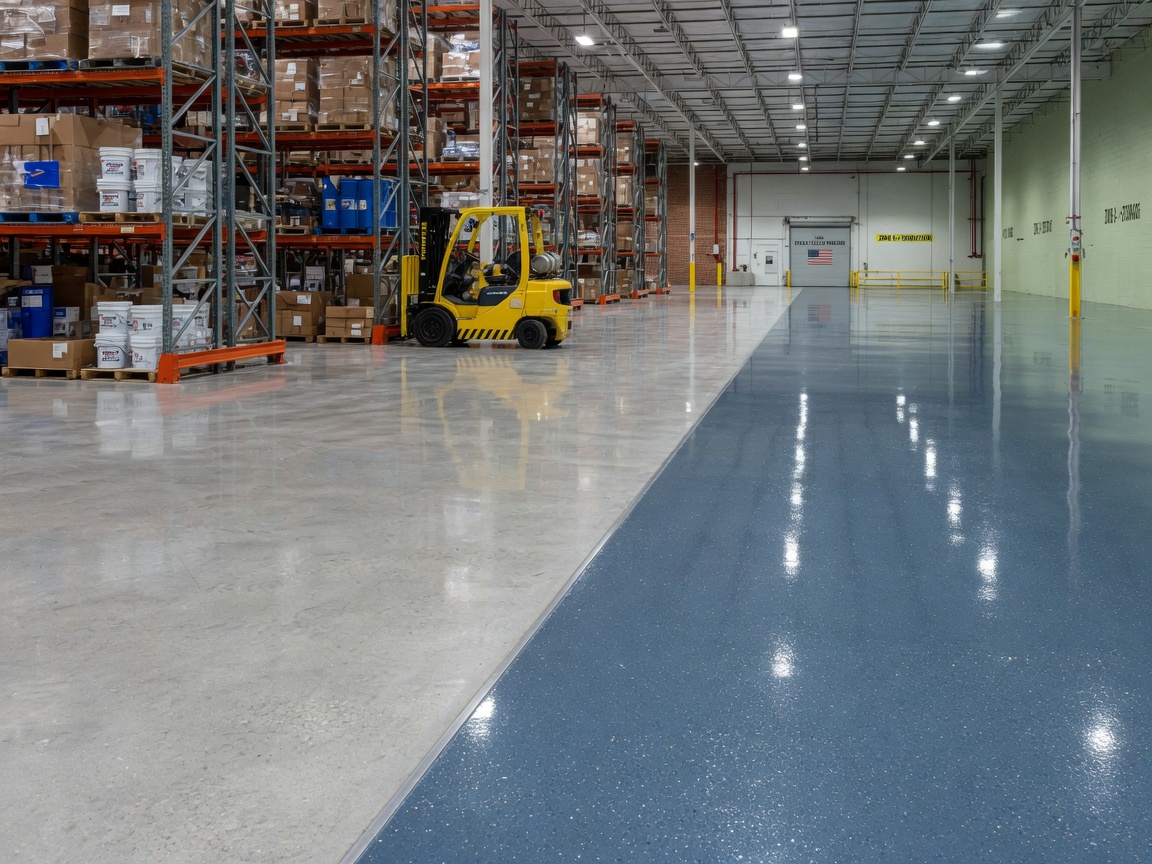
For an Atlanta warehouse or plant, the short answer is this: use polished concrete in general storage, aisles, and forklift-traffic areas where you want a durable, low-maintenance, light-reflective floor, and use epoxy or polyaspartic in loading docks, wash bays, chemical-storage, food, pharma, and high-spill production zones that need a seamless, impervious surface. Polished concrete wins on longevity and maintenance cost because it is the slab itself — nothing to chip off or peel. Epoxy wins wherever you need chemical resistance, spill containment, or an easy-to-sanitize seamless membrane. In practice, most facilities of any size don’t pick one — they spec both, mapped to how each zone actually gets used.
What Is the Difference Between Polished Concrete and Epoxy?
Polished concrete is a mechanical process, not a coating. The existing slab is ground and honed through progressively finer diamond abrasives, then chemically densified and burnished to a hard, reflective finish. There is no separate film sitting on top of the concrete — the surface you walk on is the cured slab, refined.
Epoxy floor coating is the opposite: a resin system applied over the prepared slab as a bonded film, usually in multiple coats. That film is what delivers chemical resistance, spill containment, and a seamless surface with no grout lines or pores. Polyaspartic is a related coating chemistry, often used as a fast-curing topcoat or as the full system where quick return-to-service matters.
That structural difference — refined slab versus bonded film — drives almost every trade-off below.
Which Floor Holds Up Better Under Forklift Traffic and Rack Loads?
Both systems handle forklift traffic and rack point-loads well when they’re installed on a sound slab. The distinction is in how they fail.
Polished concrete can’t chip, peel, or delaminate, because there’s no coating to separate from the substrate. Per industry flooring guidance (retrieved 2026), its abrasion resistance is excellent and it wears in place rather than wearing through. Its weakness is inherited: if the base slab cracks or spalls, that damage telegraphs straight through the polished surface, because the surface is the slab. Polishing a poor or damaged slab doesn’t hide those problems — it can highlight them.
Epoxy adds a layer of impact, abrasion, and chemical protection on top of the slab. Its failure mode is adhesion. A coating can chip under hard impact, and if moisture or a bond problem lets it delaminate, the fix isn’t a patch — the coating has to be ground off and the area recoated. Epoxy also yellows under UV exposure, which matters near dock doors and skylights but rarely deep inside a building. Neither weakness disqualifies epoxy; they’re just the things a competent installer prevents through slab prep, moisture testing, and the right system choice.
How Do Polished Concrete and Epoxy Compare for Cold Storage and Temperature Swings?
Temperature is where the two diverge most. In cold storage and any zone with wide temperature swings, thermal cycling — repeated expansion and contraction — puts stress on a coating, and the joints are where that stress concentrates. Per industry flooring guidance (retrieved 2026), that cycling raises the risk of delamination at control joints and edges over time.
Polished concrete has better dimensional stability in temperature extremes precisely because it moves with the slab instead of on top of it. For freezers, coolers, and buildings with big indoor-outdoor temperature deltas, that stability is a real advantage.
The single most important thing to flag on any coating decision is slab moisture. Moisture-vapor transmission — water vapor migrating up through the concrete — is one of the top causes of epoxy failure. If a slab is passing vapor and it isn’t tested and addressed before coating, the coating can bubble, blister, or delaminate regardless of how well it’s applied. This is why a proper moisture test comes before any epoxy goes down, and why skipping it is one of the more expensive mistakes in commercial flooring.
Polished Concrete vs. Epoxy: Side-by-Side Comparison
| Factor | Polished Concrete | Epoxy / Polyaspartic Coating |
|---|---|---|
| Best-use zones | General storage, aisles, forklift lanes, showroom/retail-back, warehouse floors | Loading docks, wash bays, chemical storage, food/pharma, high-spill production |
| Durability | Won’t chip or delaminate; wears in place; base-slab cracks telegraph through | Impact/abrasion resistant; can chip; failed coating must be ground off and recoated |
| Chemical resistance | Limited — porous to aggressive spills unless heavily densified/sealed | Strong — seamless, impervious, easy to contain and sanitize |
| Temperature stability | Better in extremes; moves with the slab; strong for cold storage | Thermal cycling stresses joints; delamination risk if not detailed for it |
| Maintenance | Periodic re-burnish and re-densify; routine cleaning | Recoat on a wear cycle; repair chips and worn areas |
| Downtime to install | Mostly dust-controlled mechanical work; often no wet cure wait | Multi-coat application plus cure time before return to service |
What Does Each Floor Cost to Own Over Time?
Up-front cost varies too much by slab condition, square footage, and system to quote here, and any contractor throwing out a single per-square-foot number without seeing the slab is guessing. The more useful way to think about it is total cost of ownership over the life of the floor.
Polished concrete generally carries lower long-term maintenance. The upkeep is periodic re-burnishing and re-densifying plus routine cleaning — no recoat cycle, because there’s no coating to wear off. Epoxy’s long-term cost includes a recoat cycle: the coating wears, and at some point the worn areas or the whole zone gets recoated. That’s the cost of the chemical resistance and seamlessness epoxy provides — it’s a fair trade in the zones that need those properties, and unnecessary spend in the zones that don’t.
Downtime is its own cost, and it favors polishing in most cases. Polishing is largely dust-controlled mechanical work with no wet cure to wait on, so a zone can often go back into service quickly. Epoxy needs cure time, and a multi-coat system means multiple passes and the downtime that comes with them — a real consideration in an operating facility where floor space is revenue space. For a fuller breakdown of what a coated floor runs, see our post on what warehouse epoxy floors actually cost in Atlanta.
Why Do Most Facilities Use Both?
Because a warehouse isn’t one environment. The open storage bays, the forklift lanes, the dock, the wash-down area, and the production line all get used differently, and forcing one floor system across all of them means overpaying in some zones and under-protecting in others.
A zoned floor spec fixes that. You put polished concrete where you want durability, reflectivity, and low maintenance — the open floor and the aisles. You put epoxy or polyaspartic where you need chemical resistance and spill containment — the dock, the wash bay, chemical storage, and any food or pharma area. The result is the right surface in each zone instead of a compromise everywhere.
That zoned approach is how we scope a commercial floor. Rather than quoting one blanket system, we walk the building, look at how each area actually gets used and what the slab is telling us, and write a spec that assigns the right system per zone. Our commercial concrete polishing work handles the storage and traffic areas; our commercial epoxy floor coating work handles the wet, chemical, and production zones. On most buildings, the honest answer isn’t polished or epoxy — it’s both, in the right places.
Frequently asked questions
Which is better for a warehouse floor, polished concrete or epoxy?
For most of a warehouse — the open storage, aisles, and forklift lanes — polished concrete is the stronger fit, because it’s durable, low-maintenance, and won’t chip or peel. Epoxy is the better choice for specific zones like loading docks, wash bays, and chemical or high-spill areas that need a seamless, chemical-resistant surface. Most warehouses end up with both, assigned by zone.
Is epoxy or polished concrete cheaper?
It depends on slab condition and the zone, so no single number applies. Generally, polished concrete carries lower long-term maintenance cost because there’s no coating to wear off and recoat, while epoxy costs more to maintain over time but delivers chemical resistance and spill containment that polished concrete can’t. The right question is cost over the life of the floor, not just the install price.
Which lasts longer under heavy forklift traffic?
Both handle forklift traffic well on a sound slab. Polished concrete can’t delaminate because it is the slab, and it wears in place rather than wearing through — its weakness is that cracks in the base slab telegraph through. Epoxy resists impact and abrasion but can chip, and a failed coating has to be ground off and recoated rather than patched.
Which floor is better for cold storage?
Polished concrete generally performs better in cold storage and buildings with wide temperature swings, because it has better dimensional stability and moves with the slab. Per industry flooring guidance (retrieved 2026), thermal cycling stresses coatings at the joints and raises delamination risk, so any epoxy used in cold zones must be detailed and moisture-tested for that environment.
Can you have both polished concrete and epoxy in one building?
Yes, and most larger facilities do. A zoned floor spec puts polished concrete in general storage and traffic areas and epoxy or polyaspartic in wet, chemical, food, pharma, and high-spill zones. That matches each surface to how the area is actually used instead of forcing one system across the whole building.
Which needs less downtime to install?
Polishing usually needs less downtime. It’s largely dust-controlled mechanical work with no wet cure to wait on, so a zone can often return to service quickly. Epoxy requires cure time and, with multi-coat systems, multiple application passes — which means more downtime, an important factor in an operating facility.