
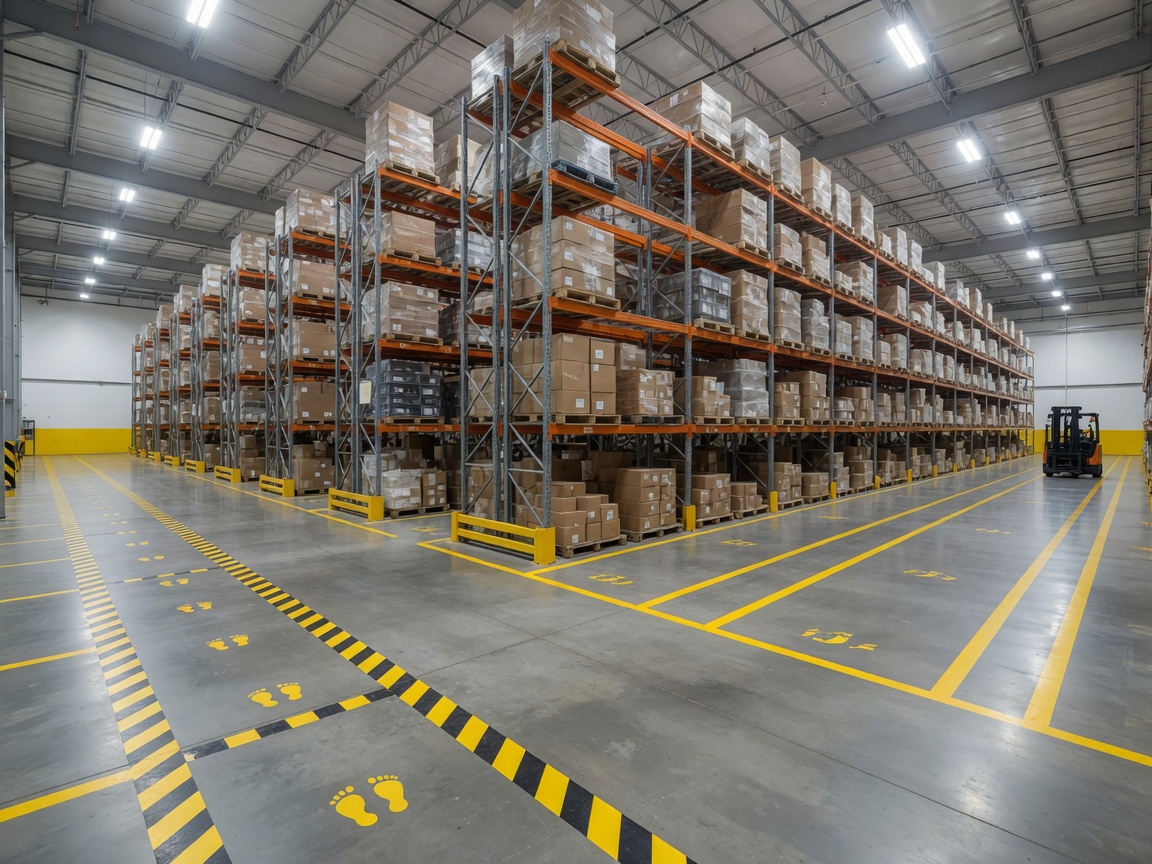
OSHA doesn't assign floor colors to specific uses, but the widely followed convention pairs yellow with aisles and traffic lanes, white with equipment and workstations, red with fire and emergency equipment, orange with dangerous machine parts, and green with safety and first-aid. Aisles have no single fixed OSHA width — the practical standard is at least 4 feet, or at least 3 feet wider than the widest load that travels them. Interior striping runs roughly $2–$4 per linear foot for paint and $3–$8 for thermoplastic, per 2026 industry pricing guides.
What Do the OSHA Floor Marking Color Codes Mean?
OSHA's color rule is narrower than most facility managers expect. Under OSHA 29 CFR 1910.144, the safety color code formally specifies only two colors: red for fire protection equipment, danger, and emergency stops, and yellow for physical hazards that could cause striking, tripping, falling, or caught-between injuries.
Everything else you see on a well-marked warehouse floor comes from ANSI Z535.1 and decades of industry practice, which OSHA accepts as a recognized means of meeting the general aisle-marking requirement. The convention most Atlanta warehouses and distribution centers follow breaks down like this:
| Color | Typical Use |
|---|---|
| Yellow | Aisles, traffic lanes, work cells, and physical-hazard boundaries |
| White | Equipment, workstations, racking footprints, and materials not otherwise color-coded |
| Red | Fire equipment, emergency stops, hazardous-material areas |
| Orange | Energized or dangerous machine parts, exposed edges of equipment |
| Green | Safety equipment, first-aid stations, eyewash and PPE locations |
| Blue | Informational — caution, work-in-progress, or materials awaiting inspection |
| Black/White (striped) | Areas to be kept clear for operational or safety reasons |
The colors themselves aren't the point — consistency is. An auditor and a forklift operator both need the same color to mean the same thing in every bay. A floor where yellow means "aisle" in one zone and "hazard" in another is a floor that will get flagged.
How Wide Do Warehouse Aisles Have to Be Under OSHA?
There is no single OSHA aisle-width number, and any contractor who quotes you one is guessing. OSHA 1910.176(a) requires that where mechanical handling equipment is used, "sufficient safe clearances shall be allowed for aisles" and that aisles be kept clear and in good repair — but it deliberately doesn't fix a dimension.
The practical standard the industry works to is straightforward: an aisle should be at least 4 feet wide, or at least 3 feet wider than the widest piece of equipment or load that travels it — whichever is greater. A pallet jack aisle and a reach-truck aisle are not the same width, and the marking should reflect the equipment that actually runs in each lane.
Line width itself typically runs 2 to 6 inches. Wider lines (4–6 in) read better at a distance and hold up longer under traffic; narrower lines suit tighter work-cell markings. What matters more than the exact width is that the lines are unbroken, square at the corners, and continuous enough that an operator reads the lane at speed, not up close.
If you're laying out lanes from scratch — new tenant fit-out, a re-racking project, a line move — the marking plan should be drawn against the actual travel paths and equipment before a single line goes down. Our warehouse and facility line striping work starts with that layout step, because a floor striped to the wrong plan is more expensive to fix than to mark correctly the first time.
What Does Warehouse Floor Striping Cost Per Foot?
Interior striping is priced by the linear foot, and the number moves with the material and the condition of the slab. These are published 2026 industry pricing ranges, retrieved August 2026 — not a Southeast Commercial Services quote, since every floor is different:
| Material | Cost (published ranges) | Typical Service Life |
|---|---|---|
| Paint striping | ~$2–$4 per linear foot | Refresh every 1–3 years under forklift traffic |
| Thermoplastic | ~$3–$8 per linear foot | 5–7 years; refresh every 3–5 years under traffic |
Two things drive where you land inside those ranges. The first is material: paint is cheaper up front and easier to change when your layout shifts, which is why it suits dynamic floors and work cells that move. Thermoplastic and epoxy-based markings cost more but survive forklift wheels far longer, which pays off on fixed high-traffic aisles that won't be re-laid for years.
The second — and the one that actually determines durability — is surface prep. Prep is roughly 90% of how long a marking lasts. Paint or thermoplastic laid over a dusty, oily, or previously coated slab lifts under the first weeks of traffic no matter how good the material is. On a properly ground and cleaned floor, the same material hits the top of its service-life range. When you compare striping bids, the prep spec is where the real difference between a two-year floor and a five-year floor hides.
For floors that also need a coating — chemical resistance, dust control, or a finished look — striping is often integrated into an epoxy floor coating so the lines sit within the coating system rather than on top of it, which extends their life further.
Why Atlanta Facilities Stripe Around a Running Production Schedule
The hard part of interior striping is rarely the marking — it's doing it without stopping the operation. Metro-Atlanta distribution centers, third-party logistics floors, and manufacturing plants can't shut down a shift so a crew can lay lines and wait on cure times.
That's why warehouse striping gets phased or run off-shift. A floor gets sectioned so one zone is marked and curing while the rest of the operation keeps moving, or the crew works nights and weekends against your production calendar. Cure and dry times get planned around when equipment actually rolls over the lines, not around when it's convenient for the crew.
For a working Atlanta facility, that scheduling discipline is the difference between a marking project that costs you a day of throughput and one that costs you nothing but the striping itself.
Frequently asked questions
Does OSHA require yellow for warehouse aisles?
Not explicitly. OSHA 1910.144 only formally assigns red and yellow to specific hazard categories, and 1910.176(a) requires aisles to be marked and kept clear without naming a color. Yellow for aisles is the ANSI Z535.1 convention that OSHA accepts as a recognized method — it's the industry standard, not a coded mandate.
What is the minimum aisle width in a warehouse?
There's no single OSHA number. The practical standard is at least 4 feet, or at least 3 feet wider than the widest load or piece of equipment that travels the aisle, whichever is greater. Aisle width should be set by the equipment that actually runs in each lane.
How wide should floor marking lines be?
Typically 2 to 6 inches. Wider lines (4–6 in) read better at distance and last longer under traffic; narrower lines suit tighter work-cell and equipment markings. Continuity and clean corners matter more than the exact width.
How often does warehouse striping need to be redone?
Under forklift traffic, paint markings generally need a refresh every 1–3 years and thermoplastic or epoxy-based markings every 3–5 years, per 2026 industry guidance. Surface prep quality is the biggest factor — a properly prepped floor holds its lines toward the top of that range.
Is paint or thermoplastic better for a warehouse floor?
It depends on the floor. Paint is cheaper and easier to change, which suits layouts that move. Thermoplastic costs more but survives forklift traffic far longer, which pays off on fixed high-traffic aisles. Many facilities use both — paint for dynamic zones, thermoplastic for permanent lanes.
Can striping be done without shutting down the warehouse?
Yes. Interior striping is routinely phased or run off-shift — the floor is sectioned so one zone cures while the rest of the operation keeps running, or the crew works nights and weekends against your production schedule so throughput isn't interrupted.