
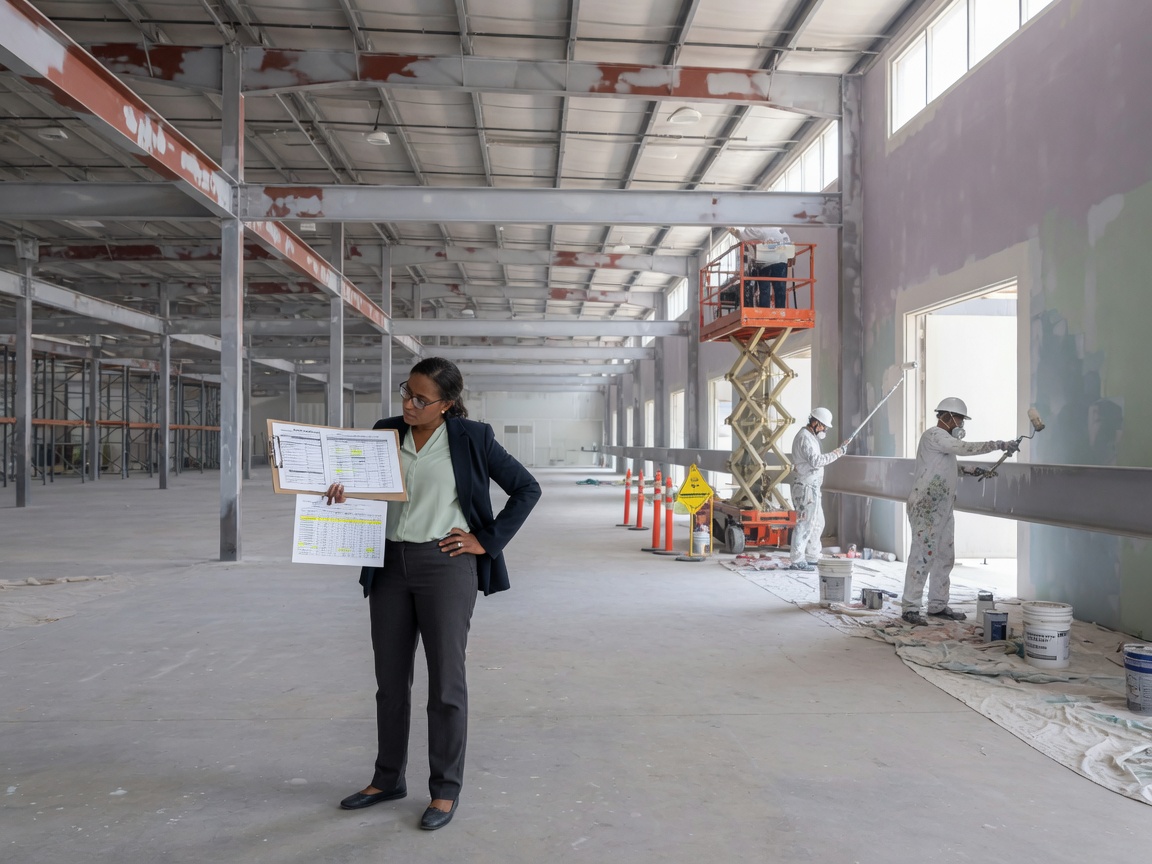
To spec a large commercial painting or industrial coating project so bids are actually comparable, your RFP has to pin six things: the surface-prep standard (by SSPC/AMPP designation), the exact coating system and number of coats, the target dry film thickness (DFT) per coat, measurable acceptance criteria (DFT verified per SSPC-PA 2, adhesion per ASTM D3359), a containment-and-operations plan, and warranty terms tied to documented prep and thickness. Leave any of those out and the bids come back priced on different scopes — at which point a "low" bid usually just means a thinner system you can't see until the coating starts failing.
Why "Get Three Quotes" Falls Apart at Facility Scale
The standard advice — get three quotes and pick the middle one — works for repainting a break room. It breaks down the moment you're coating 200,000 square feet of warehouse deck, a tank farm, or the exterior of an occupied high-rise. If you're scoping work at that size, our commercial & industrial painting team sees the same pattern on nearly every large coating project that goes out to bid.
Here's the mechanism. When your RFP describes the outcome ("paint the warehouse interior") instead of the system, each bidder fills in the blanks with their own assumptions. One prices a single coat over a quick solvent wipe. Another prices two coats over an abrasive blast. Both are answering your RFP honestly. They are not bidding the same job.
The spread you see isn't three prices for one scope. It's three different scopes wearing one job title. The cheapest number almost always corresponds to the thinnest prep and the fewest mils on the wall — decisions buried where you can't audit them at bid time, and won't discover until the coating fails early.
The fix isn't more quotes. It's pinning the variables so every bidder is forced to price the identical system, and any who want to cut corners have to do it in writing where you can see it.
The Six Spec Elements That Make Bids Comparable
A comparable RFP nails down six things. Miss one and you've reopened a lane for bidders to differ without disclosing it.
- Surface-prep standard — the SSPC/AMPP designation, not "clean and prep."
- Coating system — exact manufacturer, product, and number of coats.
- Dry film thickness (DFT) — target mils per coat and total.
- Acceptance criteria — how prep, thickness, and adhesion get verified, and against what standard.
- Containment and operations plan — how they work around your production.
- Warranty terms — what's covered, for how long, and what voids it.
The first four turn the coating from a promise into a measurable deliverable. The fifth protects your operation while the work happens. The sixth makes the whole thing enforceable after the crew leaves. The rest of this guide walks each one.
Surface Prep: The Biggest Hidden Cost Variable
Surface preparation is where most of the price spread lives, and it's the single element buyers most often leave vague. Prep can be the largest line item in a coating project — and it's invisible once the topcoat goes on, so it's the easiest place for a low bidder to quietly save money.
The industry standardized these levels so they don't have to be argued case by case. The definitions come from SSPC (now AMPP, following the 2021 merger of SSPC and NACE). Three you'll reference most:
- SP1 — Solvent Cleaning. Removal of oil, grease, and soluble contaminants with solvent or detergent. It's a cleaning step, not a profile step — you almost always pair it with a mechanical or abrasive method, never rely on it alone for a high-performance system.
- SP6 — Commercial Blast. Abrasive blast that removes most contaminants. Per AMPP's summary of the standard, staining, streaks, or shadows are permitted on up to 33% of each unit area of the surface. A sound, cost-effective baseline for many structural steel and industrial surfaces.
- SP10 — Near-White Blast. A more aggressive blast requiring at least 95% of each unit area to be free of all visible contaminants. Specified for immersion service, aggressive chemical exposure, and demanding industrial coating systems where early failure is expensive.
Source: AMPP, "Surface Prep Standards — A Quick Summary"; American Galvanizers Association.
Which one your facility needs depends on the substrate and the service environment — a climate-controlled office interior and a chemically exposed process structure are not the same job. On a warehouse deck or exposed steel, the standard has to be named per substrate. The point for the RFP is simpler: name the standard by its designation. "SP6 on all structural steel, SP1 on previously coated interior drywall" gives every bidder the same starting line. "Surface to be properly prepared" gives them permission to differ.
Coating System and DFT: Spell Out the Product and the Mils
Once prep is pinned, specify the coating system exactly: manufacturer, product line, and number of coats — primer, intermediate, topcoat as applicable. "Two coats of quality epoxy" is not a system. "[Manufacturer] [product], one primer coat and two topcoats" is.
Then specify dry film thickness — the target mils each coat should measure once cured. This is what governs whether the system performs to its rating. Coatings are engineered to a thickness window: too thin and you lose the barrier and service life you paid for; too thick and you can get cracking, solvent entrapment, or adhesion problems.
Per ASTM D7091, specifications stipulate minimum and maximum DFT per layer, and high-performance coating manufacturers warranty their systems based on the specified per-layer thickness being achieved. That's the leverage point: the manufacturer's warranty is contingent on hitting the DFT you specify. If the RFP doesn't state the DFT, no one is accountable to it, and the manufacturer warranty you're counting on may not attach.
Write it as a range per coat and a total system minimum — for example, "primer [min]–[max] mils DFT, each topcoat [min]–[max] mils DFT, total system minimum [value] mils." There is no universal mil number to drop in here: pull the exact DFT range straight from the manufacturer's product data sheet (PDS) for the specific system you're specifying, and write those figures into the RFP. The right target is set by the product and the substrate, and the PDS is the only authoritative source for it — a number copied from another job's spec is how systems end up under- or over-applied.
Measurable Acceptance Criteria: Turn the Spec Into Something Enforceable
A spec is only as good as your ability to verify it. Acceptance criteria are the clauses that convert your requirements from aspirational to enforceable — they define how the finished work gets inspected and what passes.
Three to write in:
DFT verification per SSPC-PA 2 — "Measurement of Dry Coating Thickness With Magnetic Gages." The standard defines how thickness is measured so a reading is repeatable and not cherry-picked: a spot measurement is the average of three gauge readings taken within a 1.5-inch-diameter circle. Specifying "DFT measured and documented per SSPC-PA 2" means the numbers on the inspection report were gathered by a defined method, not by one convenient touch of a gauge.
Adhesion per ASTM D3359 — "Rating Adhesion by Tape Test." Per ASTM D3359-23, Method A (the X-cut) is used for coatings thicker than 125 µm (5 mils), and Method B (the cross-hatch) for coatings thinner than 125 µm (5 mils). Naming the method and the passing rating gives you an objective check that the coating actually bonded to the substrate.
Prep verification — require documentation that the specified prep standard was achieved before coating began (profile readings, cleanliness sign-off, photos). Prep is buried under the topcoat; if it isn't documented as it happens, it can't be proven later.
Together these three mean a dispute isn't your word against the contractor's. It's the inspection record against a published standard.
The Operations and Containment Plan: Score It, Don't Assume It
At facility scale, how the work gets done around your operation matters as much as the coating itself. Make the operations plan a scored, written line item in the RFP — not an afterthought you sort out on day one.
What to require in it:
- Phasing around production — how they'll sequence the work so your operation keeps running, including which areas go when.
- Overspray, dust, and debris containment — how they'll protect the air, adjacent areas, and finished surfaces.
- Off-hours and shift work — availability to work nights, weekends, or planned shutdowns where production can't be interrupted.
- Protecting inventory and equipment — masking, tenting, and moving or covering what stays in place.
- Surface prep wash-down — any pressure wash-down needed to clean surfaces before coating is scoped here, as a prep line item inside the painting work.
A bidder with facility experience will answer these in specifics — crew sizes, containment methods, a phasing map. A bidder who's mostly done smaller work will answer in generalities. That contrast is exactly what you want to surface before you sign, and it's why the ops plan gets scored alongside price.
Occupied Facilities: Low-VOC Selection and Reoccupancy
If people are working in or near the space during or right after painting, coating selection and reoccupancy timing belong in the spec.
Volatile organic compound (VOC) content drives both odor and the low-emission profile of a coating. The EPA sets a category ceiling on VOC content under the National VOC Emission Standards for Architectural Coatings — the AIM Rule, 40 CFR Part 59, Subpart D. Per that rule, flat coatings are capped at 250 g/L and nonflat coatings at 380 g/L of VOC, measured excluding water, exempt compounds, and colorant added to tint bases. Those are category ceilings, not target values — many modern low-VOC and zero-VOC products come in well below them.
For an occupied office, hospital, school, or a warehouse that can't fully shut down, specify low-VOC products by category and require the contractor to state reoccupancy timing — how long after application before the space is safe to reoccupy for normal use. On an occupied building shell — say exterior repaint or an occupied high-rise — the same discipline applies to odor drift and access. That's a schedule input your facility team needs, not a detail to discover after the fact.
Warranty and What Voids It
A warranty is only worth what the documentation behind it can prove. Tie yours to the two things that actually determine coating performance: documented surface prep and achieved DFT.
This is the reason the acceptance criteria above aren't busywork. Manufacturer system warranties are written against the specified prep standard and per-layer thickness being met. If prep wasn't documented and DFT wasn't measured per SSPC-PA 2, you may have a warranty on paper that has no evidence to stand on when you try to invoke it. Require, in the contract, that the prep records and the DFT inspection report are deliverables — handed over at closeout as the backing for the warranty.
How to Level the Bids Once the Spec Is Pinned
With the six elements specified, every bid is now priced on the same system. Now you can level them fairly:
- Normalize scope first. Confirm each bidder priced the exact prep standard, coating system, coats, and DFT you specified. Any bid that substituted a different product, fewer coats, or a lighter prep is bidding a different job — set it aside or send it back to re-bid the specified scope.
- Then weigh qualifications, not price alone. Relevant facility references, the strength and specificity of the operations plan, and demonstrated experience at your scale. A contractor who's coated occupied plants before is worth more than a few percent on the number.
- Read the price spread as information. Once scope is genuinely identical, an outlier low bid is a flag to investigate — usually a missed line item or an assumption that hasn't surfaced — not automatically the best value.
Price matters. But at facility scale it's the last screen, after scope is normalized and qualifications are weighed — because the expensive mistake isn't overpaying by a few percent, it's recoating in three years.
A Copy-Ready RFP Scope-of-Work Skeleton
Drop this structure into your RFP and fill the brackets. It forces every bidder onto the same system.
- 1. Surface Preparation — Prep standard by SSPC/AMPP designation per substrate (e.g., "SP6 Commercial Blast on all structural steel; SP1 Solvent Cleaning on previously coated interior surfaces"). Prep to be documented before coating.
- 2. Coating System — Manufacturer, product line, and number of coats per substrate (primer / intermediate / topcoat as applicable). No substitutions without written approval.
- 3. Dry Film Thickness (DFT) — Target mils per coat and total system minimum, taken from the specified product's manufacturer product data sheet (PDS). Fill these brackets with the PDS values for your chosen system — do not carry a number over from another spec.
- 4. Acceptance Criteria — DFT measured and documented per SSPC-PA 2; adhesion tested per ASTM D3359 (state method and passing rating); prep verification documented.
- 5. Containment & Operations Plan — Production phasing, overspray/dust containment, off-hours availability, inventory/equipment protection, and any prep wash-down. Scored line item.
- 6. Warranty — Term, coverage, and exclusions; contingent on and backed by the prep records and DFT inspection report delivered at closeout.
- 7. Schedule — Start/finish, phasing milestones, low-VOC product selection and reoccupancy timing for occupied areas.
Frequently asked questions
What should a commercial painting RFP or scope of work actually include?
Six technical elements, at minimum: the surface-prep standard (by SSPC/AMPP designation), the exact coating system and number of coats, the target dry film thickness per coat, measurable acceptance criteria (DFT per SSPC-PA 2, adhesion per ASTM D3359), a containment-and-operations plan, and warranty terms tied to documented prep and thickness. These force every bidder to price the same system instead of filling in the blanks with their own assumptions.
Why are my three painting bids so different in price — and how do I compare them fairly?
Usually because your RFP described the outcome, not the system, so each bidder priced a different scope — a thinner prep or fewer coats reads as a lower price. To compare fairly, pin the six spec elements above, then confirm every bid priced that exact system before you look at the number. Once scope is genuinely identical, a low outlier is a flag to investigate, not automatically the best value.
What is the difference between SSPC SP1, SP6, and SP10 surface prep, and which does my facility need?
Per AMPP's summary of the SSPC standards: SP1 (Solvent Cleaning) removes oil and grease and is a cleaning step, not a profile step; SP6 (Commercial Blast) is an abrasive blast that permits staining or streaks on up to 33% of each unit area; SP10 (Near-White Blast) requires at least 95% of each unit area to be free of visible contaminants. Which one you need depends on the substrate and service environment — SP6 is a common baseline for structural steel, SP10 is for immersion and aggressive chemical exposure. Have the specifying contractor match the standard to each substrate.
How do I verify a contractor actually applied the coating thickness (DFT) they were paid for?
Require DFT to be measured and documented per SSPC-PA 2, "Measurement of Dry Coating Thickness With Magnetic Gages," where a spot measurement is the average of three gauge readings within a 1.5-inch-diameter circle. Make that inspection report a contract deliverable at closeout. It's also what your manufacturer system warranty is written against — per ASTM D7091, high-performance coating warranties depend on the specified per-layer thickness being achieved.
How do I keep my plant or office operating while it's being painted, and can that be written into the contract?
Yes — make the operations and containment plan a scored, written line item in the RFP. Require production phasing, overspray and dust containment, off-hours or shift availability, and protection of inventory and equipment. For occupied spaces, specify low-VOC products (the EPA sets category ceilings under the AIM Rule, 40 CFR Part 59, Subpart D — 250 g/L for flat and 380 g/L for nonflat architectural coatings) and require the contractor to state reoccupancy timing so your team can plan around it.