
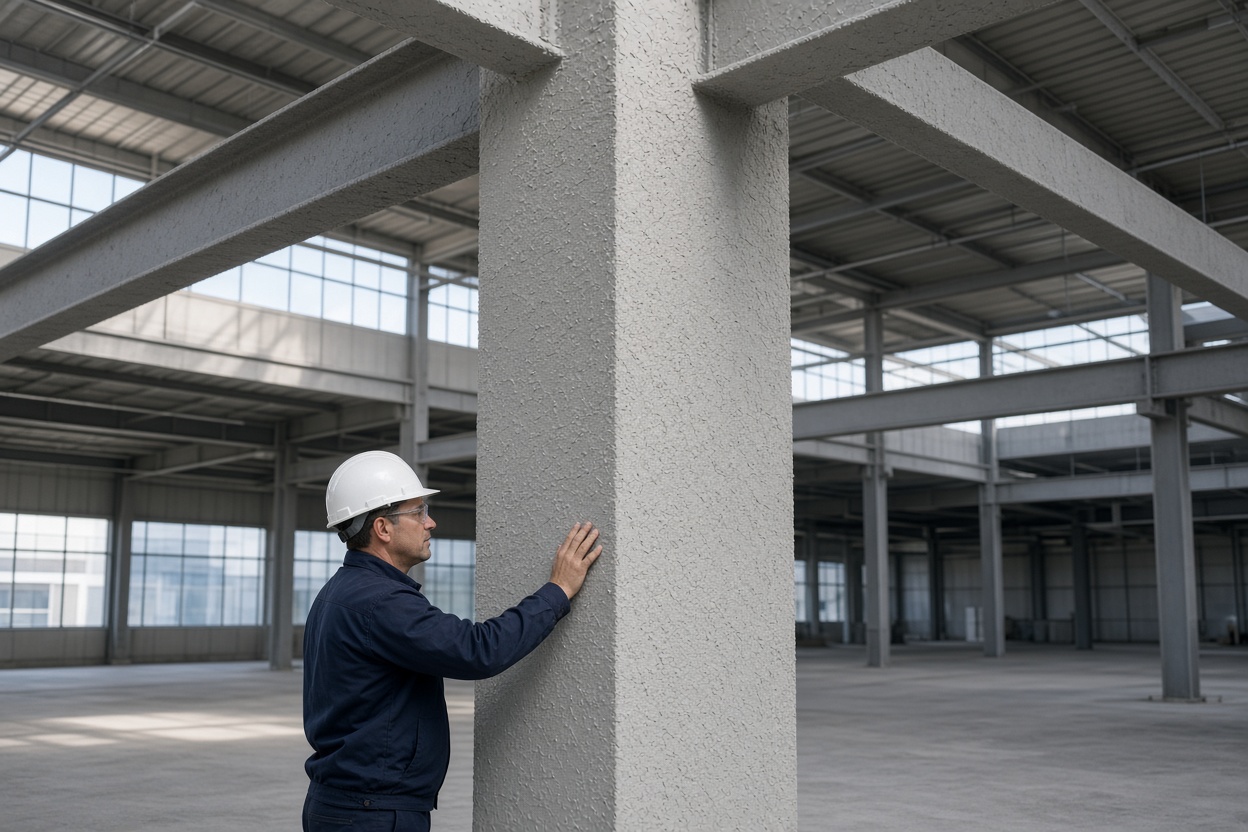
If your building has exposed fire-rated structural steel — a warehouse, a plant, a parking deck, a mixed-use frame — the thin coating on that steel is doing one of the most consequential jobs in the building, and it’s the one most owners never think about until an inspector points at a damaged beam. Here’s the straight answer to the three questions facility managers actually ask: inspect the coating periodically on a manufacturer-driven schedule (there is no fixed code interval), treat any damage, thinning, moisture, or penetration as a threat to the rating, and understand that a damaged area can usually be recoated to the manufacturer’s approved system — but certifying the fire rating is the job of the Authority Having Jurisdiction and a third-party special inspector, not the painter. That’s the exact line our industrial and protective coatings work stays on.
What intumescent fireproofing is — and why a thin coating carries the rating
Intumescent fire-resistant coatings are thin-film coatings that char and expand when heated in a fire, forming an insulating layer that slows heat transfer into the structural steel so it retains its load-bearing capacity for a set period. Steel loses strength as it heats; the coating buys the rated time the building’s fire-resistance design depends on.
That rated time is established by a standard fire test. The fire resistance of a steel assembly is proven by the ASTM E119 standard fire test (and the technically equivalent UL 263) — the recognized test methods for fire tests of building construction and materials (ASTM E119-19; UL 263). Ratings are expressed in hours, commonly 1 to 3 hours for structural steel assemblies. The critical point for an owner: the coating as installed has to match the tested and listed assembly, at the specified thickness, to actually carry that rating. A coating that looks fine but is damaged, thin, or incorrectly topcoated may no longer be the assembly that was tested.
How often should you inspect it?
This is where a lot of bad advice circulates, including specific intervals presented as if a code sets them. It doesn’t. There is no single code-mandated reinspection interval for intumescent coatings in service. Manufacturers and fireproofing specialists recommend periodic condition inspection, with the interval set by the coating manufacturer’s product guidance and tightened in high-impact, high-humidity, or damage-prone environments.
For a facility manager, that translates into a practical routine rather than a magic number: a recurring visual condition walkdown of the exposed fire-rated steel, looking for the failure modes below, on a cadence that reflects how harsh the environment is. A climate-controlled office frame and a humid, forklift-heavy warehouse don’t need the same frequency. Anchor the schedule to the manufacturer’s listed guidance for the specific product on your steel, document each walkdown, and tighten the interval anywhere the steel takes abuse. The goal is simple: catch damage while it’s a touch-up, not after it’s a code finding.
What degrades or voids the rating
Because the rating depends on the coating staying intact at its specified thickness, anything that removes, thins, or compromises the film is a compliance problem, not a cosmetic one. Film thickness is the controlling variable. These are the failure modes an FM should be looking for on every walkdown:
| Failure mode | What it looks like / where it happens |
|---|---|
| Mechanical damage & abrasion | Scrapes, gouges, and worn spots on columns and low beams in traffic lanes |
| Impact at grade / high-traffic areas | Forklift, pallet, and equipment strikes on columns near docks and aisles |
| Moisture intrusion & corrosion under the film | Staining, blistering, rust bleed; NIST identifies moisture as a primary enemy of the coating |
| Over-thin application | Areas below the specified dry film thickness — may look coated but under-protect |
| Incompatible or excessive topcoats | Decorative or maintenance coats that aren’t part of the listed system can impair intumescence |
| Unrepaired penetrations | Old anchor holes, removed attachments, and service penetrations left open in the film |
| Trades drilling into / hanging loads from rated members | New conduit, signage, or equipment fastened to protected steel — breaches the coating |
NIST’s work on fire protection of structural steel is blunt about the stakes: damage and service penetrations must be fixed because they compromise the fire rating, and topcoat damage is a leading cause of degradation. The practical rule for facilities teams is that no new hole or hung load goes into protected steel without a plan to restore the coating — and that a “small” breach on a rated member is still a breach of the rating.
What the code requires — and who certifies it
During construction, these coatings carry a formal special-inspection requirement. Under the 2021 International Building Code §1705.16, mastic and intumescent fire-resistant coatings require special inspection in accordance with AWCI Technical Manual 12-B, performed during construction (IBC 2021 §1705.16). AWCI 12-B governs the field dry-film-thickness testing that proves the coating was applied to its specified thickness; where an individual measured thickness reading falls below 80% of the specified thickness, it must be corrected (AWCI 12-B, as referenced in ICC-ES ESR-3874, 2025). That 80%-per-reading rule is the clearest illustration of why thickness — not appearance — is what the rating rides on.
Here is the boundary every owner should be clear on: this construction-phase special inspection, and any certification of a fire rating, are the responsibility of the AHJ and a qualified third-party special inspector — not the coatings contractor. An industrial coatings firm applies the product, preps and recoats to the manufacturer’s approved system, and documents what it did. It does not, and should not, issue a fire-rating certification. Southeast Commercial Services performs coating application and approved recoat and touch-up only, and certifies no fire ratings. Anyone who tells you their paint crew “certifies” your fireproofing is describing a job that doesn’t belong to them.
Recoat and touch-up vs. a listed specialty applicator
This is the decision that actually sits on a facility manager’s desk when a walkdown turns up damage: do we touch this up, or does it need a specialty firm and an inspector? The honest dividing line is whether the work maintains an existing rated system or re-creates the rated assembly.
When recoat / touch-up is the right scope
Localized, in-kind repair of an otherwise-intact installation — abrasions, impact marks, small areas of missing or thin coating, a few penetrations to fill — is maintenance of an existing system. A qualified industrial and protective-coatings contractor can prep the area correctly, apply the coating manufacturer’s approved repair product, and restore the specified dry film thickness. This is the everyday work of keeping rated steel in the condition it was inspected in, and it’s the scope SECOMM operates in.
When it needs a listed specialty applicator (and the AHJ)
Some situations go beyond touch-up: re-establishing the original tested assembly, recoating large areas or full members to a listed system, a product change, or any situation where IBC special inspection applies. That work calls for a manufacturer-listed specialty applicator and brings the AHJ’s third-party special inspector back into the picture. When you’re re-creating the rated assembly rather than maintaining it, certification and inspection aren’t optional, and they aren’t the coatings contractor’s call.
| Situation | Typical path |
|---|---|
| Localized abrasion, impact marks, small thin/missing areas | Recoat / touch-up to the manufacturer’s approved repair system |
| Filling old penetrations in otherwise-intact coating | Recoat / touch-up, restoring specified film thickness |
| Re-establishing the original tested assembly | Listed specialty applicator + AHJ / third-party special inspection |
| Recoating large areas or full members to a listed system | Listed specialty applicator + special inspection |
| Product change or any work triggering IBC special inspection | AHJ-governed; special inspection per IBC §1705.16 / AWCI 12-B |
If you’re maintaining protective and industrial coatings across a facility, fireproofing touch-up usually travels with the rest of the steel-coating program. For the broader protective-coating scope on tanks, structural steel, and process equipment, see our industrial tank and steel coating work — and when a repair crosses into rated-assembly territory, the right move is to loop in the AHJ and a listed applicator rather than treat it as ordinary paint.
Frequently asked questions
How often should intumescent fireproofing be inspected?
There is no single code-set reinspection interval for intumescent coatings in service. Manufacturers and fireproofing specialists recommend periodic condition inspection, with the interval set by the coating manufacturer’s product guidance and tightened in high-impact, high-humidity, or damage-prone environments. The practical approach for a facility manager is a routine visual condition walkdown of exposed fire-rated steel — looking for damage, cracking, moisture, and penetrations — on a schedule driven by how harsh the environment is, with the manufacturer’s listing as the governing reference.
What voids or degrades a steel fire rating?
The fire rating depends on the coating staying intact at its specified thickness, so anything that removes, thins, or compromises the film can degrade it: mechanical damage and abrasion, impact at grade or in high-traffic areas, moisture intrusion and corrosion under the film, over-thin application, incompatible or excessive topcoats, unrepaired penetrations, and other trades drilling into or hanging loads from rated members. NIST notes that damage and service penetrations must be fixed because they compromise the fire rating. Film thickness is the controlling variable — which is why damaged or thin areas can’t simply be painted over and ignored.
Can a painting contractor recoat intumescent fireproofing?
An industrial and protective-coatings contractor can prep and recoat or touch up damaged areas to the coating manufacturer’s approved repair system — surface preparation, the correct product, and the specified dry film thickness. What a coatings contractor does not do is certify a fire rating. Where the work requires rebuilding the original tested assembly, a manufacturer-listed applicator, or IBC special inspection, that is the domain of the Authority Having Jurisdiction and a qualified third-party special inspector. Southeast Commercial Services performs coating application and approved recoat and touch-up, and certifies no fire ratings.
What does the code require for intumescent fireproofing inspection?
Under the 2021 International Building Code §1705.16, mastic and intumescent fire-resistant coatings require special inspection in accordance with AWCI Technical Manual 12-B, performed during construction (IBC 2021 §1705.16). AWCI 12-B governs field dry-film-thickness testing; where an individual measured thickness reading falls below 80% of the specified thickness, it must be corrected (AWCI 12-B, as referenced in ICC-ES ESR-3874, 2025). This construction-phase special inspection and any fire-rating certification are the responsibility of the AHJ and a qualified third-party special inspector.
How is the fire resistance of coated steel established?
The fire resistance of a structural-steel assembly is established by the ASTM E119 standard fire test (and the technically equivalent UL 263) — the recognized test methods for fire tests of building construction and materials. Ratings are expressed in hours, commonly 1 to 3 hours for structural steel assemblies. The coating as installed has to match the tested and listed assembly, at the specified thickness, to carry that rating.
What’s the difference between recoat and a specialty applicator?
Recoat and touch-up means repairing localized damage to the manufacturer’s approved system on an existing, otherwise-intact installation — the right scope for abrasions, impact marks, and small areas of missing or thin coating. A manufacturer-listed specialty applicator is required when the original tested assembly has to be re-established, when large areas or full members need recoating to a listed system, or when IBC special inspection applies. The honest dividing line is whether the work is maintaining an existing rated system or re-creating the rated assembly — and when it’s the latter, special inspection and certification belong to the AHJ and a third-party inspector.