
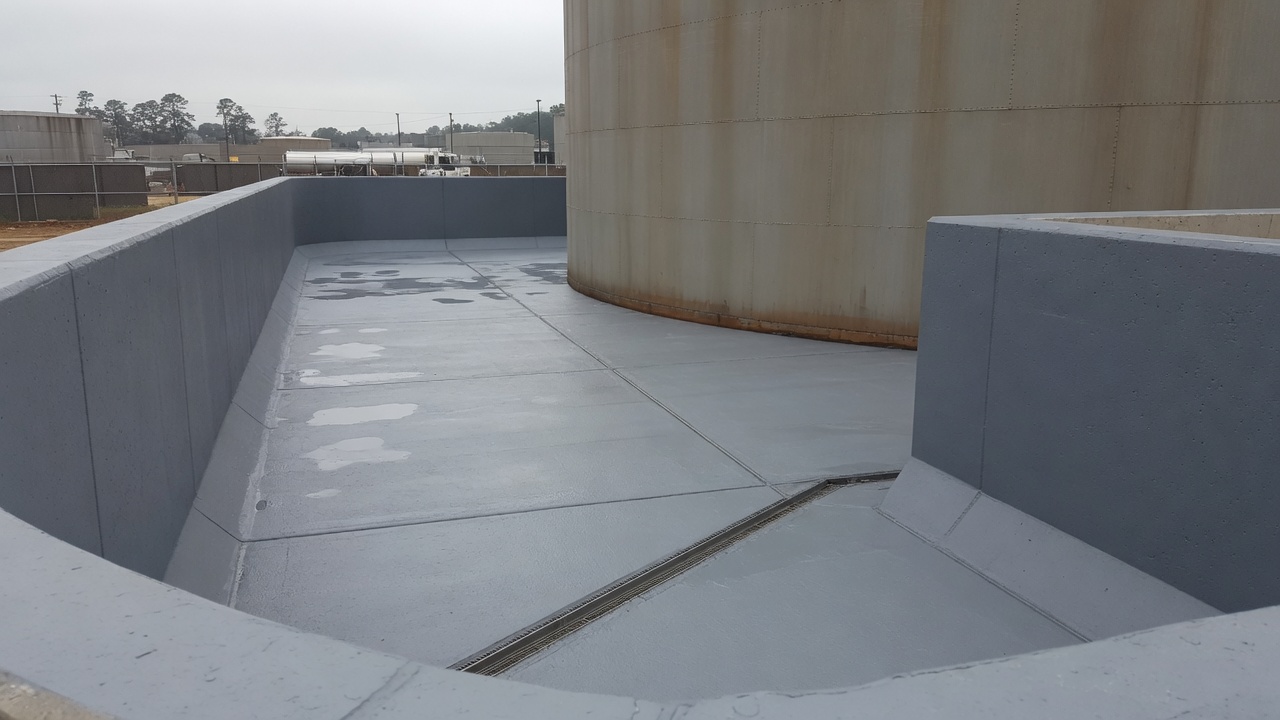
“Sufficiently impervious” has no EPA permeability number. The SPCC rule does not set a hydraulic-conductivity figure or a retention-time threshold — it leaves the design to the owner/operator and the certifying Professional Engineer using good engineering practice. For a coating contractor, that has one practical consequence: the coating is built to the engineer’s written spec, not to a universal EPA standard. Southeast Commercial Services applies secondary containment coatings to the system your PE specifies, and documents what was applied — we do not certify SPCC compliance.
If you are scoping a containment coating for an Atlanta tank farm, manufacturing plant, fuel depot, or transformer pad, this article lays out what the standard actually requires, which coating specs buyers ask about, and where the applicator’s responsibility starts and stops.
What SPCC secondary containment is, and why it exists
The Spill Prevention, Control, and Countermeasure (SPCC) rule exists to keep an oil discharge from reaching navigable waters. The mechanism is containment: if a tank fails, the released product has to be caught and held in place long enough to be detected and cleaned up before it escapes the site.
Under the EPA’s SPCC rule, 40 CFR 112.8(c)(2), a bulk storage installation must “provide a secondary means of containment for the entire capacity of the largest single container and sufficient freeboard to contain precipitation.” That is the sizing logic behind the dikes, berms, and coated containment pads you see around tank farms: enough volume for the biggest single container, plus headroom for rainfall.
Containment is a system — concrete, geometry, drainage control, and the coating that makes the surface hold. The coating is the layer that turns a porous concrete floor or berm into a barrier that retains the product instead of letting it soak through.
What “sufficiently impervious” actually means under 40 CFR 112
Here is the nuance that trips up most specifications. The SPCC rule requires secondary containment to be “sufficiently impervious” — but, per the EPA’s own SPCC Guidance for Regional Inspectors (Chapter 4, Secondary Containment and Impracticability), the rule does not specify permeability, hydraulic conductivity, or retention-time performance criteria. “Sufficiently impervious” does not mean indefinitely impervious; it means impervious enough to contain a discharge until the material is detected and removed.
Because there is no number, EPA places the determination on the owner/operator and the certifying Professional Engineer. Per that same guidance, the sufficiently-impervious determination is made case by case, based on good engineering practice and site-specific conditions, and is documented in the SPCC Plan — verified by the certifying PE (or by the owner/operator at qualified facilities).
So “what coating meets SPCC?” is the wrong question. The right question is “what does our PE’s spec require for this product and this containment geometry?” The coating is engineered to that answer.
Therefore the coating meets the engineer’s spec — not an EPA figure
This is the operating reality for everyone in the chain. The PE writes a spec appropriate to the stored product, the exposure, and the containment design. The coating manufacturer supplies a system with data to match. The applicator installs it to the written parameters and records what was done. No one in that chain is working to a blanket EPA permeability value, because none exists.
SECOMM’s role sits at the installation step. We take the specified coating system — the product, the film build, the prep standard, the test criteria your engineer called out — and apply it to those parameters, then hand back documentation of conformance. We do not write the spec, and we do not rule on whether the finished containment satisfies SPCC. That ruling belongs to your certifying PE.
The coating specs buyers actually ask about
Three technical parameters come up in nearly every containment-coating spec. Each answers a different question about whether the system will perform, and each is defined by a published test standard — not by an applicator’s opinion.
| Spec item | What it is | What it proves |
|---|---|---|
| Dry film thickness (DFT) | Cured coating thickness vs. the spec’s stated mils | The barrier was built to the thickness the engineer specified — too thin fails early, too thick can crack |
| Adhesion — ASTM D7234 | Pull-off adhesion strength of the coating on concrete | The coating is bonded to the substrate and will not disbond under load or product contact |
| Chemical / immersion resistance — ASTM C267 | Resistance of the surfacing to the specific stored reagent | The system holds up to the actual product it must contain, not just “chemicals” in the abstract |
| Surface preparation | Concrete surface profile and moisture control before coating | The foundation for every parameter above — prep failures void the rest |
Dry film thickness is the most basic conformance check: the cured coating has to hit the mils the spec calls for. ASTM D7234, “Standard Test Method for Pull-Off Adhesion Strength of Coatings on Concrete Using Portable Pull-Off Adhesion Testers,” is the referenced method for confirming the coating is bonded to the concrete — a containment coating that disbonds is a containment coating that leaks. ASTM C267, “Standard Test Methods for Chemical Resistance of Mortars, Grouts, and Monolithic Surfacings and Polymer Concretes,” is the reference point for whether the system resists the specific product being stored, since a coating fit for diesel may be wrong for a solvent or an acid.
Surface prep is the determinant, not the product label
The single biggest predictor of containment-coating performance is not the product — it is the concrete prep underneath it. A premium chemical-resistant coating applied over a contaminated, under-profiled, or moisture-laden slab will fail, and it will fail at the bond line, which is exactly where ASTM D7234 adhesion testing exposes the problem.
Concrete containment surfaces need the right surface profile for the specified system, and they need moisture under control — slab moisture and vapor drive are a common cause of coating failure on at-grade and below-grade containment. “Sufficiently impervious” is an outcome of prep plus application plus the right product, in that order. This is why a credible applicator treats prep, ambient conditions, and film build as the job, and treats the product data sheet as the starting constraint.
What the facility has to document
SPCC is a documentation regime as much as a physical one. The SPCC Plan must describe how secondary containment is designed, implemented, and maintained, and the certifying PE attests to it. The coating contributes a specific, bounded piece of that record.
On a SECOMM containment job, the conformance package typically covers the specified system installed, surface prep performed, DFT readings against spec, and any adhesion or inspection results called for in the spec. That is the applicator’s share of the evidence file — proof that what was specified is what was applied. It is not an SPCC certification, and it does not replace the PE’s plan or determination. It feeds them.
The boundary, stated plainly
To be unambiguous, because this is where facilities get exposed: SECOMM applies the specified coating system and documents its installation. SECOMM does not certify SPCC compliance, does not determine whether containment is “sufficiently impervious,” and does not act as the certifying Professional Engineer. Those responsibilities rest with the facility owner/operator and the PE, by rule.
A contractor who tells you their coating “makes you SPCC compliant” is misrepresenting how the rule works. Compliance is a determination about your whole containment system and plan — made by your engineer, not purchased with a coating. What you can buy from an applicator is a correctly specified coating, correctly installed, correctly documented. That is the honest scope, and it is the part that actually fails in the field when someone cuts it short.
Scheduling containment work around Atlanta operations
Containment coating in a live industrial setting — tank farms, manufacturing, fuel and oil storage, transformer containment across metro Atlanta — is as much a sequencing problem as a coatings problem. The surface has to be emptied, cleaned, and dried; prep and cure windows have to fit around production; and ambient temperature and humidity have to be inside the product’s range, which in Georgia means planning around summer humidity and cure times.
Containment coating usually runs alongside broader asset-protection work — tank coating and industrial tank painting, and other industrial-facility services such as industrial duct cleaning — so staging a containment recoat during a planned outage often makes sense. For smaller facility upkeep that keeps a site presentable and functional between major projects, commercial facility maintenance can carry the lighter scope. The throughline on all of it: we execute the specified work and document it; your engineer owns the compliance call.
Frequently asked questions
Does an SPCC secondary containment coating have to meet a specific EPA permeability number?
No. The EPA’s SPCC rule at 40 CFR 112 requires containment to be “sufficiently impervious” but does not specify a permeability, hydraulic conductivity, or retention-time number. The determination is made case by case by the certifying Professional Engineer or owner/operator using good engineering practice, so the coating is built to the engineer’s spec, not to an EPA figure.
What does “sufficiently impervious” actually mean?
It is a performance standard, not a numeric one. Per EPA’s SPCC Guidance for Regional Inspectors, it means the containment must be impervious enough to hold a discharge until the material is detected and removed, not impervious indefinitely. The certifying PE decides what that requires for your product and site.
Can a coating contractor certify that my facility is SPCC compliant?
No, and you should be cautious of any contractor who claims otherwise. SPCC compliance is a determination about your entire containment system and SPCC Plan, made by the owner/operator and certified by a Professional Engineer. A coating applicator applies the specified system and documents the installation; it does not issue a compliance ruling.
Which coating specs matter most for secondary containment?
Dry film thickness, adhesion, and chemical resistance to the stored product. Adhesion on concrete is commonly verified by ASTM D7234 pull-off testing, and chemical resistance of surfacings is referenced to ASTM C267. All three are defined by the engineer’s spec for the specific product being contained.
Why does surface preparation matter so much for containment coatings?
Because prep, not the product label, is the main driver of whether the coating holds. A chemical-resistant coating applied over a contaminated, under-profiled, or moisture-laden slab will disbond, usually at the bond line that ASTM D7234 testing checks. Getting the concrete profile and moisture right is the foundation of a “sufficiently impervious” result.
What documentation should a containment coating contractor provide?
A conformance package showing the specified system that was installed, surface prep performed, dry film thickness against spec, and any adhesion or inspection results the spec called for. This feeds the facility’s SPCC Plan but does not replace it; the certifying PE still owns the plan and the compliance determination.