
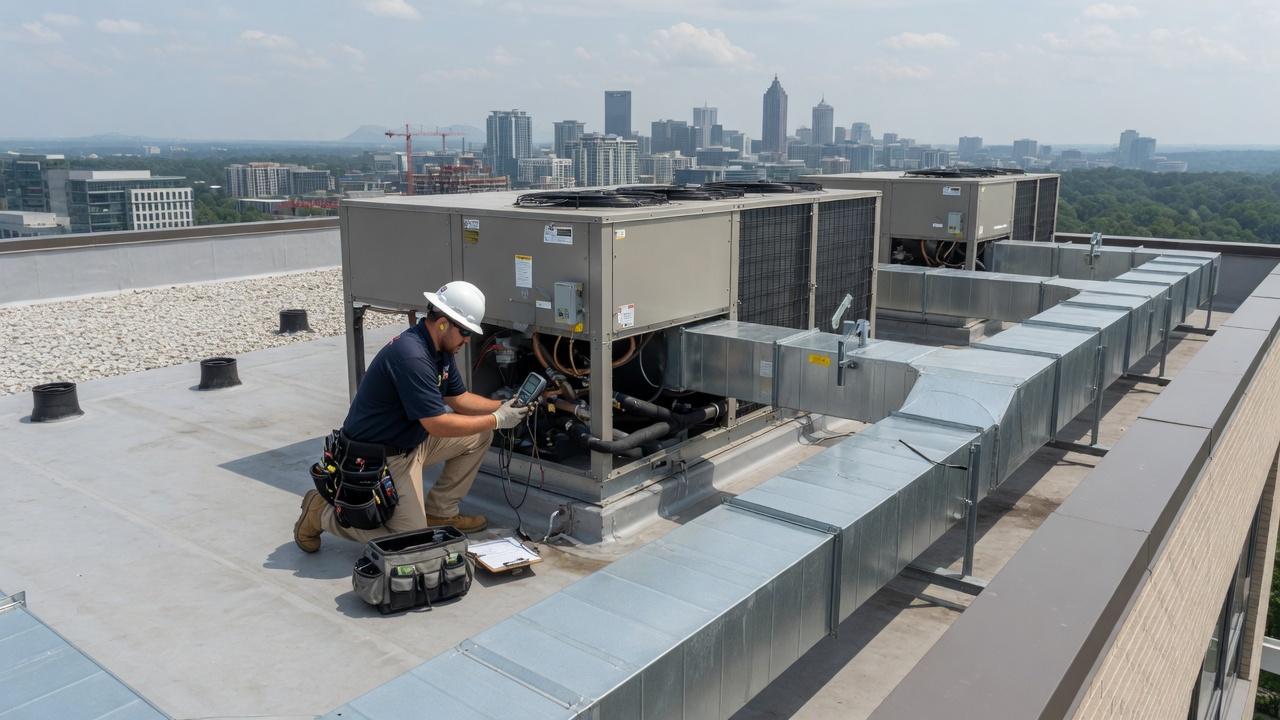
There is no fixed calendar date for commercial duct cleaning. Per NADCA's ACR, The NADCA Standard (2025 Edition), a commercial building's HVAC system should be inspected at least annually and cleaned based on what the inspection finds — not on a set schedule. In practice, that means most metro-Atlanta facilities settle into a building-type rhythm: published NADCA-ACR-informed industry guidance (as reported, 2025 Edition) puts high-fouling environments like restaurants and healthcare at roughly every 6–12 months, and low-traffic office space closer to every 2–3 years, with manufacturing and high-dust warehouses falling toward the shorter end. Atlanta's humidity and heavy pollen load push most buildings here toward the more frequent end of that inspection cadence.
The honest answer: inspect on a schedule, clean on findings
Facility managers want a number they can drop into a budget line and defend to ownership. The standards body that writes the rules for this work won't give you a flat one — and that's the answer that actually holds up.
Per NADCA's ACR, The NADCA Standard (2025 Edition), the defensible cadence is an annual inspection, with cleaning performed when the inspection findings meet the Standard's criteria. The trigger is condition, not the calendar. A building that's clean at its annual walk-through doesn't get cleaned just because twelve months passed; a building that fails the criteria at month seven gets cleaned at month seven.
That framing is what makes an interval defensible. "We clean every two years" is a guess. "We inspect annually against the ACR Standard and clean when the findings require it" is a process — and it's the sentence you want in your maintenance file when ownership or a tenant asks why.
Building-type intervals: what the ranges actually look like
Once a building has a few inspection cycles behind it, a practical rhythm emerges by building type. The following ranges are published NADCA-ACR-informed industry guidance (NADCA's ACR, The NADCA Standard, 2025 Edition, as reported) — directional intervals that real facilities tend to land on, not a substitute for the annual inspection itself.
| Building type | Typical interval (as reported) | Why |
|---|---|---|
| Restaurants, healthcare | Every 6–12 months | High fouling load, grease/biological contamination, air-quality sensitivity |
| Manufacturing, high-dust warehouses | Toward the shorter end of the range | Particulate and process dust load the system faster |
| Low-traffic office | Every 2–3 years | Low occupant density, filtered supply air, lighter load |
The exact per-building-type breakdown lives inside the ACR Standard document itself; the ranges above are the published, reported version. For how this plays out across a mixed portfolio — offices, warehouses, and production space under one manager — see our work on commercial duct cleaning and the office-specific considerations on our office duct cleaning page.
What triggers a cleaning between inspections
The annual inspection sets the baseline, but four conditions move a cleaning up regardless of where you are in the cycle:
- Visible contamination at registers, in trunk ductwork, or on coils and air-handler components.
- Confirmed or suspected microbial growth — a real concern in Atlanta's humidity, where cooling coils and drain pans stay damp.
- Post-renovation dust after any build-out, demolition, or tenant improvement that loaded the system with drywall dust and debris.
- Water intrusion — roof leaks, a flooded mechanical room, or a condensate failure that wetted insulation or ductwork.
Any one of these is a standalone reason to act, independent of the interval. Water intrusion and microbial growth in particular shouldn't wait for the next scheduled inspection.
Why "one component at a time" makes a quote defensible
Commercial HVAC isn't one object you clean in a single pass. A rooftop unit, its air handler, the cooling coil, and the supply and return ductwork are separate components, and the ACR approach assesses them separately.
How the components break down
- Air handler / rooftop unit — blower assembly, housing, and interior surfaces.
- Cooling coil and drain pan — the humidity-and-biology hot spot in an Atlanta building.
- Supply and return ductwork — the trunk lines and branches that actually move conditioned air to the space.
Assessing each component on its own is what lets you scope honestly. A coil that's fouled while the ductwork is clean doesn't justify cleaning the whole system — and a whole-system quote built from a component-by-component assessment is far easier to defend than a flat "clean the ducts" line item. On larger industrial systems with big trunk runs and plant exhaust, this component-level scoping is the core of our industrial duct cleaning work.
The Atlanta factor: humidity and pollen
Metro Atlanta buildings don't get to run on the low end of these ranges by default. Two local realities push the cadence up.
Humidity keeps cooling coils, drain pans, and nearby duct surfaces damp for long stretches of the cooling season — exactly the conditions that move "suspected microbial growth" from a footnote to a finding. Pollen loads outdoor-air intakes and filters heavily in spring, and what the filters miss ends up in the system.
Neither changes the Standard — you still inspect annually and clean on findings. What they change is the likelihood that the findings come back positive sooner, which is why Atlanta facilities tend to cluster toward the more frequent end of the published ranges rather than the relaxed end.
How to set an interval you can actually defend
Put the process on paper, not the number. The sequence that holds up under scrutiny:
- Schedule the annual inspection per NADCA's ACR Standard and keep the report on file.
- Use your building type to set the budget expectation — office on the long end, manufacturing and high-dust warehouse on the short end.
- Clean when findings meet the criteria, and document the four between-inspection triggers as standing exceptions.
- Scope every quote component by component so the spend maps to the condition.
That's a maintenance policy you can hand to ownership, a tenant, or an insurer and stand behind. For scoping an inspection across a commercial or industrial building in metro Atlanta, start with our industrial duct cleaning page.
Frequently asked questions
How often should commercial air ducts be cleaned?
Per NADCA's ACR, The NADCA Standard (2025 Edition), there isn't a fixed schedule — you inspect at least annually and clean when the inspection findings meet the Standard's criteria. In practice, published NADCA-ACR-informed guidance (as reported) ranges from roughly every 6–12 months for high-fouling buildings to every 2–3 years for low-traffic office space.
How often should HVAC ducts be cleaned in an office building?
Low-traffic office space typically lands around every 2–3 years per published NADCA-ACR-informed industry guidance (as reported, 2025 Edition), because occupant density is lower and supply air is filtered. That's still an outcome of the annual inspection, not a replacement for it. Atlanta offices may run shorter if humidity or pollen loading shows up in the findings.
Do we really need to clean ductwork if it looks fine?
Per NADCA's ACR Standard, cleaning is driven by inspection findings against defined criteria, so a system that passes doesn't need cleaning just because time has passed. The value of the annual inspection is exactly this: it keeps you from cleaning on a guess and documents why you did or didn't.
What conditions require duct cleaning before the next inspection?
Four conditions trigger action regardless of the interval: visible contamination, confirmed or suspected microbial growth, post-renovation dust, and water intrusion. Water intrusion and microbial growth in particular shouldn't wait for the next scheduled inspection. Document these as standing exceptions in your maintenance policy.
How often do manufacturing plants and warehouses need duct cleaning?
Higher-fouling environments like manufacturing and high-dust warehouses fall toward the shorter end of the published ranges (as reported, NADCA's ACR Standard, 2025 Edition), because particulate and process dust load the system faster. The annual inspection still sets the actual trigger — these buildings just tend to meet the cleaning criteria sooner.
Why does Atlanta come up in duct-cleaning frequency?
Atlanta's humidity keeps coils and drain pans damp through the cooling season, and its spring pollen load hits outdoor-air intakes and filters hard. Neither changes the NADCA Standard, but both raise the odds that an annual inspection returns findings that meet the cleaning criteria — so metro buildings tend to cluster toward the more frequent end of the published intervals.