
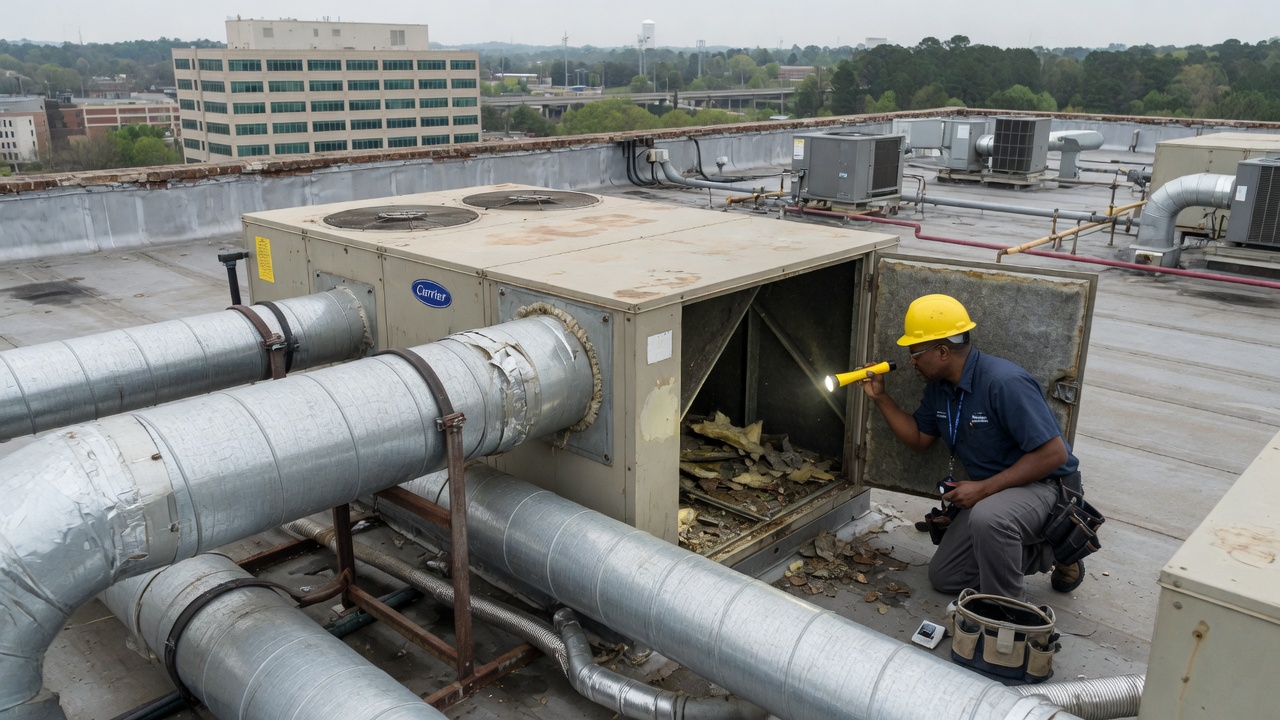
A facilities manager weighing a duct-cleaning quote against the maintenance budget is asking a fair question: is this actually worth it, or is it the HVAC equivalent of an unnecessary upsell? The honest answer — and the one that will save you money — is that commercial duct cleaning is worth it when a specific, inspectable condition calls for it, and a waste of budget when it’s sold as routine preventive maintenance. That isn’t a contrarian take; it’s the position of the U.S. Environmental Protection Agency. Here’s what the EPA actually says, the handful of conditions that genuinely justify the spend, and how a commercial building in metro Atlanta should scope the work so it pays for a real problem rather than a calendar entry.
What the EPA actually says about duct cleaning
Most “improve your indoor air quality” marketing skips the part where the federal government weighs in. The EPA’s consumer guidance, “Should You Have the Air Ducts in Your Home Cleaned?”, is blunt: the agency states that it “does not recommend that the air ducts be cleaned routinely, but only as needed.” That one sentence reframes the whole decision. The default isn’t “clean annually and skip it if money’s tight” — it’s “don’t clean unless there’s a reason to.”
The EPA goes further on the health claim that usually drives these quotes. Its guidance states plainly that “duct cleaning has never been shown to actually prevent health problems.” It also explains why routine cleaning does less than people assume: “much of the dirt in air ducts adheres to duct surfaces and does not necessarily enter the living space.” In other words, dust sitting on the inside wall of a duct is largely staying there — it isn’t all being blown into the occupied space the way a sales pitch implies.
A fair-use note before going further: the EPA’s document is written for homeowners, so it talks about “the home’ and “the living space.” The underlying principle — clean on evidence, not on a schedule — applies cleanly to a commercial building, where the HVAC systems are larger, the budgets are scrutinized harder, and the cost of an unnecessary annual clean across a big rooftop or built-up system is far higher than in a house. If anything, the as-needed logic is more important for a facility, not less.
The three conditions that do justify cleaning
“As needed” isn’t a dodge — the EPA names what “need” looks like. Its guidance says you should consider having the ducts cleaned if any of these are present:
| Condition the EPA names | What it looks like in a commercial system |
|---|---|
| Substantial visible mold | Substantial visible mold growth inside hard-surface (e.g., sheet metal) ducts or on other components of the heating and cooling system — often downstream of a coil or a water-intrusion event |
| Vermin infestation | Ducts infested with vermin — rodents or insects — which contaminate the system and are a clear removal case |
| Debris actually being released | Ducts clogged with excessive amounts of dust and debris, with particles actually being released into the occupied space — not dust merely sitting on duct walls |
The common thread is that each condition is inspectable. You can open an access panel and see mold on the sheet metal, find evidence of vermin, or observe debris blowing out of a diffuser. That’s the whole point of the as-needed standard: the trigger is something you can document, not a date on a service calendar.
The upsell the EPA explicitly warns against
If one line in the EPA’s guidance should change how you read duct-cleaning quotes, it’s this: “Do not hire duct cleaners who recommend duct cleaning as a routine part of your heating and cooling system maintenance.” The federal position isn’t neutral on the routine-maintenance pitch — it tells you not to buy it.
That creates a simple screen for any commercial provider. A contractor who quotes a blanket annual duct clean sight unseen, or who frames duct cleaning as standard preventive maintenance for the system, is selling against the EPA’s own advice. A contractor who insists on inspecting first and then scopes the work to what the assessment finds is aligned with it. We take the second posture deliberately: inspect the system, show you the condition, and clean only what’s warranted — the opposite of a routine-clean default.
What a credible commercial cleaning follows: the NADCA standard
When cleaning is warranted, the question becomes how it’s done — and here the industry has a recognized benchmark. NADCA (the National Air Duct Cleaners Association) publishes the ACR Standard, “Assessment, Cleaning, and Restoration of HVAC Systems,” which is the widely recognized industry standard for the work. Two things about it matter for a facilities buyer.
First, ACR is built around source removal — physically removing the contaminant from the system rather than masking it or relying on chemicals — which lines up with the EPA’s own emphasis that controlling the contaminant source matters more than periodic surface cleaning. Second, the standard’s name puts assessment first: you evaluate the system’s condition, then clean based on that evaluation. That’s the same inspect-first logic the EPA’s as-needed position implies, expressed as a methodology. To be clear, the ACR Standard is NADCA’s industry standard that competent cleaning follows — not a Southeast Commercial Services invention or a proprietary certification.
When a commercial buyer genuinely should act
Put the EPA’s conditions and the real-world triggers together, and the “yes, clean it” cases for a commercial facility are specific:
- Documented mold or confirmed water intrusion in or around the system — the EPA’s first condition, and a clear removal case.
- Vermin evidence inside the ductwork — the EPA’s second condition.
- Visible debris entering occupied space from diffusers or returns — the EPA’s third condition.
- Post-renovation construction dust drawn into the system — a common, concrete reason after a build-out or remodel.
- Persistent airflow loss or occupant complaints traced to the system, where an assessment confirms the ducts are the cause.
- Pre-occupancy of a long-vacant building — bringing a dormant facility back online is a sensible time to assess and clean what the assessment finds.
Notice what’s not on that list: “it’s been a year.” Every item is a documentable condition, which is exactly the bar the EPA’s as-needed standard sets. If you want a defensible interval framework by building type to pair with this decision, our companion guide walks through how often a commercial building should have its ductwork cleaned — inspect annually, clean on findings.
How Southeast Commercial Services scopes it honestly
Our approach follows the standard, not the sales script. We inspect the system first — air handlers, coils, and supply/return ductwork — and show you what’s actually there. If none of the EPA’s conditions are present, we’ll tell you the clean isn’t warranted, because recommending a routine clean is precisely what the EPA says to avoid. If a condition is present, we scope a source-removal clean to the affected part of the system, work it around your operating hours, and document the before-and-after. This is our commercial duct cleaning service; heavier process and manufacturing systems fall under industrial duct cleaning, which we keep to straightforward source-removal work. Either way, it slots into the broader facility maintenance we handle under one accountable team, so a duct assessment doesn’t become a separate-vendor project.
The bottom line for a facilities budget: duct cleaning is worth it when it fixes a documented problem, and it isn’t when it’s a line item on autopilot. The EPA’s as-needed standard, NADCA’s assess-then-clean methodology, and an inspect-first contractor all point the same direction — spend on evidence, not on a calendar.
Frequently asked questions
Is commercial duct cleaning worth it?
It’s worth it when a specific condition calls for it — and a waste of money when it’s sold as routine. The EPA’s guidance states that it “does not recommend that the air ducts be cleaned routinely, but only as needed,” and that duct cleaning “has never been shown to actually prevent health problems.” For a commercial building, the honest test is whether there’s documented mold, a vermin infestation, or debris actually entering occupied space — not whether a calendar says it’s time. Inspect first, clean what’s warranted.
What does the EPA say about when to clean air ducts?
The EPA names three conditions. Per its guidance “Should You Have the Air Ducts in Your Home Cleaned?”, you should consider cleaning if there is substantial visible mold growth inside hard-surface (e.g., sheet metal) ducts or on other system components; if ducts are infested with vermin such as rodents or insects; or if ducts are clogged with excessive amounts of dust and debris and/or particles are actually being released into the occupied space. Absent one of those, the EPA’s position is that routine cleaning isn’t recommended.
Does duct cleaning improve indoor air quality or health?
The EPA is candid here: duct cleaning “has never been shown to actually prevent health problems,” and much of the dirt in air ducts “adheres to duct surfaces and does not necessarily enter the living space.” That doesn’t make cleaning useless — when there’s real mold, vermin, or debris being released, removing the source matters — but it does mean duct cleaning should be scoped against a documented problem, not sold as a general air-quality upgrade.
How often should commercial ductwork be cleaned?
On an as-needed basis, driven by inspection — not on a fixed annual schedule. The EPA does not recommend routine cleaning. The industry approach, reflected in NADCA’s ACR Standard (Assessment, Cleaning, and Restoration of HVAC Systems), is to assess the system’s condition and clean when the assessment shows it’s warranted. For a defensible interval guide by building type, see our companion article on how often a commercial building should have its ductwork cleaned.
How can I tell if a duct cleaning company is legitimate?
Watch for the upsell the EPA explicitly warns against: “Do not hire duct cleaners who recommend duct cleaning as a routine part of your heating and cooling system maintenance.” A credible commercial provider inspects first, scopes the work to what the assessment actually finds, and follows a recognized source-removal methodology such as NADCA’s ACR Standard — rather than quoting a blanket annual clean sight unseen.
When should a commercial building actually have its ducts cleaned?
The clear triggers are a documented problem: substantial visible mold inside the ducts or on components, a vermin infestation, debris being released into occupied space, post-renovation construction dust in the system, confirmed water intrusion, a persistent airflow loss, occupant complaints traced to the system, or bringing a long-vacant building back into occupancy. Each of those is a specific, inspectable reason — which is exactly the standard the EPA’s as-needed position sets.