
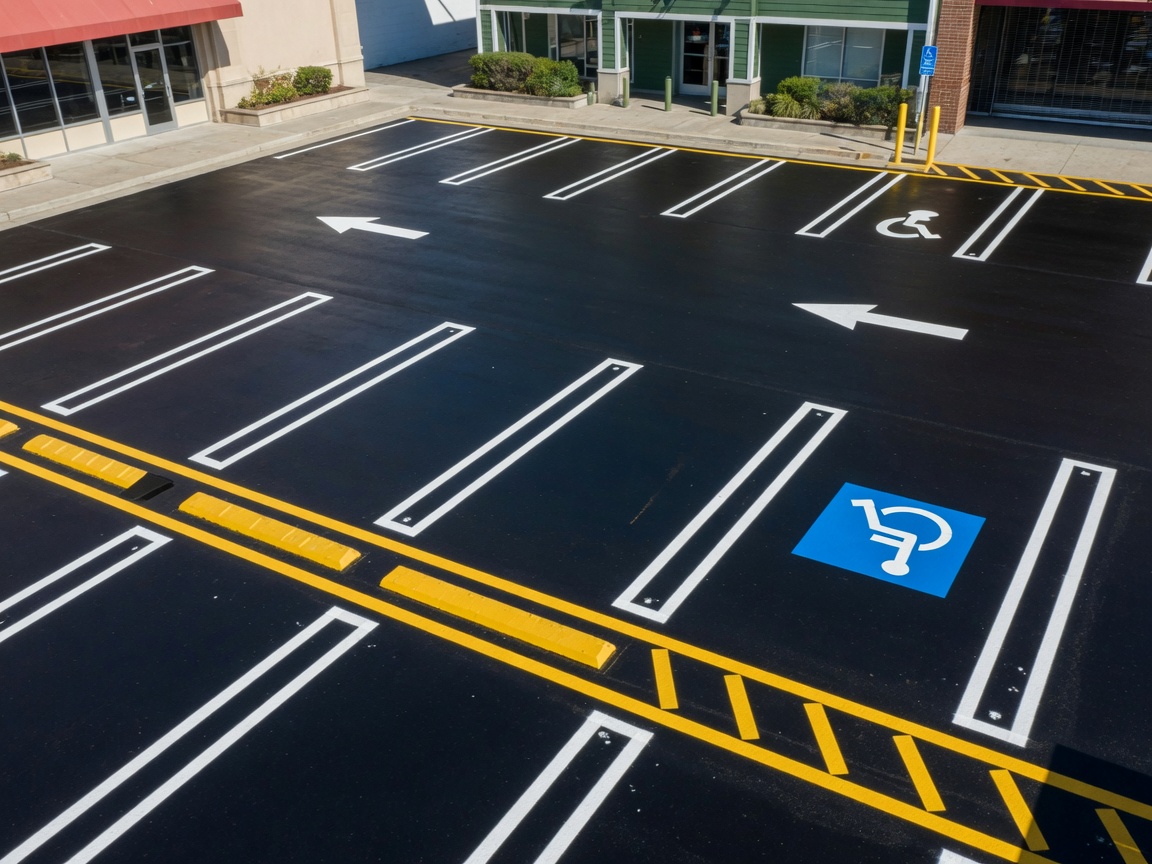
Most commercial parking lots need restriping every 18 to 24 months, with high-traffic retail lots closer to once a year, and a fresh sealcoat every 3 to 5 years — commonly cited facility-maintenance industry guidance. The catch most maintenance plans miss: sealcoat covers your existing lines, so you always restripe after you reseal — which means those two line items have to be sequenced together, not budgeted as if they were unrelated.
That sequencing is where property managers either save money or spend it twice. Below is the cadence for each task, how paint type changes the math, what shortens the interval, and how to budget the reseal and the restripe as one coordinated cycle.
How Often Should a Commercial Parking Lot Be Restriped?
For a typical office park, medical campus, or light-traffic warehouse yard, plan on restriping every 18 to 24 months, per commonly cited industry guidance. High-turnover retail and grocery-anchored centers — where cars enter, park, and leave all day — wear the paint faster and usually need it annually.
The driver is traffic, not the calendar. A medical office lot that fills at 8 a.m. and empties at 5 p.m. sees a fraction of the tire passes that a strip-center lot sees, and the paint reflects that. When you’re setting a capital-maintenance schedule, tie the interval to how hard the lot is actually used, then let the visible condition confirm or move the date.
Restriping isn’t only cosmetic. Faded stalls cost you parking density (drivers spread out when they can’t see lines), and faded fire-lane and accessible-space markings are a liability and code exposure — more on that below.
How Often Should a Commercial Parking Lot Be Resealed?
Sealcoat — the asphalt-emulsion or coal-tar layer applied over the pavement — typically gets reapplied every 3 to 5 years, per commonly cited industry guidance. Sealcoat is the wear layer that protects the asphalt underneath from UV, water intrusion, and oil, so resealing on schedule is what stretches the life of the pavement itself and defers the far larger cost of a mill-and-overlay or full repave.
Where you land in the 3-to-5-year range depends on sun exposure, drainage, and traffic. A fully exposed lot in the Georgia sun oxidizes faster than a shaded one; a lot that ponds water after every storm degrades faster than one that drains clean.
Why Sealcoating and Restriping Have to Be Coordinated
Here is the coordination insight most striping vendors bury, because it’s the one that determines whether you pay for line work once or twice: sealcoat goes down over the entire surface and covers your existing lines. Every stall, arrow, fire lane, and accessible marking disappears under the new coat. So a reseal always forces a restripe.
That means the two tasks are not independent budget lines. If you reseal in Year 4 and then restripe six months later because someone scheduled them separately, you’ve thrown away the striping you paid for just before the reseal — and paid for line layout twice inside a single year.
The correct sequence is: reseal first, cure, then restripe onto the fresh surface. Bundled that way, the reseal and restripe are one project, one mobilization, and one line layout — and the paint actually adheres better and lasts longer on new sealcoat than on old oxidized asphalt. When you build the maintenance schedule, anchor the restripe to the reseal year, and plan the interim restripes (the ones between reseals) around paint wear.
How Does Striping Paint Type Change the Lifespan?
The paint you specify changes the interval as much as traffic does. The two common choices for commercial lots are waterborne (latex) traffic paint and thermoplastic, and they live on very different timelines.
| Striping material | Typical lifespan | Best use |
|---|---|---|
| Waterborne / latex traffic paint | ~12–18 months | Standard stalls and interior lot lines; lower up-front cost; most office parks, medical, and general commercial lots |
| Thermoplastic | ~3–5 years | High-traffic, high-abrasion zones — drive aisles, fire lanes, crosswalks, retail lots; higher up-front cost, longer life |
Waterborne paint is the default for most lots: lower cost, fast to apply, and easy to refresh on the 12-to-18-month cycle. Thermoplastic is a heat-applied, thicker material that bonds into the surface and holds up 3 to 5 years — it costs more per foot but earns it back on high-abrasion markings you don’t want to redo every year, like fire lanes, crosswalks, and main drive aisles.
A practical middle path: waterborne for the bulk of the stalls, thermoplastic for the high-wear and safety-critical markings. That way you’re not repainting the whole lot on the shortest interval, and the markings that matter most for safety and code stay legible longest.
What Accelerates Wear and Shortens the Interval?
Two lots on the same street can be on different schedules. The variables that shorten your interval:
Traffic volume and turnover. Every tire pass abrades paint. A retail or grocery lot with all-day turnover wears markings far faster than a nine-to-five office lot.
Sun and UV. Direct, unshaded exposure oxidizes both sealcoat and paint. Fully exposed lots reseal and restripe more often than shaded ones.
Water pooling and poor drainage. Standing water breaks down sealcoat, lifts paint, and works into cracks — draining the pavement is part of protecting the coating.
Oil, fuel, and tire abrasion. Drip zones, delivery bays, and drive aisles see the fastest breakdown; these are the spots that go illegible first.
Snow plowing and de-icing, where it applies. A plow blade scrapes paint and sealcoat directly, so lots that get plowed run shorter intervals — a bigger factor in northern climates than for most metro-Atlanta lots.
What Are the Visible Signs It’s Time to Restripe or Reseal?
You don’t have to wait for the calendar. The lot tells you. Signs it’s time to restripe:
Faded or illegible stall lines — drivers park crooked or the lot loses stall count. Fading fire-lane and accessible (ADA) markings — a safety and compliance problem, not a cosmetic one. Worn directional arrows and crosswalks — traffic flow and pedestrian paths become ambiguous.
Signs it’s time to reseal:
Gray, oxidized asphalt — the black has faded to gray, meaning the protective layer is spent. Surface cracking — small cracks that will widen and admit water if left unsealed. Raveling — loose aggregate coming off the surface.
When the asphalt is signaling a reseal and the lines are fading at the same time, that’s your cue to bundle the two — reseal, then restripe — rather than chasing them separately.
How Does Restriping Intersect with ADA and Fire-Lane Compliance?
This is where maintenance cadence stops being optional. Accessible parking spaces, access aisles, and the required signage and pavement markings have to stay legible to remain compliant under the ADA Standards for Accessible Design — a faded accessible symbol or an unreadable access aisle is a compliance exposure, not just a worn line. The same holds for fire lanes, which have to stay clearly marked and legible under the applicable local fire code.
Two practical implications for the schedule. First, because a reseal covers all markings — including accessible spaces and fire lanes — the restripe that follows is also a re-compliance checkpoint: it’s the natural moment to confirm your accessible spaces, access aisles, and signage still meet current requirements, not just to repaint what was there. Second, if your layout predates a requirement change, the restripe after a reseal is the least disruptive time to correct it, since the surface is already blank.
If your questions are specifically about accessible-space layout, count, and signage rather than cadence, that’s a separate topic — our guide on whether restriping triggers ADA compliance covers the requirements side, and this article covers how often the maintenance comes due.
How Should You Budget and Sequence Reseal + Restripe Together?
The goal is one coordinated cycle, not two calendars fighting each other. A workable framework:
Anchor the restripe to the reseal. In a reseal year (every 3–5 years), the restripe is mandatory and non-negotiable — the reseal erased the lines. Budget them as a single bundled project.
Plan interim restripes around paint wear. Between reseals, restripe when the paint fades — every ~12–18 months on waterborne, longer if you specified thermoplastic on the high-wear markings.
Never restripe just before a reseal. If a reseal is coming inside the next year, hold the restripe and bundle it after — otherwise you’re paying for line layout twice.
Spec paint by zone. Thermoplastic on fire lanes, crosswalks, and main drive aisles buys you longer intervals on the markings that matter most; waterborne on the general stalls keeps cost down.
Fold it into the broader exterior plan. Parking-lot cadence sits alongside the rest of the building envelope — exterior painting, signage, and site work often share a mobilization window and a capital-maintenance calendar.
Done this way, the parking lot runs on a predictable cycle you can defend in a budget meeting: a small interim restripe on the paint’s schedule, and a bundled reseal-plus-restripe every few years that protects the pavement and resets everything at once. That’s exactly how we scope commercial parking lot striping for property managers running a portfolio.
Frequently Asked Questions
How often should a commercial parking lot be restriped?
Every 18 to 24 months for typical commercial lots, and about annually for high-traffic retail, where all-day turnover wears the paint faster — commonly cited industry guidance. Traffic volume drives the interval more than the calendar does, so set the schedule to how hard the lot is used and let visible fading confirm the timing.
How often does a commercial parking lot need sealcoating?
Commonly every 3 to 5 years. Sealcoat is the protective wear layer over the asphalt; reapplying it on schedule defers the much larger cost of resurfacing or repaving. Sun exposure, drainage, and traffic decide where in that range a given lot lands.
Do I have to restripe every time I sealcoat?
Yes. Sealcoat is applied over the entire surface and covers all existing lines — stalls, arrows, fire lanes, and accessible markings. Every reseal erases the striping, so a restripe always follows. The two should be bundled as one project.
How long does parking-lot striping paint last?
Waterborne/latex traffic paint typically lasts about 12–18 months; thermoplastic lasts roughly 3–5 years — commonly cited industry ranges. Thermoplastic costs more up front but holds up far longer on high-abrasion markings like fire lanes, crosswalks, and drive aisles.
What makes parking-lot lines wear out faster?
Traffic volume and turnover, direct sun and UV, standing water from poor drainage, and oil and tire abrasion in drip zones and drive aisles. High-turnover retail lots and fully exposed lots run the shortest intervals; shaded, well-drained, lower-traffic lots run the longest.
Does restriping affect ADA and fire-lane compliance?
Yes. Accessible spaces, access aisles, and fire lanes have to stay legible to remain compliant under the ADA Standards for Accessible Design and applicable local fire codes. Because a reseal covers those markings too, the restripe that follows is the natural point to confirm your accessible spaces and signage still meet current requirements — not just to repaint what was there.