
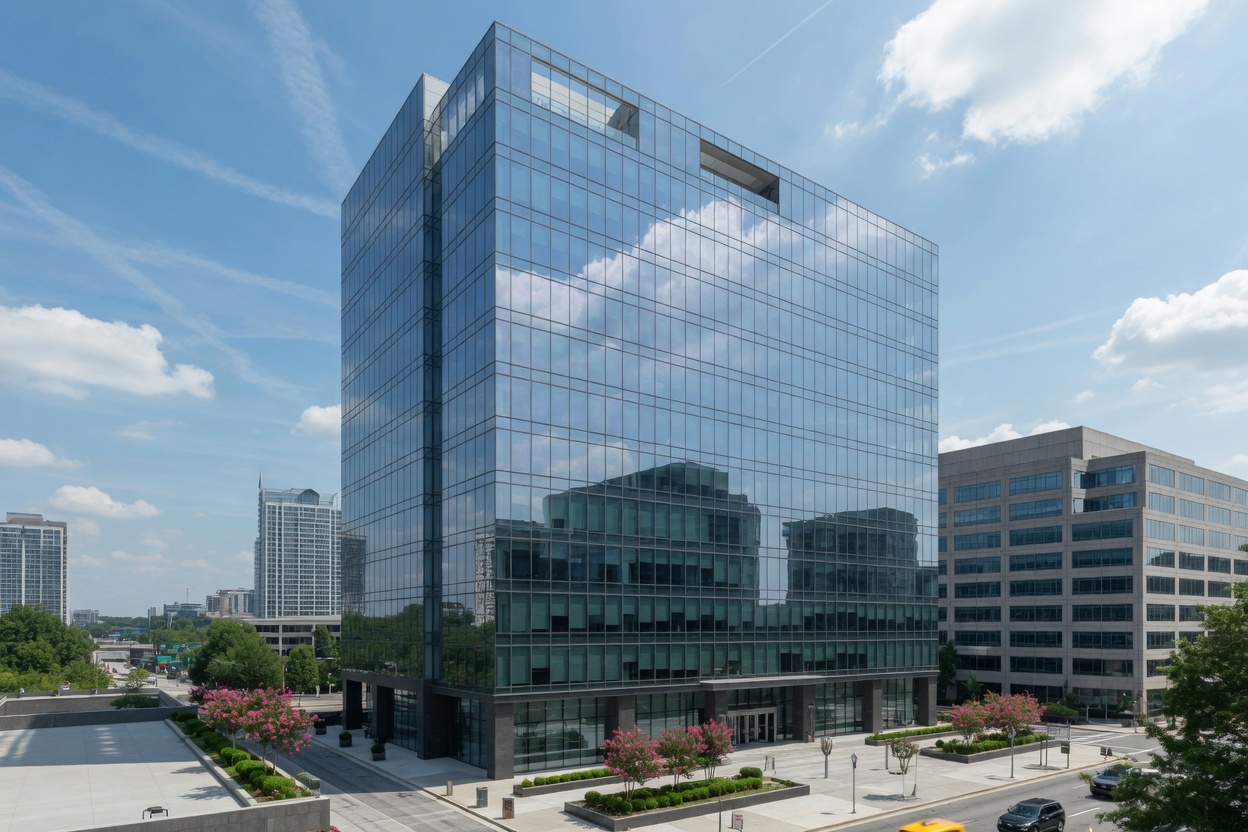
Most metro-Atlanta office buildings can expect solar-control window film to pay for itself in about 2 to 5 years, with the majority of projects landing in the 3-to-4-year range — measured against a film service life of 15 to 20-plus years. Payback depends on your glass area, orientation, and how much you currently spend on cooling, but because Atlanta is a cooling-dominated climate, the savings side of the equation tends to run toward the higher end of published industry ranges. In practical terms, you’re buying most of the solar-control performance of new high-efficiency glazing as a retrofit onto your existing glass, then collecting cooling savings every summer for the life of the film.
What Payback Can an Atlanta Office Building Actually Expect?
Plan for a 2-to-5-year payback on solar-control window film, with most commercial projects recovering their cost in 3 to 4 years. Window-film industry reporting (retrieved September 2026) commonly cites a payback period in that 2-to-5-year band, set against a film service life of 15 to 20-plus years — meaning the film keeps returning savings for well over a decade after it has paid for itself.
The reason the number lands where it does comes down to climate. Atlanta summers are long and cooling-dominated, so a large share of an office building’s energy bill goes to air conditioning the space behind the glass. Solar-control film cuts the solar heat coming through that glass, which is exactly the load your chillers and rooftop units are fighting from roughly April through October. In a heating-dominated northern market the same film pays back more slowly; here, the math works in your favor.
Two variables move your specific payback inside that range: how much untreated, sun-facing glass you have, and how high your current cooling spend is. A glass curtainwall high-rise with large west- and south-facing elevations sits at the fast end. A smaller warehouse office with limited window area sits at the slower end. An energy assessment sizes this for your building rather than a generic estimate — more on that below.
How Much Energy Does Commercial Solar-Control Film Actually Save?
Window-film industry reporting (retrieved September 2026) commonly cites total building energy savings of roughly 10–20%, with cooling-specific savings of 15–40% in warm climates. Because Atlanta is cooling-dominated, a well-specified solar-control film on sun-exposed glazing tends to land toward the higher part of that cooling range.
It helps to keep the two figures straight. The 10–20% number is the reduction in the whole building’s energy bill — it’s diluted by all the loads film doesn’t touch, like plug loads, lighting, and heating. The 15–40% cooling figure is the reduction in the cooling portion specifically, which is the load film directly addresses. For an Atlanta building where cooling is the dominant seasonal cost, the whole-building savings tend to sit at the stronger end because cooling makes up more of the total.
| Savings metric | Published industry range | What it measures | Atlanta expectation |
|---|---|---|---|
| Total building energy | ~10–20% | Reduction across the whole utility bill | Upper part of range (cooling-heavy load) |
| Cooling-specific | ~15–40% | Reduction in the AC / cooling portion only | Upper part of range (long cooling season) |
| Film service life | 15–20+ years | How long the film keeps performing | Full life expected with quality commercial film |
| Typical payback | ~2–5 years (most 3–4) | Time to recover film + install cost | Faster end for high sun-exposed glass area |
Savings also stack with other envelope and lighting measures. If you’re already scoping an LED lighting retrofit, pairing it with window film is a common way to attack both the cooling load (film) and the lighting-plus-heat-gain load (LED) in one capital project — which can improve the combined business case and reduce mobilization costs versus two separate projects. Our warehouse high-bay LED retrofit guide walks through how run-hours and rebates drive that side of the math.
How the Payback Math Works
The calculation is straightforward: total installed cost of the film divided by annual cooling savings equals payback in years. On the cost side you have the film material plus professional installation, priced by square foot of glazing and the film system specified. On the savings side you have the annual reduction in cooling energy — the 15–40% cooling figure above, applied to your building’s actual cooling spend.
The key framing for a business case: this is a retrofit, not new glazing. Replacing a curtainwall with high-performance insulated glass is a major capital project measured in dollars per square foot several times higher than film, plus scaffolding, tenant disruption, and long lead times. Film delivers a large share of the solar-control benefit by bonding to the glass you already own, installed from inside in most cases, with minimal disruption to occupied floors. That lower cost basis is why the payback compresses into the 2-to-5-year band even at Atlanta energy prices.
Because payback turns on your glass area, orientation, and current cooling cost, the honest way to produce a defensible number is a building-specific assessment rather than a rule-of-thumb. A generic “X% savings” applied to your bill is a starting point for a pro forma, not a commitment you’d put in front of ownership.
Incentives: What’s Actually Available as of September 2026
Start with utility rebates. Some utilities offer per-square-foot rebates on treated glass or fold window film into broader commercial energy-efficiency incentive programs. These change year to year and by service territory, so the right move is to verify current offers with Georgia Power (or your local utility’s commercial efficiency program) at the time you scope the project. A rebate applied against installed cost directly shortens payback, so it’s worth confirming before you finalize the pro forma.
On the federal side, be careful with 179D. The 179D Commercial Buildings Energy-Efficiency Tax Deduction has historically rewarded qualifying energy-efficiency improvements to commercial buildings. According to the U.S. Department of Energy (179D program information, accessed September 2026), the One Big Beautiful Bill Act — enacted July 4, 2025 — set a construction-start deadline of June 30, 2026 for 179D eligibility. As of today, that window has closed: 179D is not available for a new film project starting now. Only projects that began construction before June 30, 2026 fall within the eligibility window. We mention it only so you don’t build a business case around an incentive that has since expired for new starts.
Because tax rules and utility programs change, confirm any current federal or state incentives with your tax advisor and your utility before counting them in your ROI. Treat rebates and deductions as upside that can shorten payback — not as the foundation of the case. The cooling savings carry the case on their own.
The Non-Energy Value That Strengthens the Case
Energy is the headline, but several other benefits show up on the same invoice and often matter as much to tenants and ownership:
Glare reduction. Cutting glare on sun-facing floors makes screen-heavy workspaces usable without dropping every blind, which occupants notice immediately.
Occupant comfort near glass. Perimeter offices next to large glazing run hot in the afternoon. Reducing solar gain evens out the temperature between the core and the glass line — a common tenant-satisfaction and retention factor in leased buildings.
UV and fade protection. Quality solar-control film blocks the bulk of UV, protecting flooring, furnishings, artwork, and merchandise from fading — a real cost avoidance in lobbies, showrooms, and finished interiors.
Safety and security film options. Where the goal is holding shattered glass together against impact, storms, or forced entry, security-grade film is a distinct product line that can be specified on the same glazing.
None of these show up in the cooling-savings line, but they’re legitimate items in a whole-building case — especially in leased assets where comfort and appearance affect renewals. For buildings scoping a broader exterior refresh, film also pairs naturally with a high-rise painting and facade program when the whole envelope is already in the capital plan.
Is Window Film Right for Our Building?
Film is a strong fit for some glazing profiles and a weaker fit for others. A quick qualifier before you assess:
Glass area. The more sun-exposed glazing you have, the faster the payback. Large curtainwall elevations are ideal candidates; small punched windows return less.
Orientation. West- and south-facing glass takes the most solar load in Atlanta and benefits most. North-facing glass sees limited solar-control upside.
Single vs. double pane. Both can be filmed, but the film system must be matched to the glazing to avoid thermal stress — this is a specification question, not a one-size product.
Existing low-e coatings. Glass that already carries a low-e or reflective coating changes what film adds and which product is appropriate. It doesn’t rule film out, but it does require a professional look at the existing glass before specifying.
If your building has significant west/south glass, high summer cooling bills, and no strong existing solar-control coating, you’re squarely in the profile where film pays back fast. If you’re unsure about your glazing, that’s exactly what a site assessment resolves — see our commercial window tinting service for scope and the assessment step.
Frequently asked questions
What is the payback period for commercial window film in Atlanta?
Most Atlanta commercial buildings recover the cost of solar-control window film in about 2 to 5 years, with the majority landing at 3 to 4 years. Window-film industry reporting (retrieved September 2026) cites that range against a film service life of 15 to 20-plus years, so the film keeps saving long after it pays for itself.
How much can solar-control window film cut my energy bill?
Published window-film industry data (retrieved September 2026) commonly cites total building energy savings of roughly 10–20% and cooling-specific savings of 15–40% in warm climates. Because Atlanta is cooling-dominated, well-specified film on sun-exposed glass tends to land toward the upper part of those ranges.
Is window film cheaper than replacing our glass?
Yes — significantly. Film is a retrofit that bonds to your existing glazing, so you get much of the solar-control benefit of new high-performance glass at a fraction of the cost and disruption of a full curtainwall replacement. That lower cost basis is the main reason payback compresses into the 2-to-5-year range.
Are there rebates or tax incentives for commercial window film?
Sometimes. Some utilities offer per-square-foot rebates or include window film in commercial energy-efficiency programs, so verify current offers with Georgia Power or your local utility at project time. On the federal side, the 179D deduction’s construction-start window closed June 30, 2026, so it is not available for a new project starting now — confirm any current programs with your tax advisor.
Can I still use the 179D tax deduction for a window film project?
Not for a new project starting today. According to the U.S. Department of Energy (accessed September 2026), the One Big Beautiful Bill Act set a construction-start deadline of June 30, 2026 for 179D eligibility. Only projects that began construction before that date qualify; new starts do not. Confirm the current federal and state incentive landscape with your tax advisor.
Does commercial window film do anything besides save energy?
Yes. Beyond cooling savings, solar-control film reduces glare, improves occupant comfort near large glazing, blocks most UV to protect interiors from fading, and — with security-grade products — can hold shattered glass together against impact or forced entry. These benefits often matter to tenants and ownership as much as the utility savings.