
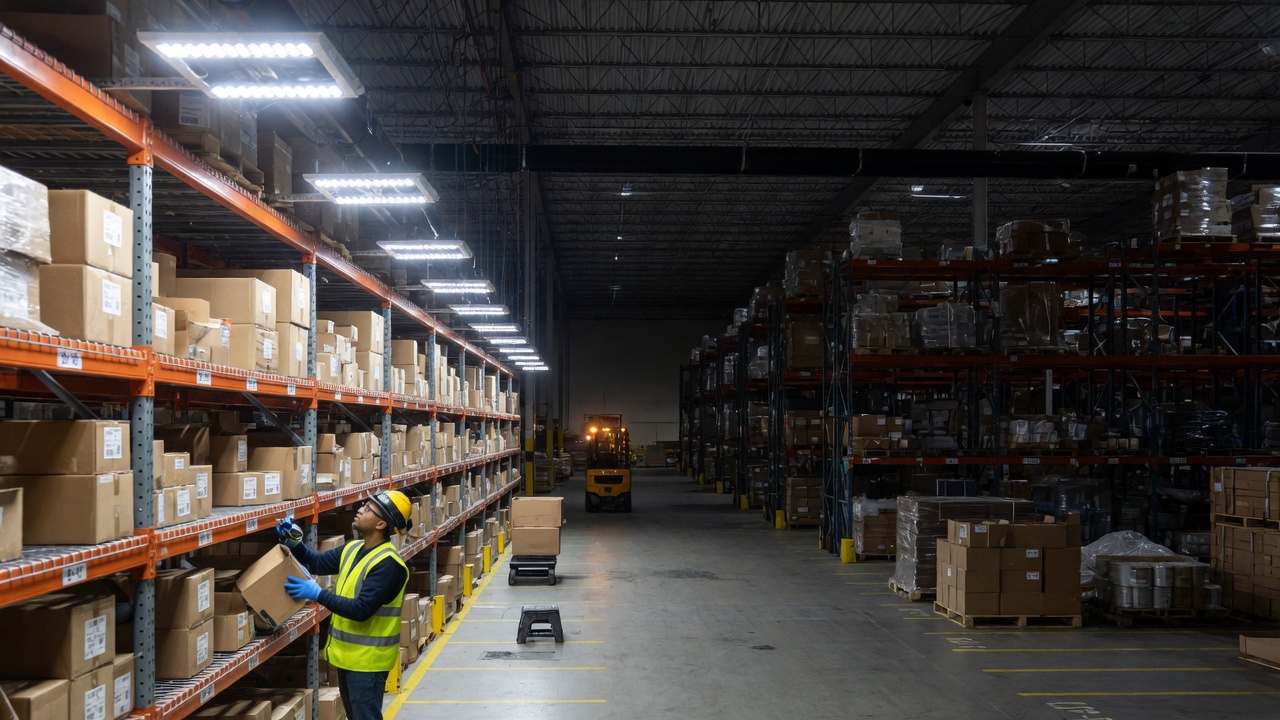
A warehouse or plant has two different lighting answers, and most facility managers merge them into one. OSHA's illumination minimums are a legal floor — general warehouse and indoor areas carry a 5 foot-candle minimum under 29 CFR 1926.56, Table D-3 — the point below which a space is non-compliant. The Illuminating Engineering Society's recommended practice for industrial lighting (ANSI/IES RP-7) is what a lighting designer actually aims for, task by task, and those levels sit well above the OSHA floor: roughly 10 foot-candles for bulk storage, 20–30 for active picking, 30–50 for general assembly, and 50–100 and up for color-critical inspection. Design only to OSHA and you've passed an inspection and under-lit your operation.
What are OSHA's minimum foot-candle requirements?
OSHA's illumination minimums are a legal floor — the point below which a work area is non-compliant — not a target you design toward. Under OSHA 29 CFR 1926.56 and its illumination table (Table D-3), the regulation sets minimum illumination intensities, measured in foot-candles, for different categories of work area.
The headline numbers are low on purpose. General warehouse and indoor areas — warehouses, corridors, hallways, and exitways — carry a minimum of 5 foot-candles (29 CFR 1926.56, Table D-3). Loading platforms, active storage, and general construction area lighting sit lower still, at 3 foot-candles. Offices, first-aid stations, and infirmaries require far more — 30 foot-candles.
One clarifying point for a permanent facility: 1926.56 is OSHA's construction-sector illumination standard and the concrete federal foot-candle table people cite, while OSHA's general-industry rules don't publish a comparable numeric foot-candle table — which is exactly why the IES design standard carries the real weight for an operating warehouse or plant.
The key thing to understand about these figures: they exist to keep a space from being dangerously dark, not to make it good to work in. A warehouse lit to the bare OSHA minimum is legally compliant and still a place where a picker misreads a label or a forklift operator loses contrast in an aisle. Compliance is the floor. It was never meant to be the ceiling.
OSHA's own rule points beyond its own table
Here's the part most facility managers miss, and it's the hinge of this whole decision. OSHA's illumination standard doesn't claim to cover every work area. For areas its own table doesn't cover, 29 CFR 1926.56(b) refers employers to the American National Standard A11.1–1965 (R1970), Practice for Industrial Lighting — the ANSI industrial-lighting recommended practice that the Illuminating Engineering Society maintains today as ANSI/IES RP-7.
Read that again: the regulation defers to the design standard for anything its table doesn't spell out. So the question isn't “OSHA or IES?” OSHA points you to the industrial-lighting recommended practice. The legal minimum and the design standard aren't competitors — the law itself treats the design standard as the fuller answer.
What does the IES design standard recommend?
The Illuminating Engineering Society's recommended practice for industrial lighting (ANSI/IES RP-7) sets recommended illuminance levels by task, not by room. That's the mental shift: you don't light “a warehouse,” you light a storage aisle, a staging zone, a pick line, an assembly station, and an inspection bench — each to the level that task demands.
The levels below are IES recommended practice — design guidance, not legal minimums — and the foot-candle figures are directional. Actual design targets depend on the specific task, the age and visual acuity of the workforce, contrast and speed requirements, and surface reflectances. Treat them as ranges to brief a designer with, not as fixed numbers.
Low-activity storage and bulk aisles
Where material simply sits and movement is infrequent — bulk storage, rack aisles with little picking — IES recommended levels are relatively low, typically around 10 foot-candles (ANSI/IES RP-7 recommended practice, directional). Even here, though, that level generally runs above the bare OSHA warehouse floor of 5 foot-candles, because the goal is legible labels and safe aisle travel, not just the absence of darkness.
Active picking, staging, and assembly
Where people are reading labels, picking at speed, staging, or doing general assembly, recommended levels climb into the mid range — generally 20–30 foot-candles for active picking and staging, and 30–50 foot-candles for general assembly, higher for fine or detailed assembly (ANSI/IES RP-7 recommended practice, directional). This is where the compliance-versus-design gap bites hardest: an aisle lit to the OSHA minimum but used for high-speed picking is under-lit for the actual task by a wide margin.
Inspection and color-critical QC
The highest recommended levels are reserved for close, detailed, or color-critical work — fine inspection, quality control, and tasks where small defects or color differences have to be caught. IES recommended levels for this kind of work typically run to 50–100 foot-candles and up (ANSI/IES RP-7 recommended practice, directional). No general-area lighting scheme delivers this; it's designed in deliberately, usually as supplemental task lighting over the bench or line.
Why design to IES instead of bare OSHA compliance?
Because the cost of under-lighting shows up in your operation, not on an inspection report. Light to the task and you reduce picking and labeling errors, improve defect-catch rates in QC, and give forklift operators and floor staff the contrast they need to move safely. Light to the bare legal minimum and you've optimized for passing an inspection while quietly accepting a higher error and incident rate — the expensive kind of “compliant.”
The old objection to designing above the minimum was energy cost: more foot-candles meant more watts, and under legacy HID lighting that was a real penalty. That objection has largely collapsed, which is the next point.
How modern LED efficacy changes the math
The reason the design-versus-compliance decision is now cheaper to get right is efficacy — lumens produced per watt consumed. High-efficacy high-bay LED luminaires deliver far more usable light per watt than the metal-halide and high-pressure-sodium HID fixtures they replace. Per the U.S. Department of Energy / FEMP, referencing DesignLights Consortium (DLC) high-bay technical requirements, qualifying high-bay LED luminaires reach 175 lumens per watt or more (FEMP/DLC Technical Requirements Table V5.1, high-bay category). Metal-halide and high-pressure-sodium systems deliver far fewer usable lumens per watt, especially once lamp lumen depreciation and fixture losses are counted.
What that means for your retrofit decision is concrete: you can hit the higher IES recommended levels and still cut energy consumption versus the HID you're removing. The trade-off that used to force facilities to settle for “just enough to be compliant” is mostly gone. Designing to the task is now the efficient choice, not the expensive one — which is also why the payback case has gotten stronger. For the numbers behind that, see our breakdown of high-bay LED retrofit cost and payback. This is the scope our commercial LED lighting retrofit crews plan around when they spec a facility.
A zone-by-zone target table for your retrofit brief
Use this as the design brief for a retrofit — define your zones by task, then set a target for each. The OSHA column is the legal floor; the IES column is the design target you actually want to hit. The IES figures are directional recommended-practice ranges, not legal minimums.
| Zone (by task) | OSHA legal minimum (fc) | IES recommended design target (fc, directional) | Notes |
|---|---|---|---|
| Low-activity / bulk storage, rack aisles | 5 | Typically ~10 | Legible labels + safe aisle travel; above the OSHA floor |
| Staging / picking (active) | 5 | Generally ~20–30 | Error-rate zone; most under-lit if designed to OSHA only |
| General assembly | 5 | Generally ~30–50 | Scale up with task fineness and speed |
| Inspection / color-critical QC | 5 | Typically ~50–100 and up | Design in as supplemental task lighting, not general-area |
| Loading platforms / active storage | 3 | Per task (often ~10–20) | OSHA's lowest tier; dock activity may warrant more |
| Offices / first-aid | 30 | Per IES office recommended practice (above the 30 fc floor) | Separate task standard; different from floor areas |
The point of the table isn't the exact number in any one cell — it's the structure. Define zones by what people actually do in them, set the design target to the task, and treat the OSHA figure as the line you must stay above, not the line you aim for.
Frequently asked questions
Is OSHA foot-candle compliance enough for a warehouse?
It's legally enough, but it's rarely operationally enough. OSHA's minimums under 29 CFR 1926.56, Table D-3 are a floor that keeps a space from being dangerously dark — 5 foot-candles for general warehouse and indoor areas — not a level designed to deliver the light needed for accurate, high-speed work. For areas its own table doesn't cover, 29 CFR 1926.56(b) refers employers to the American National Standard A11.1–1965 (R1970), Practice for Industrial Lighting — the ANSI industrial-lighting recommended practice that the Illuminating Engineering Society maintains today as ANSI/IES RP-7.
What's the difference between OSHA minimums and IES recommended levels?
OSHA minimums are legal requirements — drop below them and you're non-compliant. Under 29 CFR 1926.56, Table D-3, general warehouse and indoor areas carry a 5 foot-candle minimum. IES levels, from the Illuminating Engineering Society's recommended practice for industrial lighting (ANSI/IES RP-7), are design recommendations set by task, and they typically sit well above the OSHA floor. One answers “am I compliant?”; the other answers “will my people see well enough to work accurately and safely?”
How many foot-candles does a picking or assembly area need?
As a design matter, far more than general storage. The Illuminating Engineering Society's recommended practice for industrial lighting (ANSI/IES RP-7) generally puts active picking and staging around 20–30 foot-candles and general assembly around 30–50 foot-candles — higher for fine or detailed assembly — well above OSHA's 5 foot-candle warehouse minimum (29 CFR 1926.56, Table D-3). Treat those as directional recommended-practice targets to confirm with a lighting designer against your specific tasks.
How much light does inspection or quality-control work need?
The most of any typical industrial zone. The Illuminating Engineering Society's recommended practice for industrial lighting (ANSI/IES RP-7) typically puts fine, detailed, or color-critical inspection at roughly 50–100 foot-candles and up — usually delivered as supplemental task lighting over the bench or line rather than from general-area fixtures. These are directional recommended-practice levels, not legal minimums.
Does OSHA require you to follow the IES standard?
In effect, for anything its own table doesn't cover, yes. For areas its own table doesn't address, 29 CFR 1926.56(b) refers employers to the American National Standard A11.1–1965 (R1970), Practice for Industrial Lighting — the ANSI industrial-lighting recommended practice that the Illuminating Engineering Society maintains today as ANSI/IES RP-7. Note that 1926.56 is OSHA's construction-sector illumination standard and the concrete federal foot-candle table most people cite; OSHA's general-industry rules don't publish a comparable numeric foot-candle table, which is exactly why, for a permanent facility, the IES design standard carries the real weight.
Does designing to the higher IES levels cost more in energy?
With a modern LED retrofit, much less than it used to. High-efficacy high-bay LEDs produce far more usable light per watt than legacy HID — the U.S. Department of Energy / FEMP, referencing DesignLights Consortium (DLC) high-bay technical requirements, sets qualifying high-bay LED luminaires at 175 lumens per watt or more (FEMP/DLC Technical Requirements Table V5.1, high-bay category). Metal-halide and high-pressure-sodium systems deliver far fewer usable lumens per watt, especially once lamp lumen depreciation and fixture losses are counted. So a facility can hit the higher IES targets and still cut total energy use versus the HID it replaces.