
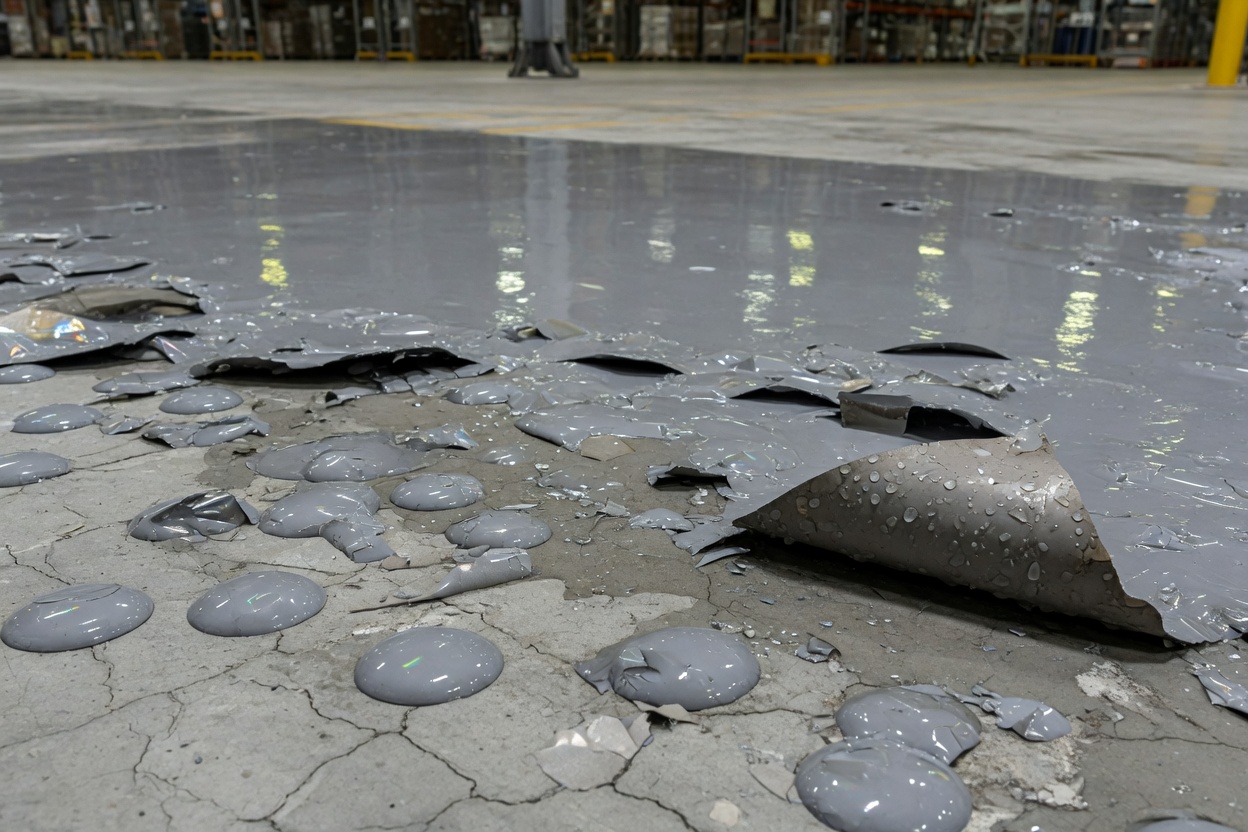
If a commercial epoxy floor bubbled, blistered, delaminated, or peeled within a year or two, the problem almost certainly was not the epoxy. It was the slab underneath it — and, more precisely, what nobody tested before coating it. The single most common cause of failure on a warehouse or industrial floor is moisture-vapor transmission: water vapor migrating up through the concrete and pushing against the coating from below until the bond breaks. The next most common causes are coating a slab that had not fully cured, and preparing the surface incorrectly — usually skipping the mechanical profile a heavy-duty floor needs. All three are preventable, and all three come down to what happens before the first coat goes down, not the product in the bucket.
This is written for the reader with a five-figure problem: a plant manager whose freshly coated floor is failing, or a GC and facility owner spec’ing a new install across thousands of square feet on a construction clock where the slab’s 28-day cure is racing an occupancy date. Here is why these floors fail, how the moisture is actually measured, and what a correct install does differently.
What Actually Causes Commercial Epoxy Floors to Fail?
Three causes account for the large majority of coating failures on commercial and industrial slabs, and they stack in a predictable order of blame.
1. Moisture-vapor transmission (the leading cause). Concrete is porous, and on a slab-on-grade — especially one below grade or without an intact vapor retarder underneath — ground moisture continuously migrates upward as vapor. An epoxy coating is essentially a sealed membrane. When that vapor reaches the underside of the coating and can’t escape, it builds pressure, and that pressure lifts the coating off the slab. The visible result is bubbles, blisters, or sheets of coating peeling away.
2. An under-cured slab. Fresh concrete carries a large amount of mix water that has to leave the slab before it’s ready to coat. Coat too early and you trap that water under the membrane, producing the same blistering and adhesion failure as ground moisture. On a construction timeline, this is where the pressure to hit an occupancy date does the most damage.
3. Inadequate surface prep. Even a dry, cured slab will fail if the coating has nothing to grip. A troweled or sealed concrete surface is too tight for epoxy to key into. Without a proper mechanical profile, the coating can delaminate or flake off under traffic even though moisture was never the issue.
Why Does Moisture Vapor Break the Bond?
It helps to picture the mechanism, because it explains why a floor can look perfect for months and then fail. Below the slab, moisture is under pressure — hydrostatic pressure from groundwater and vapor pressure from evaporation inside the concrete. That pressure is always trying to move upward and out. On a bare slab, the vapor simply evaporates off the surface and you never see it.
Put a coating on top and you’ve capped that escape route. The vapor still arrives at the surface, but now it’s trapped at the interface between the concrete and the coating. It accumulates, the pressure builds, and eventually it exceeds the adhesion strength holding the coating to the slab. At that point the coating lifts — a blister — or debonds across an area — delamination. High-pH moisture at that interface can also chemically attack the adhesive bond of some coating systems, accelerating the failure. None of this is a manufacturing defect in the epoxy. It’s physics acting on a slab that was coated before its moisture was under control.
How Long Does a Slab Have to Cure — and Why Isn’t 28 Days Enough?
The common benchmark is that new concrete needs a minimum of 28 days to cure before it’s a candidate for coating, and that number is worth respecting. But it’s widely misunderstood as a finish line. It isn’t.
Curing and drying are two different things. Curing is the chemical reaction that gives concrete its strength; 28 days is roughly when a standard slab reaches most of its design strength. Drying is the slower physical process of excess moisture leaving the slab, and it can take far longer — often cited as roughly a month of drying per inch of slab thickness under good conditions, and longer in humid weather or on a slab that can’t breathe from below. As coatings-industry guidance puts it, a slab can be fully cured and structurally sound while still holding too much moisture to accept a coating. That is exactly why the 28-day mark is a floor, not a green light — and why a moisture test taken right before coating is non-negotiable no matter how old the slab is.
How Do You Actually Measure Slab Moisture?
There are two ASTM standard test methods, and a serious contractor names one or both in the spec. They measure different things.
ASTM F1869 — Calcium Chloride (MVER). Per ASTM International, ASTM F1869 is the Standard Test Method for Measuring Moisture Vapor Emission Rate of Concrete Subfloor Using Anhydrous Calcium Chloride. A weighed dish of dry calcium chloride sits under a sealed dome on the slab for 60–72 hours; the moisture it absorbs is used to calculate the moisture-vapor emission rate (MVER), reported in pounds per 1,000 square feet per 24 hours. Its limitation is that it reads only the surface zone of the slab, so it can miss moisture deeper down.
ASTM F2170 — In-Situ Relative Humidity. Per ASTM International, ASTM F2170 is the Standard Test Method for Determining Relative Humidity in Concrete Floor Slabs Using in situ Probes. Probes are set into holes drilled to a specified depth in the slab and read the internal relative humidity (% RH) deep inside the concrete. Because it measures what the slab will do after it’s sealed, the in-situ RH test is widely regarded as the more predictive of the two and has become the preferred method on many commercial projects.
| Test | ASTM F1869 (MVER) | ASTM F2170 (in-situ RH) |
|---|---|---|
| What it measures | Moisture-vapor emission rate at the surface | Relative humidity inside the slab |
| Method | Anhydrous calcium chloride under a sealed dome, 60–72 hrs | In-situ probes in drilled holes, read at depth |
| Reported as | lbs / 1,000 sq ft / 24 hr | % relative humidity |
| Commonly cited barrier trigger | Above ~3 lbs | Above ~75% RH |
| Best for | Quick surface-zone reading | Predicting post-coating behavior (widely preferred) |
What Numbers Tell You a Moisture-Vapor Barrier Is Needed?
This is the go/no-go call, and it’s where honest contractors and corner-cutters separate. Coatings-industry and manufacturer guidance (retrieved September 2026) commonly cites a moisture-vapor emission rate above roughly 3 pounds per 1,000 square feet per 24 hours (ASTM F1869), or an internal relative humidity above roughly 75% (ASTM F2170), as the point at which a standard coating shouldn’t go down directly — the slab needs a moisture-vapor barrier or a mitigation system first.
The important caveat: those are commonly cited industry figures, not a universal code. The real limit is set by the specific coating product’s technical data sheet — some high-performance systems tolerate more moisture, some less. So the correct process is to test the slab, then compare the reading against the chosen product’s published maximum, and specify mitigation if the number is over. If a slab reads under the product’s limit, you can coat directly. If it reads over, a moisture-mitigation coat (a penetrating or barrier system engineered to hold back vapor pressure) goes down first, and the epoxy goes over that. Skipping this step to save a day and a line item is the single most expensive shortcut in commercial flooring, because the fix is to grind the failed floor off and start over.
What Surface Prep Does a Warehouse Slab Actually Need?
Moisture gets the headlines, but prep quietly causes just as many failures. A coating needs a mechanical profile — a controlled roughening of the concrete so the epoxy can key into it. On a commercial or warehouse slab, that means shot-blasting or diamond grinding, which open the surface uniformly and remove the tight, sealed top layer left by troweling. Acid etching — still common on small residential jobs — is generally not adequate for a heavy-duty industrial floor; it’s inconsistent and leaves residue that can undermine the bond.
Prep failures show up the same way moisture failures do — flaking, peeling, coating lifting under forklift traffic — which is why they get misdiagnosed. The difference is that a prep failure will happen on a bone-dry slab. Done right, mechanical profiling and a verified-clean surface are what let a correctly chosen coating actually reach its rated service life. If you’re weighing a coating against a mechanically refined bare slab for part of the building, our guide to polished concrete versus epoxy by zone walks through where each system belongs.
How to Tell If a Flooring Bid Is Cutting Corners
You don’t need to be a coatings chemist to vet a bid. You need three questions, and the answers should be specific and in writing:
1. “Which moisture test will you run, and what number triggers mitigation?” A defensible answer names ASTM F1869, F2170, or both, and gives a threshold tied to the coating’s data sheet. “We’ve never had a problem” is not a moisture test.
2. “How will you profile the slab?” You want to hear shot-blast or diamond grind on a warehouse floor. If the answer is acid etch, the bid is pricing a lighter-duty job than you’re buying.
3. “What’s the full coating system, and what’s the plan if the slab tests wet?” A real bid includes a contingency — a moisture-mitigation line — rather than assuming the slab will pass. A bid with no moisture line is a bid betting your floor that the slab is dry.
The gap between two flooring bids is often exactly these items — testing, profiling, and mitigation — which is why the cheapest number frequently prices the system most likely to fail. The same principle applies across coatings work; our guide on how to spec a coating project and compare bids apples-to-apples covers writing a scope that forces every bidder to price the identical system.
What a Correct Install Looks Like
Put together, a slab-first process is what separates a floor that lasts from one that fails: assess the concrete and its environment, run the ASTM moisture test that fits the slab, compare the reading against the chosen coating’s limit, mitigate if it’s over, mechanically profile the surface, and only then coat. That’s how we scope commercial epoxy floor coating — and it’s the same discipline behind our concrete polishing, warehouse painting, and industrial painting work, where a properly prepared substrate is what makes the finish hold. If your last floor failed, the useful next step is a moisture-tested assessment: find out what the slab is actually doing before anyone quotes a re-coat.
Frequently asked questions
Why do commercial epoxy floors fail?
The leading cause is moisture-vapor transmission — water vapor moving up through the concrete slab pushes against the coating from below and breaks the bond, causing bubbling, blistering, and delamination. The other two common causes are coating a slab that has not fully cured and inadequate surface prep, such as no mechanical profile. All three are preventable with moisture testing and correct preparation before any coating goes down.
How long does concrete need to cure before epoxy coating?
Industry guidance holds that new concrete needs a minimum of 28 days to cure before coating, which is why 28 days is the common benchmark. But cure time alone is not a green light: a slab can be fully cured and structurally sound while still carrying too much moisture to accept a coating. The 28-day mark is a floor, not a substitute for a moisture test taken right before coating.
How do you test a concrete slab for moisture before epoxy?
Two ASTM standard test methods are used. ASTM F1869 measures the moisture vapor emission rate (MVER) using anhydrous calcium chloride and reports the result in pounds per 1,000 square feet per 24 hours. ASTM F2170 measures relative humidity (RH) inside the slab using in-situ probes drilled to depth and reports a percent-RH reading. The in-situ RH test reflects moisture deeper in the slab and is widely considered the more predictive of the two.
What moisture level is too high for an epoxy floor?
Coatings-industry and manufacturer guidance commonly cites a moisture vapor emission rate above roughly 3 pounds per 1,000 square feet per 24 hours (ASTM F1869), or an internal relative humidity above roughly 75% (ASTM F2170), as the trigger for a moisture-vapor barrier or mitigation system. The exact limit is set by the specific coating manufacturer’s data sheet, so the product spec — not a rule of thumb — governs the go/no-go call.
What surface prep does a warehouse slab need before epoxy?
A large commercial or warehouse slab needs a mechanical profile — typically shot-blasting or diamond grinding — to open the concrete surface so the coating can key into it. Acid etching is generally not adequate for a heavy-duty industrial floor. A missing or inconsistent profile is a common reason a coating peels or flakes off later even when the slab was dry.
How can I tell if a flooring bid is cutting corners on moisture testing?
Ask the contractor which ASTM moisture test they will run (F1869, F2170, or both), what threshold triggers a moisture-vapor barrier, and how they will profile the slab. A bid that omits moisture testing, gives no threshold, or assumes acid etch on a warehouse floor is pricing a system that can fail. A defensible bid names the test, the trigger number, and the prep standard in writing.