
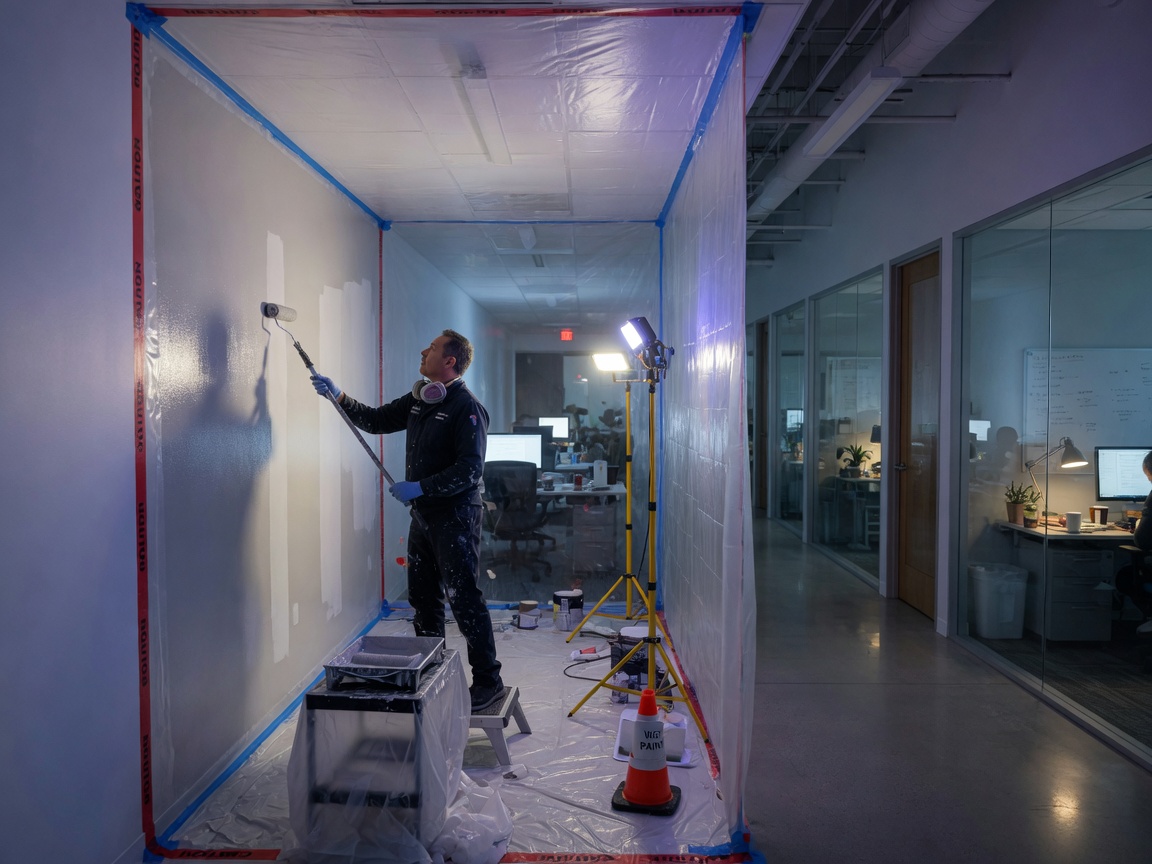
Yes — an occupied commercial building can be painted without closing, and it happens on most of the office, medical, and mixed-use jobs in a working portfolio. The work stays out of your way through three levers: after-hours and weekend crews that finish an area before staff return, phasing that keeps occupied zones usable while adjacent zones are painted, and low-odor, low-VOC coatings that let people stay in the building during and after application.
The trade-off is time. Occupied work runs meaningfully longer than the same scope in a vacant space, and the schedule has to be built around your access windows rather than around the crew’s convenience. Below is how a competent contractor sequences it, why it takes longer, and what a facility or property manager should confirm before the first drop cloth goes down.
Can You Paint a Commercial Building While It’s Occupied?
In most cases, yes. The constraint is almost never the paint — it’s coordination. A tenant-occupied floor, a running clinic, or a 24/5 distribution office each have hours when a given area is empty enough to work in, and the plan is built to hit those windows.
The two questions that decide feasibility are (1) when each zone can be released to the crew, and (2) how fast that zone has to be dry and back in service. Answer those honestly for every area, and the schedule builds itself. Where a space genuinely can’t be released — a data hall, a secure lab, a room that runs around the clock — that zone gets isolated and handled on its own terms rather than forcing the whole building to close.
After-Hours, Overnight, and Weekend Crews
The most common approach on an occupied building is to work when the occupants aren’t there. A crew mobilizes after close, completes a defined area — a suite, a corridor run, a floor section — and demobilizes so the coating has overnight to cure. By the time staff badge in, the area is dry, cleaned up, and back in use.
That rhythm shapes the whole plan:
- Access windows. Every shift is bounded by when the last person leaves and when the first arrives. A 6 p.m.–5 a.m. window is real working time minus setup and teardown, so realistic nightly production is smaller than a daytime crew would post in a vacant building.
- Setup and teardown every shift. In a vacant space you mask once and paint for days. In an occupied space you protect, paint, then strike the whole containment so the area is presentable by morning — and rebuild it the next night. That repetition is a real cost in hours, not a rounding error.
- Zone-sized scope. Work is bitten off in chunks that can be finished and made safe within a single window. A crew doesn’t leave a half-coated corridor or wet trim in a space people will walk through at 7 a.m.
Weekend blocks work the same way with a longer runway — a Friday-night-to-Monday-morning window can absorb a full floor with cure time to spare, which is why heavier scope often gets pushed to weekends and lighter touch-up runs at night.
Phasing: Floor-by-Floor, Wing-by-Wing, Tenant-by-Tenant
Phasing is how the building keeps operating while the work moves through it. Instead of treating the property as one job site, the contractor splits it into zones and sequences them so an occupied area stays usable while the crew is active somewhere else.
The unit of a phase depends on the building. A multi-tenant office phases floor-by-floor or suite-by-suite, coordinated around each tenant’s lease and hours. A single large facility phases wing-by-wing, closing off one wing behind containment while the rest runs normally. A campus phases building-by-building. The principle is constant: only a defined slice is ever “under work,” and it’s walled off from the parts that aren’t.
Two disciplines make phasing invisible to occupants:
- Containment. Poly barriers, zip walls, floor protection, and controlled entry points keep the active zone sealed. Dust, overspray, and fumes stay on the work side of the barrier.
- Clean-as-you-go. Each phase is left presentable at the end of its window — protection struck, floors cleaned, path clear. Nothing accumulates in the occupied areas.
Sequencing also weighs traffic. High-traffic public zones — lobbies, main corridors, elevator banks — are usually done in the tightest off-hours windows (overnight or weekend) because they can’t be occupied and under work at once. Low-traffic back-of-house areas have more scheduling slack and can sometimes run during business hours behind containment. Mapping zones by traffic before the schedule is set is what keeps the disruptive work off the clock when people are present.
Why Occupied Painting Takes Longer
Occupied work runs meaningfully longer than the same scope in a vacant building — as a directional planning figure, typically around 30 to 50 percent longer, though the real number depends on the building, the access windows, and the scope. This is an estimate to plan around, not a guaranteed figure, and any honest contractor will hold the range until they’ve walked the site.
The added time is structural, not padding:
| Factor | Vacant building | Occupied building |
|---|---|---|
| Working hours | Full days, back-to-back | Limited to nightly / weekend access windows |
| Masking & protection | Set once, paint for days | Set and strike every shift |
| Containment | Minimal | Full poly / zip-wall barriers per phase |
| Coordination | Crew-paced | Paced around tenants, security, and building hours |
| Daily production | High, uninterrupted | Lower — bounded windows and repeated turnover |
Put simply: shorter working windows, repeated setup and teardown, full containment, and constant coordination around occupants all draw from the same clock. None of it is optional if the building has to stay open, which is why the honest number is longer — and why a bid that prices occupied work at vacant-work speed is a bid to be skeptical of.
Low-VOC and Low-Odor Coatings for Occupied Spaces
When people stay in the building, the coating’s odor and emissions matter as much as its finish. “Low-VOC” means the product meets a stringent ceiling on volatile organic compound content, measured in grams per liter (g/L) — the compounds that carry paint odor and off-gas as a coating cures.
There are two reference points worth knowing. Under the EPA’s national VOC emission standard for architectural coatings (40 CFR Part 59, Subpart D), flat coatings are capped at 250 g/L and nonflat coatings at 380 g/L — the federal floor every architectural coating has to clear. The widely referenced low-VOC/low-odor benchmark is stricter still: SCAQMD Rule 1113 caps flat coatings at 50 g/L and nonflat at 100 g/L. That tighter tier is what most products marketed as “low-VOC” or “low-odor” are formulated to meet.
For an occupied building the practical payoff of specifying to the stricter tier is straightforward: lower odor during application, faster re-occupancy of a finished area, and better air quality both while the coating goes on and after it cures. That’s the difference between a suite that’s usable the next morning and one staff don’t want to sit in. On an occupied job, the coating system should be selected for the space and its occupants — not just for the wall.
Ventilation and Safety During Occupied Interior Work
Interior coating work in an occupied building is planned around airflow and access for safety reasons, not just convenience. OSHA’s general ventilation standard (29 CFR 1910.94) requires adequate ventilation for operations that generate airborne contaminants, and its spray-finishing standard (29 CFR 1910.107) sets requirements for interior spray and coating operations.
In practice, that’s part of why occupied-space work is sequenced the way it is: the plan accounts for how air moves through the active zone, keeps the coating operation contained and ventilated, and times the work so an area is clear and aired before occupants return. It’s also a reason spray application in an occupied zone is handled deliberately — contained, ventilated, and often shifted to off-hours — rather than run the same way it would be in an empty building.
Facility Manager’s Checklist for an Occupied Paint Job
Before the work starts, confirm these with the contractor:
- Communicate to tenants and staff. Notice of which zones, which nights or weekends, and what to expect (barriers, access changes) goes out ahead of each phase. Surprises are what generate complaints, not the work itself.
- Protect operations. Identify the areas that genuinely can’t be released — server rooms, secure areas, 24/5 functions — and confirm how each is isolated or scheduled separately.
- Sequence zones by traffic. High-traffic and public areas into the tightest off-hours windows; low-traffic back-of-house where there’s scheduling slack. Get the phase map in writing.
- Confirm access windows. Nail down who unlocks and locks, security and badge coordination, and the real start-to-finish hours per shift. Vague access is the single most common cause of occupied jobs running long.
- Confirm the coating spec. For occupied spaces, confirm a low-VOC / low-odor system and the re-occupancy expectation for each area before the schedule is priced.
This is the operational half of the job. For the scoping half — prep standard, coating system, DFT, and acceptance criteria so bids are comparable — see our companion guide on how to spec a facility painting project. If you’re pricing a warehouse or industrial space, our warehouse and industrial painting cost breakdown for Atlanta covers the cost drivers on that side.
Frequently Asked Questions
Can you paint an office building while it’s occupied?
In most cases, yes. The building stays open by phasing the work zone-by-zone behind containment and running the disruptive portions after hours or on weekends, so occupied areas stay usable while the crew works elsewhere. The main planning question is when each zone can be released and how fast it has to be back in service. For office work specifically, see our commercial office painting service.
Do you paint after hours or overnight?
Yes — after-hours, overnight, and weekend crews are the standard approach for occupied buildings. A crew completes a defined area within an access window and demobilizes so the coating cures overnight and the space is back in use by morning. Heavier scope is often pushed to weekend blocks, which give a longer runway for cure time.
How much longer does occupied painting take?
As a directional planning figure, occupied work typically runs around 30 to 50 percent longer than the same scope in a vacant building — though the real number depends on the site, the access windows, and the scope, and should be held as a range until the building is walked. The added time comes from limited nightly windows, repeated setup and teardown, full containment, and coordinating around occupants.
What is low-VOC paint and why does it matter for occupied spaces?
Low-VOC paint meets a stringent ceiling on volatile organic compound content, measured in grams per liter — the compounds that drive paint odor and off-gassing. The EPA’s national standard (40 CFR Part 59, Subpart D) caps flat coatings at 250 g/L and nonflat at 380 g/L, while the stricter SCAQMD Rule 1113 benchmark caps flat at 50 g/L and nonflat at 100 g/L — the tier most low-VOC/low-odor products meet. In an occupied building it means lower odor, faster re-occupancy, and better air quality during and after application.
Will we smell the paint, and can staff stay in the building?
With a low-VOC / low-odor system and proper ventilation and containment, staff can typically stay in the building while adjacent zones are painted — that’s the point of specifying to the stricter SCAQMD Rule 1113 tier (50 g/L flat, 100 g/L nonflat). Odor is minimized and finished areas are usable quickly. The active work zone is still sealed off and ventilated, and interior operations are planned around airflow consistent with OSHA’s ventilation and spray-finishing standards.
How do you keep dust and disruption out of occupied areas?
Each phase is sealed behind containment — poly barriers, zip walls, floor protection, and controlled entry points — so dust and overspray stay on the work side. Crews clean as they go and leave each area presentable at the end of its window, and tenants get advance notice of which zones and nights are affected. The combination of containment, off-hours sequencing, and communication is what keeps the work out of the occupants’ way.