
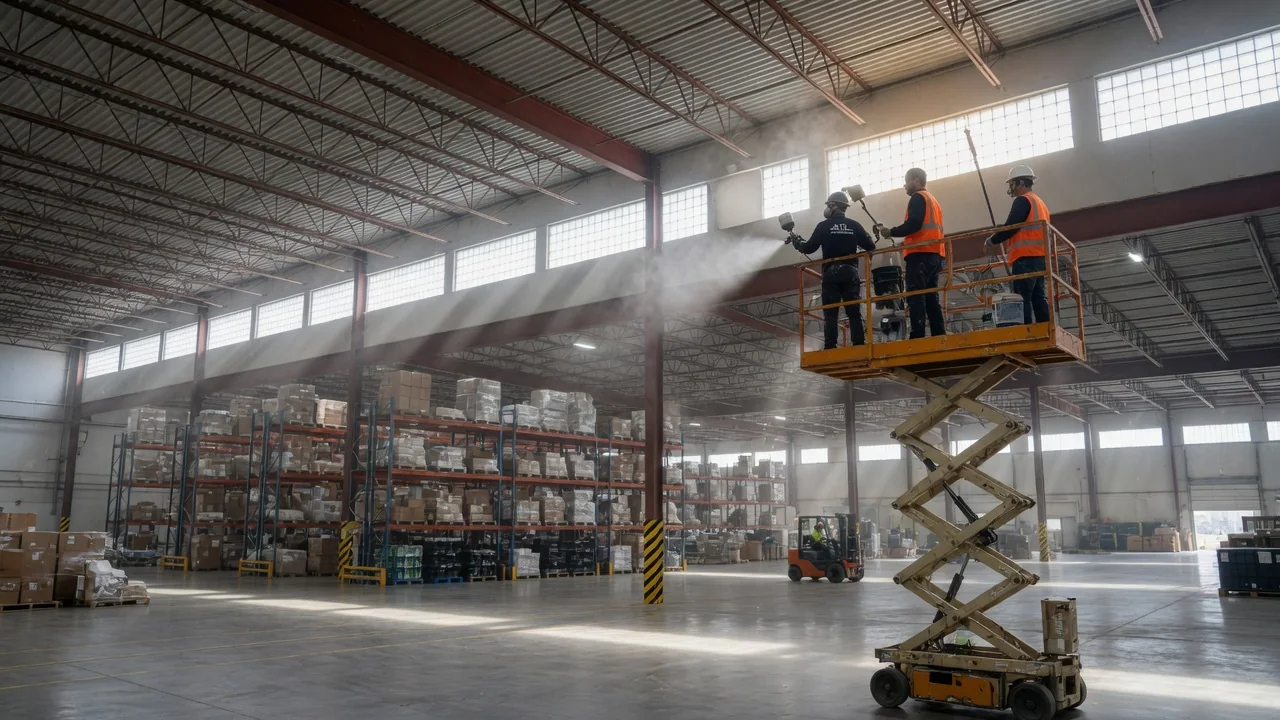
Warehouse and industrial painting in metro Atlanta typically runs about $1.50–$3.00 per square foot for standard interior wall-and-ceiling work, with specialty industrial coatings reaching $4.00–$7.00 or more (published 2026 market ranges). The biggest cost drivers are ceiling clear-height, surface type (CMU block vs. exposed metal deck), the coating system, and whether the facility stays running during the work.
That is the short version. The rest of this breaks down where those ranges come from, the six factors that actually move your number, and why a warehouse quote often carries two different units of measure. If you manage a distribution center or a plant, you already know the headline per-square-foot figure is only useful once you know what shell it is being applied to — a 16-foot painted-block office-warehouse and a 32-foot exposed-steel industrial bay are different jobs at different prices.
What does warehouse & industrial painting cost per square foot in Atlanta? (2026)
Per square foot is the number everyone asks for, and it is also the number most likely to mislead on an industrial building — because the surface and the ceiling height can nearly double it. Here is how the published ranges break down by type of work.
Interior walls and ceilings — the standard range
Published 2026 cost data puts standard warehouse interior wall-and-ceiling painting at roughly $1.50–$3.00 per square foot. That tracks with the broader commercial numbers the same guides list — general commercial painting around $2–$6 per square foot, with interior work near $1.50–$4.00. The low end is a straightforward repaint of accessible painted block or drywall; the high end is higher-clearance space or a surface that needs more prep and material.
These figures are current published averages for the 2026 market, meant for early budgeting — not a quote. Your surface type, ceiling height, coating spec, and square footage set the real number, which is exactly what a walkthrough sizes up.
Specialty and industrial coatings — the higher range
When the job calls for more than standard interior paint, the numbers climb. Industry cost guides list specialty and industrial coatings — direct-to-metal (DTM) primers, epoxies, and urethanes — at $4.00–$7.00+ per square foot as of mid-2026. Two things drive that: the coatings themselves cost more per gallon than standard interior latex, and the surfaces that need them — exposed structural steel, process equipment, high-abrasion or wash-down areas — demand tighter surface prep to bond correctly. This is the same coating discipline that governs specialty environments like low-particulate painting inside a live data center.
Exterior and building-shell painting
Painting the outside of a warehouse or plant is its own line. Published data puts commercial exterior painting at roughly $2.00–$5.00 per square foot. A building shell adds prep for weathered masonry or metal panel, height and access on tilt-up or tall walls, and weather-window scheduling. The surface still rules the price: tilt-up concrete, CMU block, and pre-finished metal panel each behave differently and take different systems.
The 6 factors that actually move the number
Every warehouse quote is really a stack of six variables. Understanding them is what lets you read one contractor's number against another's instead of just comparing headline rates.
1. Ceiling clear-height and access
Height is the biggest single driver most people underestimate. A tall warehouse means lifts or scaffolding, slower production, and far more spray-versus-roll work up in the structure. Published data lists ceiling painting anywhere from about $1.50 to $5.50+ per square foot, with clear-height doing most of the pushing, and lift or scaffolding rental commonly running $500–$1,500+ per day. A 32-foot clear bay costs meaningfully more per square foot than a 16-foot one for the exact same coating.
2. Surface type — CMU block vs. exposed metal deck
What you are coating changes both the product and the labor. CMU (concrete block) is porous and needs a block filler before topcoat to fill the pinholes and give a sound surface — that filler step roughly doubles the material spend on those walls. Exposed metal deck and structural steel need a direct-to-metal (DTM) primer and an industrial topcoat, not standard wall paint. Two warehouses of identical square footage can price very differently on surface alone.
3. Surface prep and existing-coating condition
Prep is where a quote is honest or it is not. Sound, previously painted surfaces need cleaning and spot priming. Failing, peeling, chalking, or contaminated coatings need pressure washing, scraping, abrasive prep, or full removal before anything new goes on — and a coating is only as good as the surface under it. A bid that skips prep to hit a lower number is not cheaper; it is a callback waiting to happen once the new coat lifts off the old one.
4. Coating system spec
The system — primer, mid-coat, topcoat, and how many mils of each — is a real cost lever. A single-coat refresh of sound block is one number; a full DTM-primer-plus-industrial-urethane system on exposed steel in a wash-down area is another entirely. The right spec is set by the environment: abrasion, moisture, chemical exposure, and how hard the space works. Material costs are also a moving target — industry data shows paint and coating materials up roughly 4–6% from 2025 into 2026.
5. Facility size and efficiency
Bigger jobs usually carry a lower unit price. Mobilization, setup, and lift rental get spread across more square footage, and long uninterrupted runs let a crew hit better production rates than a chopped-up small job. A 200,000-square-foot warehouse will generally price lower per square foot than a 15,000-square-foot bay for comparable work — useful to know when you are budgeting a large single building versus a small one.
6. Operational constraints — painting around a running facility
Most warehouses cannot go dark. Painting around live operations — working zone by zone, on off-shifts or weekends, with containment to keep overspray and odor off active racking and inventory — adds coordination and can stretch the schedule. That is a legitimate cost factor, and it is also the whole point: phasing avoids the far larger cost of shutting the building down. On the labor side, remember that industry data puts labor at roughly 70–85% of a paint project's total cost — so anything that changes crew efficiency, like night work or tight access, moves the number more than the paint itself does.
Square footage vs. linear footage — why your quote has two units
A warehouse painting quote often mixes two units of measure, and it trips people up. Walls and ceilings are priced per square foot, because you are covering an area. Aisle striping, safety lines, and floor markings are priced per linear foot, because you are covering distance, not area. They are different scopes with different crews and materials, so they belong on separate line items.
If your project includes both wall repaint and floor safety markings, ask for them broken out so the units are unambiguous. Floor markings and aisle lines are frequently paired with floor-coating work — commercial epoxy flooring or striping and pavement markings — rather than bundled into wall painting, which is another reason they carry their own unit and their own number. If a floor coating is part of the same job, our warehouse epoxy floor cost breakdown walks through the per-square-foot ranges the same way this guide does for paint.
What a warehouse painting quote should include
A quote you can actually compare and trust spells out the scope instead of leaving it to assumption. Look for these five things:
Prep scope. Exactly how the surfaces will be cleaned and prepared — washing, spot priming, abrasive prep, or removal — not just "prep as needed." Coating spec sheet. The named products, the system (primer/mid/topcoat), and the mil thickness, so you know what is going on the wall and steel. Phasing and downtime plan. Which zones, on what schedule, and how the work fits around your operations. Containment. How overspray, dust, and odor are kept off inventory, equipment, and active areas. Warranty. What is warranted and for how long. A quote missing these is not necessarily cheaper — it is just less defined, and undefined scope is where change orders live.
How to budget your project — a worked example
Here is how the published ranges translate into an order-of-magnitude budget. Take a 100,000-square-foot warehouse interior at the standard published range of $1.50–$3.00 per square foot. That math lands you in a band of roughly $150,000 to $300,000 for standard wall-and-ceiling work — and if a meaningful portion needs specialty industrial coating at $4.00–$7.00+ per square foot, that portion prices well above the standard band.
This is illustrative math on published 2026 market averages to show how the ranges scale — it is not a quote, and no real project prices as a flat rate across the whole building. Ceiling height, surface mix, coating spec, prep condition, and phasing all move it. A walkthrough replaces this band with a scoped number.
The point of running the math this way is to get an order-of-magnitude budget for planning — a range wide enough to be honest and narrow enough to be useful — before you invest in a detailed scope. The single biggest swing factor is how much of your square footage needs standard interior paint versus specialty industrial coating. If painting is part of a larger interior project, the same range-then-scope approach applies to the whole job — see how the numbers stack up in our Atlanta commercial build-out cost breakdown.
Getting a real number for your building
The published ranges are a planning tool. Your actual number comes from the specifics: how high the ceilings run, whether you are coating painted block or exposed steel, what shape the existing coatings are in, the system the environment calls for, and how the work has to phase around your operations. Those are the six levers above, and they are exactly what a walkthrough reads.
SECOMM handles warehouse painting and commercial & industrial painting across metro Atlanta — distribution centers, plants, and large facilities — phased around live operations, with the coating system matched to the environment rather than a one-size-fits-all spec. Because we run every trade under one roof, floor coatings, safety striping, and wall work can be sequenced together instead of chased across separate vendors.
The most useful next step is a walkthrough. We see the ceiling height and surface condition for ourselves, spec the coating system to the environment, and hand you a scoped estimate with the phasing plan in it — not a flat per-foot rate that shifts once we are on site. Request a walkthrough and we will build the number around your building and your operating schedule.
Frequently asked questions
How much does it cost to paint a warehouse per square foot in 2026?
Published 2026 cost data puts standard warehouse interior wall-and-ceiling painting at roughly $1.50–$3.00 per square foot, with specialty industrial coatings such as direct-to-metal, epoxy, and urethane reaching $4.00–$7.00 or more per square foot. Where you land depends on ceiling clear-height, whether you are coating CMU block or exposed metal deck, the coating system spec, and the total square footage. Those are planning averages — a walkthrough gives you a firm number for your building.
Why is industrial coating more expensive than standard warehouse painting?
Industrial coatings cost more because both the material and the prep are more demanding. Direct-to-metal primers, epoxies, and urethanes are more expensive per gallon than standard interior latex, and the surfaces that need them — exposed steel, process equipment, high-abrasion or chemical-exposure areas — require tighter surface prep to bond correctly. That is why published data lists specialty industrial coatings at $4.00–$7.00+ per square foot versus $1.50–$3.00 for standard interior work as of mid-2026.
Does ceiling height change my painting cost?
Yes, significantly. Higher clear-height means lifts or scaffolding, slower production, and more spray-versus-roll work, all of which raise the per-square-foot cost. Published data lists ceiling painting anywhere from about $1.50 to $5.50+ per square foot, driven largely by height, and lift or scaffolding rental commonly runs $500–$1,500+ per day. A 32-foot clear warehouse costs more per square foot to paint than a 16-foot one for the same coating.
Can you paint a warehouse without shutting down operations?
In most cases, yes. Warehouse and industrial painting is routinely phased around operations — working zone by zone, on off-shifts or weekends, with containment to keep overspray and odor away from active areas and inventory. Painting around a running facility does add coordination and can extend the schedule, which is a cost factor, but it avoids the far larger cost of shutting the building down. The phasing and downtime plan should be spelled out in the quote.
Are warehouse floor safety markings included in a painting quote?
Not automatically — and they are usually priced differently. Wall and ceiling painting is quoted per square foot, while aisle striping, safety lines, and floor markings are quoted per linear foot because they cover distance, not area. If you need both, ask for them as separate line items so the units are clear. Floor markings are often paired with epoxy or concrete floor coating work rather than wall painting.
How much does it cost to paint the exterior of a commercial building?
Published 2026 data puts commercial exterior painting at roughly $2.00–$5.00 per square foot, versus about $1.50–$4.00 for interior work. Exterior painting on a building shell adds surface prep for weathered masonry or metal, height and access considerations, and weather-window scheduling, all of which move the number. As with interior work, the surface type — CMU block, tilt-up concrete, or metal panel — and the coating system set the real figure.