
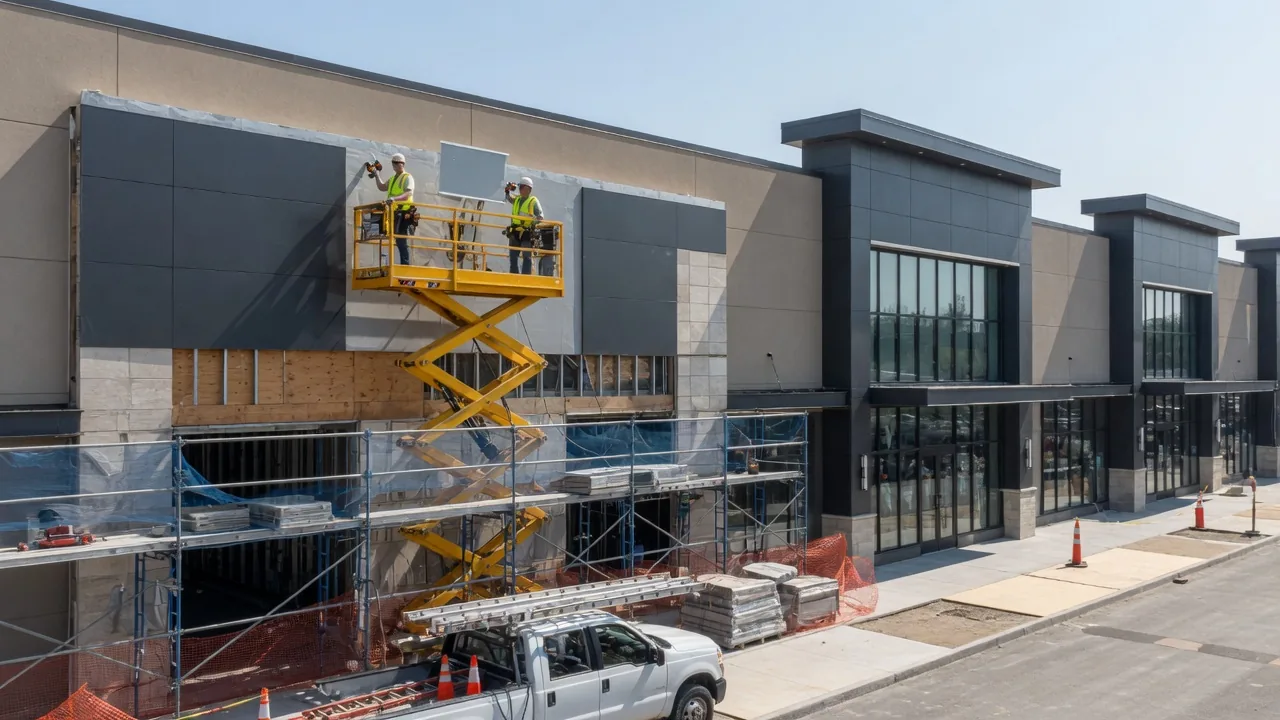
To roll out a standardized remodel across a multi-site portfolio, you run it as a program, not a string of projects: build one prototype and rollout kit, hire a single accountable partner instead of a different local GC per market, phase the work after-hours or section-by-section so locations stay open, and report status on a single rollup so every site matches and no store goes dark.
That is the short version. The rest of this is about why a portfolio rollout breaks the instincts that work fine on a single remodel, and what changes when you are doing the same scope forty or four hundred times across different cities. If you have run a one-off commercial remodel, you already know how to build a room. A program is a different discipline — repeatability, logistics, and consistency are the whole job.
Why a multi-site rollout is a different animal than one remodel
A single remodel is a project. You scope it, build it, close it out, done. A portfolio rollout is a program — the same scope executed across dozens of buildings, each with its own landlord, jurisdiction, operating hours, and existing conditions. The skill that matters is not building one great location. It is building the fiftieth location exactly like the third one, on schedule, without a site manager in Charlotte doing it differently than the one in Atlanta.
Three things separate a program from a project. Repeatability — every site has to match the standard, not the crew's best judgment that day. Consistency — a customer walking into your Marietta branch and your Alpharetta branch should not be able to tell they were built two years apart by different hands. Logistics — you are coordinating material orders, crews, permits, and store schedules across markets at the same time, which is a scheduling problem long before it is a construction problem.
The failure mode is predictable. Portfolio owners who treat each site as its own project end up with forty versions of the remodel, forty change-order fights, and a brand that looks slightly different in every market. The fix is upstream, in how the program is structured before the first site is touched.
Build the prototype and the rollout kit first
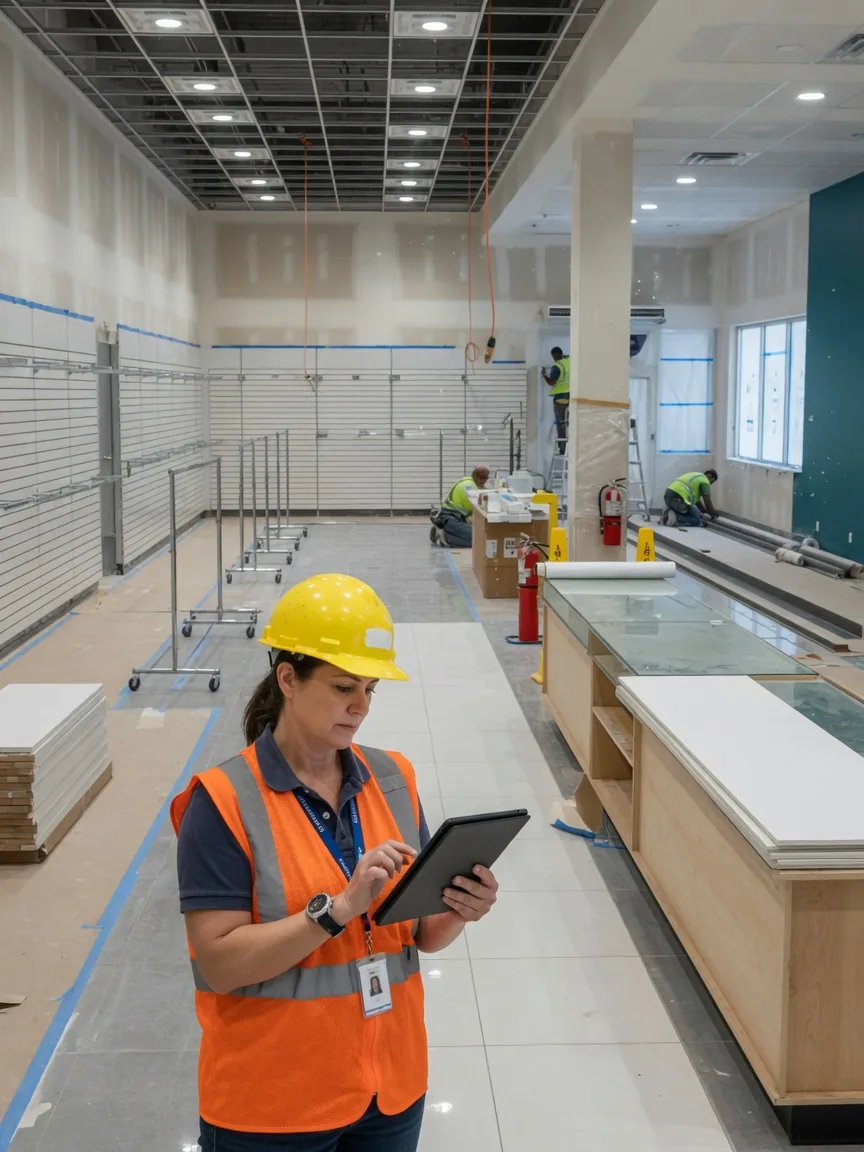
The single highest-leverage move in a multi-site program happens before construction: you build one site right, document everything, and turn it into a kit every later site is executed from. Get this wrong and you are re-deciding finishes at every location. Get it right and site number thirty is a copy job, not a design job.
The prototype site
Pick one location, build it to the exact standard, and treat it as the reference build. This is where you find the problems — the fixture that does not fit the older bank branches, the flooring transition that only works with a certain slab condition, the millwork that reads great in the rendering and installs slow in the field. You want those surprises on site one, not site nineteen. The prototype is also what leadership signs off on, so the standard everyone builds to is a real building, not a drawing.
The rollout kit
Once the prototype is approved, it becomes a documented package that every crew in every market works from. At minimum that kit is: standard drawings (the base plan and details that adapt to each site's footprint), a locked finish schedule (exact paint, flooring, ceiling, and surface specs — not "a light gray," the manufacturer and product number), and a fixture and equipment package (the specific lighting, casework, signage, and hardware, pre-sourced). When a site manager in Savannah and one in Chattanooga both pull from the same finish schedule, the buildings match. When they each pick "close enough," they don't.
The kit is also what makes volume pricing possible. You cannot negotiate a bulk rate on flooring across forty sites if every site specifies a different product. Standardization is what turns a portfolio's size into leverage instead of overhead.
One accountable partner vs. a different GC in every market
The instinct on a multi-market program is to hire a strong local GC in each city — they know the jurisdiction, they have crews there. It is a reasonable instinct and it is usually the wrong structure for a standardized rollout.
With a GC per market, you become the program manager by default. You are the one holding the standard, chasing why Nashville looks different than Atlanta, reconciling forty contracts, forty billing formats, forty interpretations of the finish schedule. Consistency erodes because there is no single party accountable for it across the portfolio — each GC is accountable only for their own sites.
A single accountable partner running the program flips that. One entity owns the standard, the schedule, and the rollup across every market. Regional crews still do the local work — the point is not that one crew drives to every city, it is that one program manager owns the outcome and the reporting. You get one contract structure, one point of escalation, and one party whose job is making site forty match site one. On a program where consistency is the deliverable, that structure is not a convenience — it is the mechanism that produces the consistency.
Phasing and scheduling to keep locations open
For a retail chain or a bank branch network, closing a location is lost revenue, and lost revenue across a portfolio adds up faster than the construction cost. The program has to be built around keeping stores operating, the same way a single occupied renovation is — just multiplied across the portfolio and mapped to each site's calendar.
Remodel while operating
Most branch and store remodels are done without closing the doors. The work is broken into sections — remodel the back half while the front stays open, then flip — or executed in overnight and weekend windows so the sales floor is whole by opening. Loud and dusty work is sealed off and scheduled outside operating hours. The customer sees a normal store; the work happens around them.
After-hours and weekend windows
A bank branch that closes at 5 gets its disruptive work after 6. A retailer open seven days gets overnight crews and a Sunday-night-to-Monday-morning finish so Monday opens clean. This costs a premium, and on a portfolio it is real money — but weigh it against a location dark for two weeks. Keeping the doors open almost always wins the math, which is why the after-hours premium belongs in the program budget from the start, not discovered site by site.
Sequencing across the portfolio
Beyond each site, the program itself is a sequence. You do not remodel every location at once — you run them in waves, so lessons from the first wave sharpen the second, crews stay loaded without overextending, and you never have too much of your own network under construction at the same time. A well-sequenced rollout also lets you pause between waves if sales data or a design tweak says to.
Keeping finishes and brand standards consistent across dozens of buildings
Consistency is the reason a portfolio standardizes in the first place, and it is the thing most likely to slip at scale. It slips for a boring reason: substitutions. A crew cannot source the specified flooring in time, grabs a lookalike, and now one branch is subtly off. Do that at ten sites and the brand standard is a suggestion.
The controls are unglamorous and they work. A locked finish schedule with no field substitutions without program-manager approval. Pre-sourced fixture and material packages ordered against the whole rollout, so availability is solved before a crew ever needs it. Sign-off at each site against the same checklist the prototype set. The consistency comes from the kit and the controls, not from hoping every crew makes the same call. This is also where a one-partner structure earns its keep — one party enforces the standard everywhere instead of forty parties each interpreting it.
Budgeting and cost control at program scale
A portfolio's size is its budget advantage, but only if the program is built to use it. Scale cuts cost in three ways a one-off remodel never sees.
Volume purchasing. A locked finish and fixture package across forty sites is a bulk order. Flooring, lighting, casework, paint — all of it prices better bought for a portfolio than site by site. Standardization is what unlocks it; you cannot bulk-buy forty different specs.
Value engineering, applied once. On the prototype, you find the spec that costs 30% more for a difference customers never notice, and you engineer it out — once, across every site. A cost decision made a single time and replicated portfolio-wide compounds in a way it never can on a lone project.
One contract instead of forty. A single program contract carries less administrative overhead than forty separate agreements — one billing structure, one set of terms, one reconciliation. For published market context, retail and branch remodels commonly run in the $50–$200-per-square-foot range as of 2026 depending on finish level and scope, and a standardized program tends to land tighter and more predictably within that band than one-off builds, because the scope is fixed and repeated rather than re-priced every time. Our own retail build-out costs breakdown walks through what moves the per-square-foot number.
Program pricing depends on total scope and site count, and the real numbers come from a walkthrough and portfolio assessment — not a per-site guess. The figures above are published market context for early planning, not a quote.
Managing permits across multiple jurisdictions
A single remodel deals with one permitting office. A portfolio deals with as many as it has cities, and every jurisdiction runs its own review timelines, submittal quirks, and inspection rhythm. Assume the process is the same everywhere and the program stalls the first time a market surprises you.
At program scale, permitting is a tracked workstream, not a step. The standard drawings get adapted to each jurisdiction's requirements and filed early, in parallel with material ordering, so the permit clock overlaps the rest of the schedule instead of stacking on top. The program manager knows which markets are slow and sequences those sites to start their permit process sooner. The advantage of running many sites is pattern knowledge — after a few markets, you know where the friction is and you plan around it instead of hitting it fresh every time.
Reporting and rollup: one view across every site
On a program, the facilities director's real question is not "how is this store doing" — it is "where does the whole portfolio stand right now." That is a reporting problem, and it is one of the clearest reasons to run the rollout through one accountable partner instead of assembling status from forty GCs.
The rollup shows every site's status on one view: which are complete, which are under construction, which are permitting, which are queued, plus budget against plan and any site off schedule. A director should be able to open one report and answer to leadership without emailing forty project managers. That single-source visibility is only possible when one party owns the whole program — with a GC per market, the rollup is a spreadsheet you maintain by hand, and it is always a little out of date.
Running your portfolio rollout as a program
The levers are all set before the first site is touched. Standard — build the prototype, lock the kit, so every site is a copy job. Structure — one accountable partner owning consistency, schedule, and the rollup, not a different GC per market. Sequence — waves that keep locations open, keep crews loaded, and let each wave sharpen the next.
SECOMM runs multi-site commercial remodeling programs across metro Atlanta and the surrounding region, every trade under one contract and one point of accountability. The program discipline — prototype, rollout kit, phased waves, jurisdiction-by-jurisdiction permitting, and a single status rollup — is how a standardized remodel stays standardized from site one to site fifty.
The right first step is a portfolio walkthrough and assessment. We look at your prototype standard, your site list, and your operating calendars, then build the rollout plan and a scoped program budget around keeping your locations open. Request a program assessment and we will map the rollout to your portfolio.
Frequently asked questions
How do you keep remodels consistent across many locations?
Consistency comes from a documented rollout kit, not from crews making similar calls. You build one prototype site, lock a finish schedule and a pre-sourced fixture package to exact product specs, and require sign-off at every site against the same checklist. With one partner enforcing that standard across all markets, site fifty matches site one.
Can you remodel our stores while they stay open?
Yes — most branch and store rollouts are done without closing. Work is broken into sections or run in overnight and weekend windows, with loud and dusty work sealed off and scheduled outside operating hours. The sales floor is whole by opening, so customers see a normal store while the remodel happens around them.
Should we hire one national contractor or a local GC in each market?
For a standardized rollout, one accountable partner is usually the better structure. A GC per market makes you the program manager by default and lets consistency drift, because no single party owns the standard across the portfolio. One partner gives you a single contract, one point of escalation, and one status rollup — while regional crews still do the local work.
How do you handle permits in different cities?
Every jurisdiction runs its own review timelines and submittal quirks, so permitting is tracked as its own workstream. The standard drawings are adapted to each market's requirements and filed early, in parallel with material ordering, so the permit clock overlaps the rest of the schedule. Slower markets get sequenced to start their permit process sooner.
How is a multi-site remodel program priced?
Program pricing is driven by total scope and site count, and a standardized rollout tends to price tighter than one-off builds because the scope is fixed and repeated. Volume purchasing, value engineering applied once, and a single contract all cut cost at scale. Published market context puts retail and branch remodels around $50–$200 per square foot as of 2026, but real numbers come from a portfolio walkthrough and assessment, not a per-site guess.