
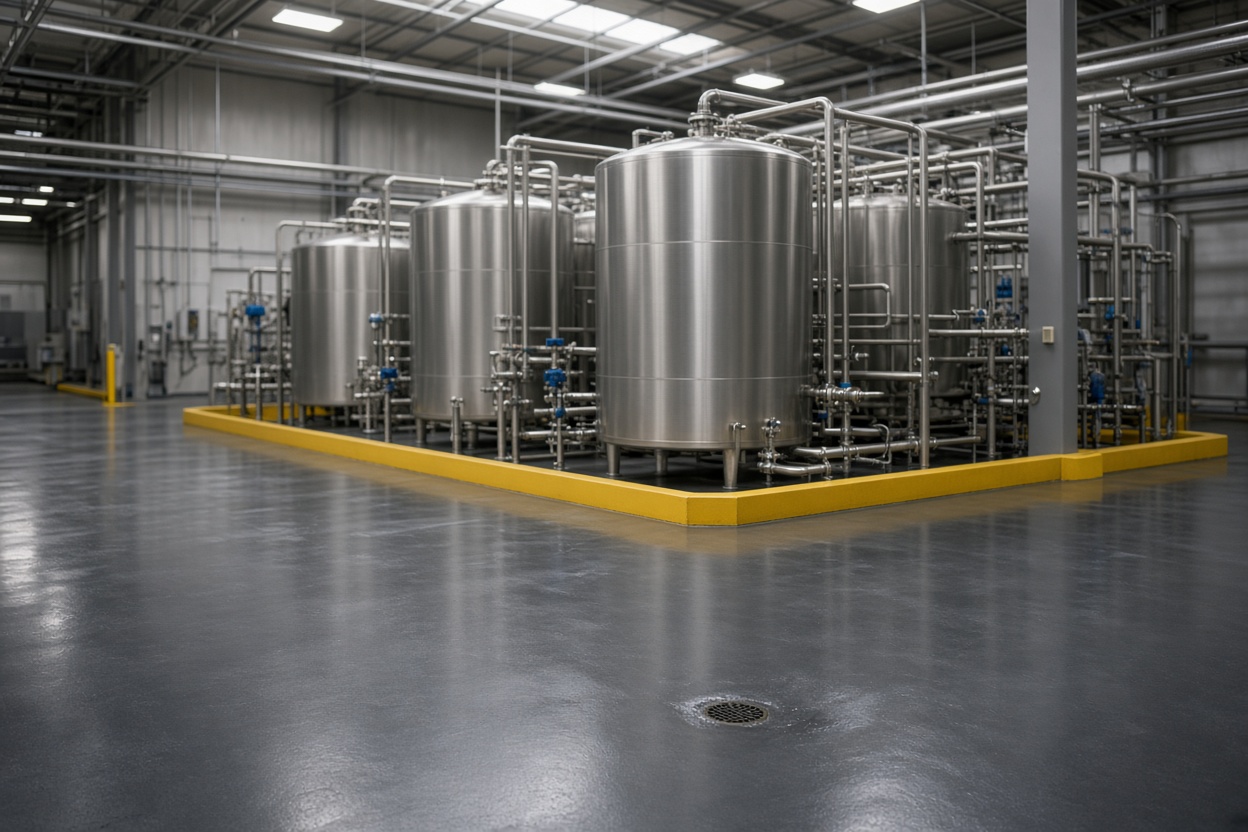
If a plant floor is softening, blistering, or peeling where chemicals hit it, here’s the short answer: standard bisphenol-A epoxy is not chemically inert, and under acids, solvents, or caustics it hydrolyzes, softens, and delaminates — which is exactly why acid-, solvent-, and process-chemical areas get specified with a novolac or other chemical-resistant system instead. Novolac epoxy’s higher crosslink density is what buys that resistance. But “chemical resistant” is not a yes/no property: whether any given system holds depends on the chemical’s concentration, the floor’s temperature, and whether the exposure is an occasional splash or continuous immersion. That’s the distinction we build into every commercial epoxy and resinous flooring project across metro Atlanta where chemistry is in play.
This matters because the spec gets written too loosely. A datasheet says “chemical resistant,” a boilerplate line says “acid resistant epoxy,” and the floor goes down — then fails in a year because nobody matched the coating to the 70% sulfuric at 120°F that actually lives in that bay. Here is what standard epoxy actually does under chemical load, what novolac changes, and how to specify a system that survives the chemicals your facility really handles.
Why standard epoxy fails under acids, solvents, and caustics
Most commercial epoxy floors are built on bisphenol-A epoxy — an excellent general-duty resin for abrasion, impact, and light chemical splash, which is why it covers most warehouse and plant floors. But its cured network is not designed to stand up to aggressive chemistry, and published chemical-resistance guides are direct about how it breaks down. According to industrial chemical-resistant flooring guides such as Sustainable Industrial Solutions’ complete guide, acids and caustics drive hydrolysis of the cured resin — the chemical attacks the bonds in the polymer — while solvents swell and soften the film. The two mechanisms converge on the same end state: loss of adhesion to the slab.
On a real plant floor that failure is easy to recognize once you know the sequence. It usually presents as softening and discoloration where the chemical sits, then blistering and chalking, and finally delamination — the coating lifts off the concrete in sheets or flakes. The moment the film softens or lifts, the chemical reaches the bare slab, and from there you’re no longer protecting concrete, you’re replacing floor. In a secondary-containment area the stakes are higher still: a delaminated containment coating no longer holds the spill it was installed to hold.
What novolac epoxy is — and why density is the whole point
Novolac epoxy is an epoxy phenol or cresol novolac resin. Where a standard bisphenol-A molecule carries two reactive epoxy groups, a novolac resin carries more of them along its backbone, so when it cures it forms a far tighter, more heavily linked three-dimensional network. Manufacturer datasheets for novolac linings — Ergon Armor’s Novocoat SC-3300 novolac epoxy lining and Epoxy.com’s Product #633 novolac coating among them — attribute the chemistry’s performance to exactly this higher crosslink density.
That density is not a marketing adjective; it is the mechanism. A more tightly crosslinked network gives the hydrolysis and solvent-swelling reactions fewer vulnerable points to attack and less room to penetrate, so the film holds its integrity against concentrated acids and aggressive solvents that would soften a bisphenol-A floor. This is why novolac systems are the ones specified for concentrated acid exposure, solvent contact, and aggressive process chemicals — and why they cost and cure differently than a general-duty floor. You spend the money where the chemistry demands it, not everywhere.
The core mistake: “acid resistant” without the three variables
Here is the single most important point in this entire article, and the one most specs get wrong: “acid resistant” means nothing on its own. Chemical resistance is not a property a coating either has or doesn’t — it is a function of three variables that have to be stated together:
- Concentration. A coating that holds 10% sulfuric acid can fail outright at 70%. The same reagent at a different strength is, for coating-selection purposes, a different chemical.
- Temperature. Resistance that is fine at ambient can collapse when the floor runs hot — elevated temperature accelerates chemical attack, so a hot process area is more demanding than the same spill cold.
- Exposure duration and mode. An occasional splash and spill that gets cleaned up is a far lighter duty than continuous immersion or standing contact. A system rated for splash can fail under immersion.
Published chemical-resistance guides make the same point: a system that comfortably handles a dilute reagent at room temperature as an occasional splash can fail when that reagent shows up concentrated, hot, or standing. So a spec line that reads “acid-resistant epoxy” tells a coatings contractor almost nothing actionable. “Resistant to 30% sulfuric acid, intermittent splash, up to 100°F” tells them exactly what to select against.
How to read a chemical-resistance chart
Every reputable chemical-resistant product publishes a chemical-resistance chart: reagents listed down one axis, each rated — typically Resistant / Limited / Not Recommended — and broken out by concentration, often with temperature and exposure notes. A chart is only useful if you read it against your own facility, not in the abstract. Drawing on published chart-reading guidance, the discipline is:
| Rating on the chart | What it means | What to do with it |
|---|---|---|
| Resistant | Holds the reagent at the stated concentration, temperature, and exposure | Acceptable for that exact condition — confirm the concentration and temperature on the chart match yours |
| Limited | Tolerates occasional splash/spill but not prolonged contact or immersion | Only acceptable if your exposure is genuinely intermittent and cleaned up; not for standing or immersion duty |
| Not Recommended | Degrades under that reagent/condition | Rules the system out for any area that handles that chemical — one such hit is disqualifying |
| Same reagent, higher concentration | Often shifts from Resistant to Limited or Not Recommended | Match the chart line to your actual concentration, never a weaker one |
| Same reagent, elevated temperature | Ratings typically drop as temperature rises | Use the hottest realistic floor temperature in that area, not ambient |
The non-negotiable step is mapping your actual chemical inventory and SDS sheets against the chart. List every reagent that contacts the floor, with its real concentration, the floor temperature in that area, and whether it’s a splash or standing/immersion exposure — then check each one. A single Not Recommended for a chemical you genuinely handle disqualifies that system no matter how well it does on everything else.
Where chemical-resistant and novolac systems get specified
These systems aren’t a whole-building default — they’re specified for the specific areas where aggressive chemistry contacts the floor:
- EPA SPCC secondary containment. Under the U.S. EPA’s Spill Prevention, Control, and Countermeasure (SPCC) rule, facilities storing oil above threshold quantities must provide secondary containment — curbed, sealed areas sized to hold a spill. Where that containment also sees acids or solvents, a chemical-resistant lining is what keeps the containment impermeable.
- Battery charging & plating rooms. Sulfuric acid from battery charging and the acid/caustic baths of plating lines are classic novolac-system environments.
- Chemical manufacturing & process areas. Reactor bays, mixing areas, and transfer zones where concentrated process chemicals are routine.
- Laboratories. Reagent handling and frequent spot spills of a wide and changing mix of chemicals.
System build and surface prep — the parts that make the chemistry work
Resin chemistry is only half the specification. Published industry ranges describe chemical-resistant floors built at different film-thickness bands for different duty: thinner coating builds for splash-and-spill service, and substantially heavier mortar or broadcast builds where the floor faces both mechanical abuse and chemical immersion — the added thickness and aggregate carry impact and abrasion while the resin carries the chemistry. Those are published industry ranges for how these systems are assembled; the right build for a given room is a project-specific engineering call, not a number to copy off a blog.
The step that quietly voids all of it is surface preparation. A chemical-resistant resin is only as good as its bond to the slab, and manufacturer datasheets condition their chemical-resistance ratings on proper concrete preparation and profile. If the resin isn’t bonded to a correctly prepared, profiled substrate, the chemical simply reaches the bond line and the floor delaminates anyway — chemically resistant resin over bad prep still fails. For immersion-grade linings over steel, datasheets commonly reference an SSPC-SP 10 / NACE No. 2 near-white metal blast as the required surface condition. Slab readiness and moisture are part of the same discipline — see why commercial epoxy floors fail to moisture and vapor for the prep and slab-readiness side of this.
Chemical resistance is one of several failure modes — match the system to the threat
Chemical attack is one specific failure mode, and the right answer depends on which threat your floor actually faces. A floor failing to chemicals needs a novolac or other chemical-resistant system; a floor failing to thermal shock and hot washdown — a brewery, dairy, or commercial kitchen line — is a different problem with a different answer, covered in urethane cement vs. epoxy for food & beverage washdown. And if you’re weighing resin systems more broadly for a general plant or warehouse floor, the epoxy vs. polyaspartic vs. urethane comparison lays out the trade-offs. The common thread: you don’t pick a floor by brand, you pick it by the threat you’re defending against.
The decision cue: hand over the chemical list
If you take one action from this page, make it this: before you talk price or product, build the list your coatings contractor actually needs — every chemical that contacts the floor, its concentration, the floor temperature in that area, and whether the exposure is splash or immersion. Pull it straight from your SDS inventory. Hand that list over, and the right system gets specified the first time instead of discovered after the first floor fails. A contractor who asks for that list before quoting is specifying to your facility; one who quotes “acid-resistant epoxy” off a photo is guessing.
One honest limit belongs on every project: specific chemical-resistance ratings must be confirmed against the manufacturer’s current published chart for your facility’s actual reagents, concentrations, temperatures, and exposure mode. Southeast Commercial Services does not certify chemical resistance — we specify and install to the manufacturer’s documented ratings for the chemicals you give us, and point you to the chart that governs them.
Frequently asked questions
Why does standard epoxy fail under acid or solvent exposure?
Standard flooring epoxy is a bisphenol-A system, and its cured network is vulnerable to chemical attack. Published chemical-resistance guides and manufacturer datasheets describe the failure modes: acids and caustics drive hydrolysis of the cured resin, solvents swell and soften the film, and the combined effect breaks the bond to the slab, which presents on a plant floor as softening, blistering, discoloration, chalking, and eventually delamination where the coating lifts off the concrete. Once the film softens or lifts, the chemical reaches the slab directly and the floor has effectively failed.
What is novolac epoxy and why is it more chemical resistant?
Novolac epoxy is an epoxy phenol or cresol novolac resin — a chemistry with more reactive epoxy groups per molecule than standard bisphenol-A epoxy. Manufacturer datasheets for novolac linings, such as Ergon Armor’s Novocoat SC-3300 and Epoxy.com Product #633, attribute its performance to a much higher crosslink density: the cured network is tighter and more tightly bonded, which resists the hydrolysis and solvent swelling that degrade standard epoxy. That density is why novolac systems are specified for concentrated acids, solvents, and aggressive process chemicals.
Is “acid resistant” enough to specify a floor coating?
No. “Acid resistant” is meaningless without three variables: concentration, temperature, and exposure duration. Published chemical-resistance guides are clear that a coating which holds 10% sulfuric acid at ambient temperature can fail at 70% concentration or at elevated temperature, and splash-and-spill exposure is far less demanding than continuous immersion. A coating has to be matched to the actual reagent, its actual concentration, the floor temperature, and whether the exposure is an occasional splash or standing contact — not to the word “acid” alone.
How do I read a chemical-resistance chart for a floor coating?
A chemical-resistance chart lists reagents down one axis and typically rates each as Resistant, Limited, or Not Recommended, broken out by concentration and sometimes by temperature and exposure mode. The correct way to use one, as published chart guides describe, is to take your facility’s actual chemical inventory and SDS sheets, list every reagent that contacts the floor with its real concentration and temperature, and map each line against the chart. A single “Not Recommended” for a chemical you actually handle rules that system out, regardless of how it performs on everything else.
Where are novolac or chemical-resistant floor systems required?
Chemical-resistant and novolac systems are specified wherever aggressive chemicals contact the floor: EPA SPCC secondary containment areas, battery charging rooms and plating rooms, chemical manufacturing and process areas, and laboratories. Under EPA’s SPCC rule, facilities storing oil above threshold quantities must provide secondary containment such as curbed, coated areas able to hold a spill — and where that containment also sees acids or solvents, a chemical-resistant lining is what keeps the containment intact.
Does surface prep affect chemical resistance?
Yes — chemical-resistant performance is void without proper surface preparation. Manufacturer datasheets condition their chemical-resistance ratings on correct concrete preparation and profile; a chemically resistant resin that is not bonded to a properly prepared, profiled substrate will still delaminate, because the chemical reaches the bond line. For immersion-grade linings over steel, datasheets commonly reference an SSPC-SP 10 / NACE No. 2 near-white metal blast. The resin chemistry and the surface prep are a matched pair, not independent choices.