
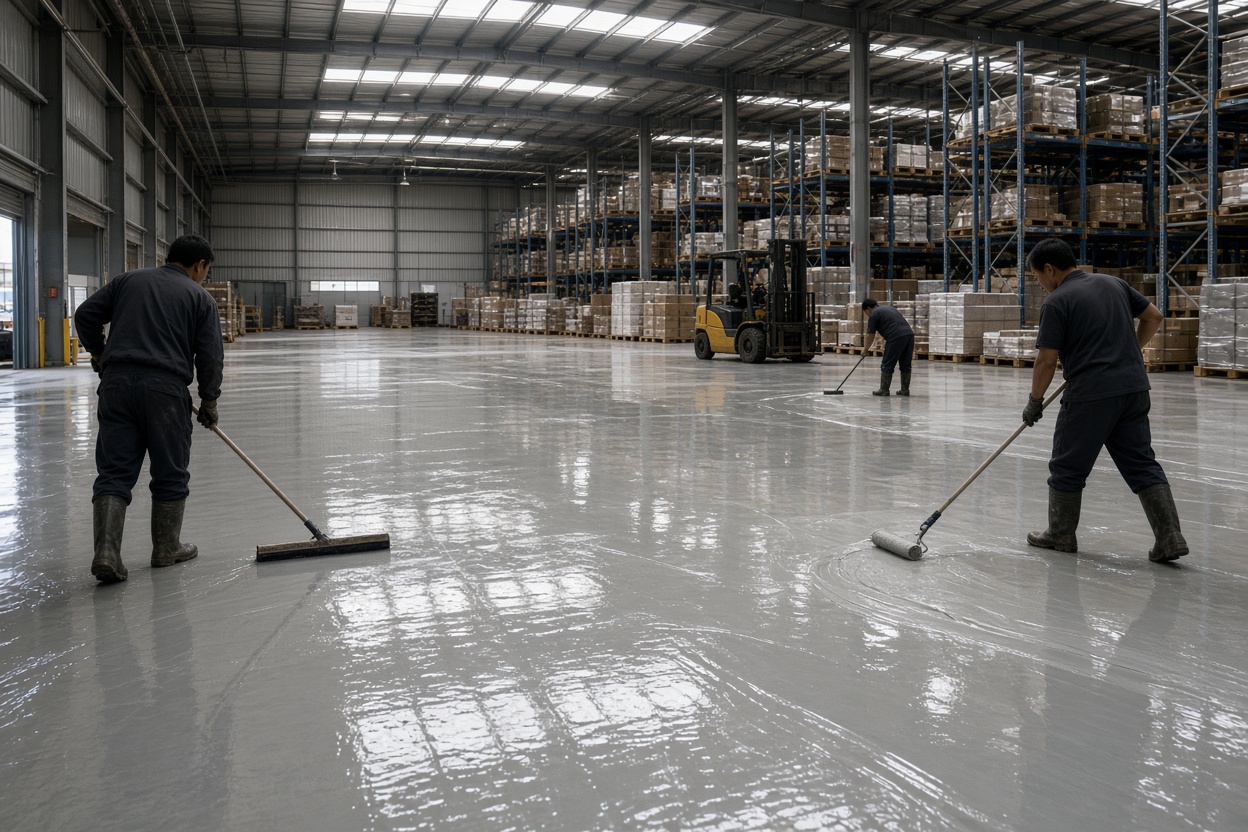
If you’re re-coating a warehouse floor and trying to choose between epoxy, polyaspartic, and urethane, here’s the direct answer: for most working warehouses you don’t pick one — you layer them, with a high-build epoxy base for fill and adhesion topcoated by a polyaspartic or aliphatic urethane wear layer for fast return-to-service, UV stability, and forklift wear. The decision that actually matters is which topcoat goes over the epoxy, and you choose it by how much downtime you can tolerate, how much natural light the floor gets, and what runs across it. That layered approach is how we scope most commercial epoxy and resinous floor coatings for metro-Atlanta warehouses and plants.
The reason this gets confusing is that each product is marketed as if it’s a complete system. It isn’t. Epoxy, polyaspartic, and urethane are different chemistries with different strengths, and the published industrial-coating guides that compare them — Jinyu Paint, Memphis Coatings, and others — keep arriving at the same conclusion: match the chemistry to the job, then combine them. Here’s what each one actually does and how a facility manager should decide.
The three chemistries in one line each
Before the trade-offs, the plain identity of each system, as described in published industrial-coating references:
- Epoxy — a rigid, high-build resin that bonds strongly to prepared concrete and fills surface imperfections. It’s the workhorse base layer: great adhesion and build, but relatively brittle and not UV-stable on its own.
- Polyaspartic — a fast-curing aliphatic polyurea that is UV-stable and returns to service quickly. Used mainly as a topcoat, it’s the system you reach for when downtime is the constraint.
- Urethane (polyurethane) — a more flexible, abrasion- and chemical-tolerant wear layer. Its flexibility lets it absorb impact and resist the scuffing and point-loading that cracks brittle epoxy.
None of these is “best” in isolation. Epoxy bonds and builds, polyaspartic cures fast and shrugs off sunlight, urethane takes abuse. The question is which combination fits your floor.
The decision point: downtime and return-to-service
For a warehouse that can’t simply stop operating, cure time is usually the first thing that eliminates options. This is where the chemistries separate most sharply.
Per published return-to-service guidance (All Source Supply; Jinyu Paint), polyaspartic coatings commonly accept light foot traffic in roughly 2–4 hours and reach full service in about 24 hours. That fast cure is the entire reason polyaspartic exists as a topcoat — you can coat over a weekend and be running Monday.
Standard epoxy is slower by design. Industry coating guides describe roughly 24–72 hours between coats, with commonly about 5–7 days of cure before the floor should take heavy forklift and hard-wheel traffic. That’s a meaningful shutdown window for a busy distribution center, and it’s the single biggest reason a pure-epoxy build gets ruled out in a facility that runs seven days a week. If downtime is your constraint, the deeper mechanics of coating a floor in sections without stopping operations are worth reading in our piece on epoxy floor coating downtime and phasing.
These are published industry ranges. They vary with the specific product, film thickness, and — a big one in Atlanta — temperature and humidity at the time of install. They are not figures we guarantee for a given floor; they’re the planning numbers you use to size the shutdown.
UV and yellowing: where the floor sees daylight
The second axis that changes the answer is sunlight. Standard epoxy ambers — yellows — under UV exposure. Published coating guides commonly cite visible yellowing within roughly 6–12 months anywhere the floor sees direct or reflected sunlight. In a windowless interior that doesn’t matter. Near dock doors that stay open, under skylights, or along a glazed wall, it shows up fast and looks like a failure even when the coating is structurally fine.
Polyaspartic and aliphatic urethanes are UV-stable and resist that ambering, which is exactly why they’re used as topcoats in daylit areas. One honest caveat worth building into the spec: a clear UV-stable topcoat laid over a standard epoxy base can still let the epoxy base yellow underneath, which telegraphs through the clear layer. For bays with real natural-light exposure, a UV-stable or fully pigmented base — not just a clear topcoat over amber-prone epoxy — is the more durable call.
Forklift wear, abrasion, and impact
The third axis is traffic. Warehouse floors don’t fail from foot traffic — they fail from hard-wheel forklifts, pallet jacks, point-loading from racking, and dropped loads. Here the ranking published in industrial-coating guides is consistent: urethane’s flexibility gives it the edge in abrasion and impact resistance over brittle epoxy, because a slightly flexible film absorbs impact and resists cracking where a rigid one chips. Polyaspartic topcoats also wear well and add hardness and chemical resistance.
That’s why the pure-epoxy floor that looked fine on day one can spider-crack and chip in the main forklift lanes within a year or two of heavy traffic, while the same epoxy base under a urethane or polyaspartic wear layer holds up. Epoxy is doing the job it’s good at — bonding and building — and the topcoat is doing the job epoxy is bad at.
The hybrid that usually wins
Put the three axes together and the recommendation most published guides converge on for a working warehouse is a hybrid system: a high-build epoxy base coat for fill, adhesion, and build, topcoated with a polyaspartic or urethane wear layer for fast cure, UV stability, and abrasion resistance. You get epoxy’s strengths where they matter (down on the slab) and the topcoat’s strengths where they matter (up top, facing the traffic and the sun).
This is also the honest answer to the cost question. Polyaspartic and urethane topcoats cost more per square foot in material than epoxy. But published industry framing (Jinyu Paint) points out that fast-curing floors cut return-to-service time sharply, and the lost-production hours avoided during a shorter shutdown can offset the higher coating cost in a facility that can’t afford to stop. The real comparison isn’t coating cost against coating cost — it’s the material premium against the value of the production hours each system’s cure window takes off the table. In a high-throughput distribution center, the faster system is often cheaper once downtime is priced in; in a floor that can sit idle for a week, the premium may not be worth it. That math depends on your operation, not a universal number.
| Epoxy | Polyaspartic | Urethane | |
|---|---|---|---|
| Role in the system | Rigid high-build base — adhesion & fill | Fast-cure, UV-stable topcoat | Flexible, abrasion- & chemical-tolerant wear layer |
| Return-to-service / downtime | ~24–72 hrs between coats; commonly ~5–7 days before heavy forklift traffic | Light foot ~2–4 hrs; full service ~24 hrs | Varies by product; generally faster than epoxy, often used with a polyaspartic-speed cure schedule |
| UV stability | Ambers under UV — visible yellowing commonly ~6–12 months in daylight | UV-stable — resists yellowing | Aliphatic urethane is UV-stable — resists yellowing |
| Forklift / abrasion wear | Hard but brittle — can chip & crack under impact and point loads | Hard, good wear & chemical resistance as a topcoat | Best impact & abrasion tolerance — flexibility resists cracking |
| Best-fit area | Base layer; interior, low-light, lower-impact zones on its own | Topcoat where downtime is tight and the floor sees daylight | Topcoat for the heaviest forklift lanes, dock areas, impact zones |
A short selector for facility managers
If you want a quick way to narrow it down before a contractor walks the floor, decide against these five questions:
- How much downtime can you tolerate? Tight window / can’t stop → polyaspartic topcoat for the fast cure. Can sit idle for a week → a standard epoxy build may be fine.
- How much natural light / UV does the floor get? Dock doors, skylights, glazed walls → UV-stable topcoat (polyaspartic or aliphatic urethane), and consider a UV-stable or pigmented base. Windowless interior → UV is a non-issue.
- What traffic type runs on it? Heavy forklift / hard-wheel / impact → lean urethane or a urethane wear layer. Mostly foot traffic → the topcoat choice is driven more by downtime and UV.
- What chemical exposure does it face? Oils, solvents, washdown → favor chemical-tolerant urethane or polyaspartic topcoats over bare epoxy.
- What are the temperature swings? Floors that cycle through big temperature changes (near open docks, refrigerated zones) favor the flexibility of urethane over rigid epoxy.
Before any chemistry: the slab has to be ready
One point that applies no matter which system you pick: adhesion and long-term wear depend on the concrete being sound and dry enough to coat, and on proper surface prep — not on the coating chemistry. Published practice calls for concrete moisture testing under standards such as ASTM F3010 (bond and moisture evaluation for resinous coatings) and ASTM F2170 (relative humidity in the slab using in-situ probes) before coating. A fast-curing polyaspartic or urethane topcoat does not rescue a wet or poorly prepared slab.
This matters because moisture is one of the most common reasons warehouse coatings fail early — the floor delaminates or bubbles regardless of how good the topcoat is. If you’re weighing a re-coat, read why commercial epoxy floors fail from moisture vapor before you spec a system, so the testing happens before the coating goes down rather than after it lifts. And if the real question is whether you want a resinous coating at all, our comparison of polished concrete vs. epoxy frames when a coating beats a ground-and-sealed slab.
Frequently asked questions
Which floor coating system is best for a working warehouse?
For most working warehouses, a hybrid system wins: a high-build epoxy base coat for fill, adhesion, and build, topcoated with a polyaspartic or aliphatic urethane wear layer for fast return-to-service, UV stability, and abrasion resistance. Industry coating guides (Jinyu Paint, Memphis Coatings) describe this layered approach because no single chemistry is strongest on every axis — epoxy bonds and builds, while the topcoat handles cure speed, sunlight, and forklift wear. Pick the exact topcoat by how much downtime you can tolerate, how much natural light the floor gets, and the traffic type.
How long before you can drive a forklift on a new epoxy or polyaspartic floor?
Per published return-to-service guidance (All Source Supply; Jinyu Paint), polyaspartic coatings commonly accept light foot traffic in roughly 2 to 4 hours and full service in about 24 hours. Standard epoxy systems are slower — industry guides describe roughly 24 to 72 hours between coats and commonly about 5 to 7 days of cure before heavy forklift and hard-wheel traffic. These are published industry ranges that vary with product, film thickness, and temperature, not figures Southeast Commercial Services guarantees for a specific floor.
Does epoxy flooring yellow in sunlight?
Standard epoxy ambers (yellows) under UV exposure — published coating guides commonly cite visible yellowing within roughly 6 to 12 months where the floor sees sunlight. Polyaspartic coatings and aliphatic urethanes are UV-stable and resist that ambering, which is why they are used as topcoats near dock doors, skylights, and windows. One caveat: a clear UV-stable topcoat over a standard epoxy base can still let the epoxy base yellow underneath, so for high natural-light bays a UV-stable or pigmented base is the more durable choice.
Is polyaspartic or urethane worth the higher cost over epoxy?
Polyaspartic and urethane topcoats cost more per square foot than epoxy in material, but published industry framing (Jinyu Paint) points out that fast-curing floors cut return-to-service time sharply, and the lost-production hours avoided during a shorter shutdown can offset the higher coating cost in a facility that cannot stop operating. The honest way to decide is to weigh the material premium against the cost of the downtime window each system requires for your specific operation — a calculation that depends on your production value per hour, not a universal figure.
What is the difference between epoxy, polyaspartic, and urethane floor coatings?
Epoxy is a rigid, high-build resin that bonds well to prepared concrete and fills imperfections — the workhorse base layer. Polyaspartic is a fast-curing aliphatic polyurea that is UV-stable and returns to service quickly, used mainly as a topcoat. Urethane (polyurethane) is a more flexible, abrasion- and chemical-tolerant wear layer that handles impact and forklift traffic better than brittle epoxy. In practice they are layered rather than chosen in isolation, per published industrial coating guides (Jinyu Paint, Memphis Coatings).
Do I still need concrete moisture testing if I use a fast-curing coating?
Yes. Regardless of chemistry, adhesion and long-term wear depend on the slab being sound and dry enough to coat, and on proper surface prep. Published practice calls for concrete moisture testing under standards such as ASTM F3010 (bond and moisture evaluation for resinous coatings) and ASTM F2170 (relative humidity in concrete slabs using in-situ probes) before coating. A fast-curing polyaspartic or urethane topcoat does not fix a wet or poorly prepared slab — moisture is one of the most common reasons warehouse coatings fail early.