
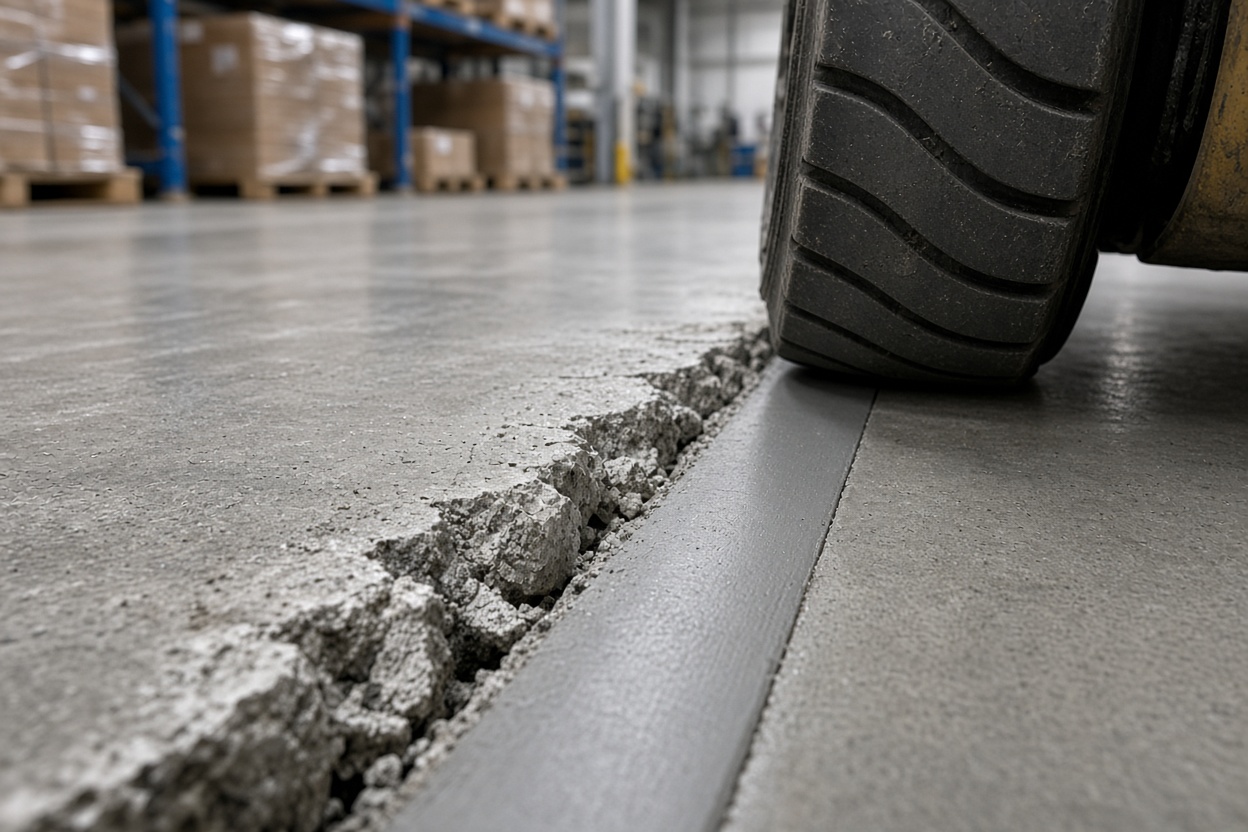
If the edges of your warehouse control joints are chipping and crumbling under forklift traffic, the fix most people reach for is the wrong product. Here’s the straight answer: a joint filler and a joint sealant do opposite jobs — a semi-rigid filler supports the concrete edge so a hard wheel rolls across it, while a flexible sealant only moves and keeps water out. Using a sealant where you need a filler is the single most common reason control-joint edges keep spalling. Spalling under forklifts is a mechanical-load problem, not a water problem, so the product that just “seals” the gap can’t stop it. That distinction — and what to actually specify — is the whole job when we treat control joints as part of our commercial epoxy and resinous flooring work across metro Atlanta.
This matters because the two products look nearly identical in the tube and on a datasheet, and the words get used interchangeably on job sites. But they’re engineered for different purposes, and handing your contractor the wrong one — or letting them guess — is how a facility ends up re-repairing the same joints every couple of years. Here’s what each one does, why the edges spall in the first place, and exactly what to put in front of a contractor.
Filler vs. sealant: the opposite-jobs rule
Start here, because everything else follows from it. Industrial joint-treatment references — including manufacturer guides from Belcovo (“Concrete Joint Filler”) and Alchatek (“Joint Sealant or Joint Filler?”) — draw the line the same way:
A joint filler is a rigid-to-semi-rigid material installed full-depth in a control joint and flush to the floor surface. Its job is structural: it fills the gap and supports the two concrete edges so that when a hard wheel crosses, the load transfers across the joint and the edge doesn’t take the hit alone. A filler is not supposed to move much — that firmness is the point.
A joint sealant is a flexible, elastomeric band. Its job is to keep water and debris out of a joint and to stretch and compress as the joint moves. It is deliberately soft and extensible. That makes it excellent where a joint needs to move — and useless where a joint edge needs to be held up under a wheel.
So the choice isn’t “which is better.” It’s “which problem am I solving — edge support, or movement and water?” Pick the wrong one and you don’t get a weaker version of the right result; you get the wrong result entirely.
Why control-joint edges spall under forklifts
To see why a sealant can’t save a spalling joint, you have to understand what’s actually breaking. As a concrete slab cures, it loses moisture and undergoes drying shrinkage — it physically pulls itself apart. Control joints are tooled or sawn into the slab on purpose to control where that cracking happens. As the slab shrinks, those control joints open, leaving a narrow gap bounded by two square, unradiused concrete edges.
Those edges are the weak point. Joint-filler manufacturer Metzger McGuire, in “Understanding Spalled Concrete Joints,” describes spalling as what happens when those unsupported edges take repeated impact. A hard polyurethane or steel forklift wheel hitting a square, unsupported concrete edge at the lip of an open joint will chip it — and once a chip starts, every pass widens it. That’s spalling: a mechanical-load failure at an unsupported edge. Water isn’t the driver. The driver is a hard wheel hammering an edge that has nothing holding it up.
This is why a semi-rigid filler, installed full-depth and flush, fixes it and a sealant doesn’t. The filler fills the gap solidly to the surface, so the wheel rolls across the joint — the filler carries part of the load and the edge is supported. A soft sealant under that same wheel simply deflects, leaving the edge to keep taking the full hit.
What to specify for hard-wheel traffic
For interior control joints in forklift and hard-wheel traffic, the published guidance is specific. ACI 302.1R, “Guide to Concrete Floor and Slab Construction,” calls for a semi-rigid joint filler in these conditions — a polyurea or epoxy filler, 100% solids, installed full-depth and shaved flush to the floor so there’s no gap and no lip for a wheel to catch. ACI 302.1R (and the related ACI 360 guidance on slabs-on-ground) points to a filler hard enough to support the edge — a Shore A durometer of roughly 80 to 90, measured by the ASTM D2240 durometer test method.
Each of those specs is doing work:
- Semi-rigid, not flexible. Shore A 80–90 per ASTM D2240 is firm enough to support the edge under a wheel, but with just enough give to tolerate the small residual joint movement — that’s the “semi” in semi-rigid.
- Full-depth, not a shallow bead. A filler that only fills the top of the joint has nothing underneath it; full-depth placement supports the edge through the thickness that the wheel loads.
- Flush, not recessed. Shaving the cured filler flush with the floor is what lets the wheel roll across with no deflection and no exposed edge to catch.
- 100% solids. A solvented product shrinks as it cures and pulls away from the joint walls; 100%-solids polyurea or epoxy stays put and stays bonded to the edges it’s supporting.
Hand a contractor those four parameters — semi-rigid, Shore A ~80–90, full-depth, flush, 100% solids — and you’ve specified the product instead of hoping they pick the right one.
Why a flexible sealant fails in a filler’s role
It’s worth being blunt about the failure mode, because it’s the exact mistake that keeps joints spalling after a “repair.” A flexible sealant is engineered to stretch and move — which is precisely the wrong behavior under a wheel. When a loaded forklift crosses a joint filled with a soft sealant, the sealant deflects under the load instead of supporting the concrete edge. With nothing holding the edge up, the square concrete lip keeps absorbing the full impact, and the spalling continues — often faster, because now there’s a soft, compressible band at the exact point that needed rigidity. The floor looks “fixed” for a while because the gap is filled, but the mechanism that breaks the edge was never addressed.
When a sealant is the right call
None of this makes sealant the villain — it makes it the right tool for a different job. A flexible sealant is correct wherever movement or water intrusion is the governing concern rather than edge support:
- Expansion and isolation joints — these are designed to move, and a rigid filler would simply tear or debond. A sealant flexes with them.
- Wet and washdown areas — where keeping water, cleaning chemicals, and bacteria out of the joint is the priority.
- Exterior joints — exposed to thermal expansion and contraction that demands real movement accommodation.
- Any joint where accommodating movement, not supporting an edge, is the real requirement.
The error is never “using a sealant.” The error is using a sealant on an interior control joint in hard-wheel traffic, where the floor needs edge support a sealant can’t provide.
The filler-vs-sealant decision, side by side
| Semi-rigid joint FILLER | Flexible joint SEALANT | |
|---|---|---|
| Job it does | Supports the concrete joint edge so a hard wheel rolls across under load | Keeps water & debris out and stretches to accommodate joint movement |
| Material / hardness | 100%-solids polyurea or epoxy; semi-rigid, Shore A ~80–90 (ASTM D2240) per ACI 302.1R; installed full-depth & flush | Flexible elastomeric (e.g., polyurethane/silicone class); low durometer, high extensibility by design |
| Where it’s correct | Interior control (contraction) joints in forklift / hard-wheel traffic, dry service | Expansion & isolation joints, wet/washdown areas, exterior joints — anywhere movement rules |
| If you use the wrong one | Put a rigid filler in a moving expansion joint and it tears or debonds as the joint moves | Put a soft sealant in a loaded control joint and it deflects under the wheel — edge spalling continues and accelerates |
Timing: fill after the slab has done its shrinking
One installation nuance decides whether a correctly chosen filler actually lasts. Because control joints keep opening as the slab dries, published industry practice is to delay filling the joints until the slab has completed most of its drying shrinkage, then fill full-depth. Fill too early, while the joint is still opening, and the filler can be pulled away from the joint walls or torn as the slab continues to shrink — reintroducing the exact unsupported-edge condition you installed the filler to prevent. Joint-filler guidance commonly describes waiting as long as the schedule allows, letting the joints open, and then filling — a timing decision that’s easy to skip under construction pressure and expensive to get wrong. If you’re coordinating a coating install around this, the sequencing overlaps with how we phase floor-coating work to limit facility downtime.
Repairing joints that are already spalled
If your edges are already chipped, you can’t just squeeze filler into a broken joint — there’s no sound edge left to support. Published industry repair practice is a three-step sequence: route or saw-clean the spalled joint back to sound concrete, rebuild the broken edges with a semi-rigid repair mortar or filler, then re-fill the joint full-depth and flush with a semi-rigid filler so the rebuilt edges are supported. Joint-filler manufacturer references such as Metzger McGuire describe this route-rebuild-refill approach. The step people skip is rebuilding the edge — troweling a soft sealant over a spalled joint leaves the broken edge broken, and the chipping comes right back.
Give your contractor the three facts that pick the product
You don’t need to specify a brand to get this right. You need to hand the contractor the three facts that determine the correct product, so the decision isn’t a guess:
- Traffic type — hard-wheel forklift vs. soft pneumatic tires. Hard wheels are what demand a filler.
- Joint type — control (contraction) joint vs. expansion/isolation joint. Control joints take a filler; expansion joints take a sealant.
- Environment — dry service vs. wet/washdown. Wet-area and movement joints shift the call toward a sealant.
With those three facts on the table, the right product almost specifies itself — and you stop paying to re-repair the same joints. The joint treatment also can’t be separated from the slab and the coating system over it: if you’re weighing the floor system itself, see epoxy vs. polyaspartic vs. urethane for warehouse floors, and if the slab shows moisture or coating failures, start with why commercial epoxy floors fail from moisture-vapor before anything goes down over it.
Frequently asked questions
What is the difference between a concrete joint filler and a joint sealant?
They do opposite jobs. A joint filler is a rigid-to-semi-rigid material that fills a control joint full-depth and flush to support the joint edges against hard-wheel traffic, so a forklift wheel rolls across with no deflection. A joint sealant is a flexible, elastomeric band that keeps water and debris out of a joint and stretches to accommodate movement — it is not designed to support an edge under load. Joint-filler references such as Belcovo and Alchatek describe this filler-versus-sealant distinction as the single most-confused decision in industrial flooring, because the products look similar but are engineered for different purposes.
Why are my warehouse control-joint edges chipping under forklift traffic?
Joint-edge spalling under forklifts is a mechanical-load problem, not a water problem. As concrete cures it undergoes drying shrinkage, which pulls the slab apart and opens the control joint. That leaves two unsupported, square (unradiused) concrete edges along the joint. When a hard forklift wheel hits those unsupported edges, it chips and crumbles them — that’s spalling. Joint-filler manufacturer Metzger McGuire, in “Understanding Spalled Concrete Joints,” describes this as the edges lacking support, and a properly installed semi-rigid filler is what provides that support so the wheel rolls across the joint instead of hammering the edge.
What should I specify for control joints in a high-forklift-traffic warehouse?
For hard-wheel traffic, specify a semi-rigid joint filler — a polyurea or epoxy filler, 100% solids, installed full-depth and flush to the floor so the wheel rolls across with no deflection. ACI 302.1R, “Guide to Concrete Floor and Slab Construction,” calls for semi-rigid joint filler in these conditions and recommends a Shore A hardness of roughly 80 or higher, measured by the ASTM D2240 durometer test method. The goal is a filler hard enough to support the joint edge, which a soft, flexible sealant cannot do.
Why does a flexible sealant fail when used where a filler is needed?
A flexible sealant is engineered to stretch and move, which is the opposite of what a joint edge under wheel load needs. When a hard forklift wheel hits a joint filled with a soft sealant, the sealant deflects under the load instead of supporting the concrete edge. With no edge support, the square concrete edges keep taking the full impact and the spalling continues — and often accelerates. Using a flexible sealant in a filler’s role is the most common reason joint edges keep breaking down after someone “repairs” them.
When is a joint sealant the correct choice instead of a filler?
A sealant is correct wherever real movement or water intrusion is the governing concern rather than edge support. That means expansion and isolation joints, which are designed to move; wet and washdown areas where keeping water out of the joint matters; and exterior joints exposed to thermal movement. In those locations a flexible elastomeric sealant does exactly what it’s built for. The error is using it on interior control joints in hard-wheel traffic, where edge support — a filler’s job — is what the floor actually needs.
How do you repair control joints that are already spalled?
Published industry repair practice is to route or saw-clean the spalled joint back to sound concrete, rebuild the broken edges with a semi-rigid repair mortar or filler, and then re-fill the joint full-depth and flush with a semi-rigid filler so the rebuilt edges are supported. Joint-filler manufacturer references such as Metzger McGuire describe this route-rebuild-refill sequence. Simply troweling a soft sealant over a spalled joint doesn’t rebuild the edge and the chipping returns.