
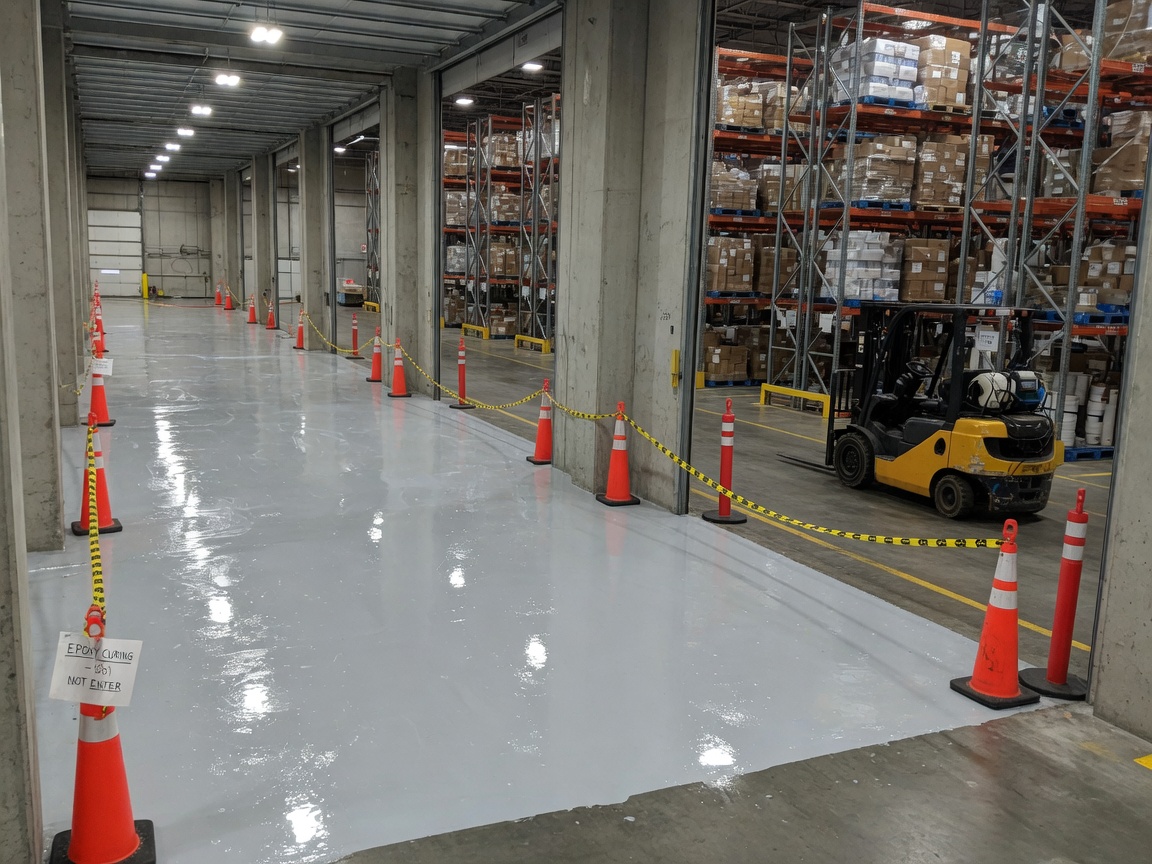
An epoxy floor coating does not take your whole facility offline for a week. A typical industrial system is dry-to-touch within hours, ready for light foot traffic in about 12–24 hours, and fully cured for forklifts, loaded pallet jacks, and rack point-loads in roughly 5–7 days at 70°F — based on typical manufacturer cure-schedule ranges — and yes, a competent contractor can phase the job bay-by-bay or run it over a weekend or shutdown window so the rest of the building stays in operation.
That distinction — walk-on versus drive-on — is where most downtime planning goes wrong. Below is the return-to-service schedule your operations team actually needs, what stretches it, and how the sequencing works in a live distribution center or plant.
What Are the Three Return-to-Service Milestones?
Epoxy does not “dry” like paint. It cures — a chemical reaction between resin and hardener that builds strength over days, not minutes. That reaction has stages, and each stage unlocks a different kind of use.
The industry vocabulary for the early stages comes from ASTM D1640, the ASTM International Standard Test Methods for Drying, Curing, or Film Formation of Organic Coatings, which defines set-to-touch, tack-free, dry-hard, and dry-through. You don’t need the chemistry to plan around it. What you need are the three practical thresholds:
1. Dry-to-touch (a few hours). The surface no longer transfers to a fingertip. The coating is set, but soft. Nothing rolls or walks on it yet — this is the “keep everyone out” window.
2. Light foot traffic (~12–24 hours). Crews can walk the floor, move light equipment on foot, and begin returning a zone to limited human activity. The film is hard enough for shoes but nowhere near its final strength.
3. Full cure — forklifts, racks, point-loads (~5–7 days at 70°F). The coating has reached the mechanical and chemical resistance it was specified for. Only now is it safe for wheeled load traffic and concentrated point-loads.
Those ranges track the cure schedules published on manufacturer technical data sheets (TDS) for industrial resin floors and quick-cure systems, but they are typical TDS ranges that shift with product and temperature, not a fixed promise. The exact numbers for your floor come off the data sheet for the specific system spec’d, read against your slab conditions.
Why Does “You Can Walk On It” Not Mean “You Can Drive On It”?
This is the single most expensive misunderstanding in floor-coating scheduling. A floor that feels rock-hard underfoot on day two can still be damaged on day two by a loaded forklift.
Here’s the mechanism. Foot traffic spreads a person’s weight across a broad, soft-soled contact area at low pressure. A forklift concentrates thousands of pounds onto a few small, hard wheel contact patches — and a loaded pallet jack or a rack post foot does the same thing, driving a high point-load straight down into a coating that is still building its final crosslink density. Until the epoxy reaches full cure, that concentrated pressure can gouge, imprint, or delaminate a surface that handles walking without a mark.
So the operative constraint for a distribution center or plant is never “when can we walk on it.” It is “when can the forklifts come back.” That is the 5–7-day number, and it is the number your production schedule should be built around.
The same logic applies to rack installation and re-racking. Setting loaded pallet racking back onto a not-yet-cured floor concentrates static point-loads at every base plate. Plan racking re-load for after full cure in that zone, not the moment the aisle is walkable. It’s the same substrate-first discipline that decides whether a coating reaches its rated life — the flip side of the moisture and prep failures behind why commercial epoxy floors fail.
What Stretches the Cure Schedule?
The TDS numbers assume roughly 70°F and controlled humidity. Real facilities are not lab conditions, and two variables move the timeline materially.
Low slab temperature slows the reaction. Epoxy cure is temperature-dependent — the colder the slab, the slower the chemistry, and the longer every milestone takes. A cold, unheated warehouse slab in winter can push a 5–7-day full cure noticeably longer. It is the slab surface temperature that governs, not the air temperature you read off the thermostat.
High humidity and a damp substrate slow it further and risk the bond. Elevated relative humidity extends cure time, and a slab carrying too much moisture vapor is the leading cause of coating failure entirely — blistering, delamination, and adhesion loss that show up weeks later. For scheduling purposes, the point is simple: cold and damp both cost you days.
The American Concrete Institute’s ACI 302.2R, Guide for Concrete Slabs that Receive Moisture-Sensitive Flooring Materials, covers the slab temperature and moisture conditions a concrete floor should meet to receive a coating. A contractor who plans against it isn’t padding the schedule — they’re protecting you from a re-coat six months out.
Does Moisture Testing Count as Part of the Downtime?
Yes — and it should happen before a single gallon is mixed, which means it belongs on your project timeline, not as an afterthought.
Concrete holds and moves moisture. If the slab is emitting too much vapor when the epoxy goes down, the coating can fail no matter how clean the prep or how good the product. That’s why the moisture gate comes first. The two standard tests are ASTM F2170, an in-situ relative-humidity probe placed into the slab, and ASTM F1869, the anhydrous calcium chloride moisture-vapor-emission test. One or both must pass before coating is cleared to start.
The practical scheduling consequence: F2170 probes need time to equilibrate in the slab before they read true, so moisture testing is a lead-time item. Build it into the front of the schedule. A contractor who tests, confirms the slab passes, and only then commits install dates is de-risking your investment — surprises found on the day of install are far more expensive than a probe reading taken a week ahead.
How Does a Contractor Phase the Work Around Live Operations?
For a running distribution center or plant, the coating rarely goes down all at once. It’s sequenced so the building keeps working. Four levers do most of the phasing:
Bay-by-bay / zone sequencing. The floor is divided into zones and coated one at a time. Operations shift out of the active zone, that zone cures through its full 5–7 days, forklifts return, and the crew moves to the next. You lose one zone at a time, never the whole floor.
Weekend windows. For a smaller area or a single critical aisle, the work is scheduled Friday evening through the weekend so a fast-cure system can hit foot-traffic or drive-on readiness before Monday operations.
Plant-shutdown windows. If you already have a scheduled maintenance or holiday shutdown, that’s the ideal envelope — the floor uses downtime you were taking anyway.
Fast-cure / quick-cure epoxy systems. When uptime is the constraint, manufacturers publish quick-cure resin systems that compress the return-to-service timeline substantially versus standard epoxy. They cost more per square foot, but for a DC where a lost operating day dwarfs the coating premium, the math usually favors the faster system.
The right combination depends on your throughput, your rack layout, and how much floor you can vacate at once. That’s the conversation to have before dates are set — not after. It also depends on which system belongs where: if part of the building would do better on a mechanically refined bare slab, our guide to polished concrete versus epoxy by zone walks through the trade-off, including the different downtime each carries.
Return-to-Service Schedule at a Glance
Typical ranges for an industrial epoxy system at ~70°F. Confirm against the specific product’s technical data sheet and your slab conditions.
| Activity resuming | Typical time at ~70°F | What damages the floor if you rush it |
|---|---|---|
| Dry-to-touch | A few hours | Any contact — dust, foot traffic, or tools mar a soft, uncured surface |
| Light foot traffic | ~12–24 hours | Wheeled loads, dropped tools, and point-loads imprint or gouge a film that is walkable but not strong |
| Full cure — forklifts, loaded pallet jacks, rack point-loads | ~5–7 days | Forklift wheels and concentrated point-loads gouge, delaminate, or crush a coating still building final strength |
Cold slabs and high humidity extend all three windows. Moisture testing (ASTM F2170 / F1869) happens before coating and adds front-end lead time.
What Do I Tell My Operations Team?
Keep it to the numbers that drive their schedule. For any zone being coated: expect that zone out of service for roughly a week end-to-end before forklifts and loaded traffic return, with people able to walk it after about a day and the surface untouchable for the first several hours.
Then sequence it. A live facility comes back online zone by zone — you clear one area, it cures, forklifts return, and the crew rotates to the next. The rest of the building never stops. If a full week per zone is too much exposure, that’s the signal to price a quick-cure system or a shutdown window instead. The point is that “epoxy floor” and “week-long facility shutdown” are not the same thing — the second only happens if the job is planned as one monolithic pour instead of a phased return-to-service. That’s exactly how we scope commercial epoxy floor coating, and the same cost-versus-downtime logic runs through our breakdown of warehouse epoxy floor cost.
Frequently Asked Questions
How long before forklifts can drive on a new epoxy floor?
Plan on roughly 5–7 days at 70°F for full cure before forklifts, loaded pallet jacks, or rack point-loads return to a coated zone, based on typical manufacturer cure-schedule ranges. Foot traffic is usually fine much earlier (~12–24 hours), but wheeled load traffic needs the coating at full mechanical strength — driving on it early is the most common way a good floor gets damaged. Confirm the exact numbers against the specific product’s technical data sheet and your slab conditions.
Can you coat a warehouse floor without shutting down the whole facility?
Yes. The standard approach is zone or bay-by-bay sequencing — the floor is divided into areas coated one at a time, so operations move out of the active zone while the rest of the building keeps running. Weekend windows and existing plant-shutdown periods are also used when the timing lines up.
Does cold weather make epoxy take longer to cure?
Yes. Epoxy cure is temperature-dependent, and it’s the slab surface temperature that matters, not air temperature. A cold, unheated warehouse slab slows the chemistry and extends every milestone. High humidity does the same and adds a bond-failure risk, which is why slab conditions are checked against ACI 302.2R before coating.
Why do I have to wait days for forklifts when I can walk on it the next day?
Because walking and driving load the floor completely differently. Foot traffic is low-pressure and spread out; a forklift or loaded pallet jack concentrates heavy load onto small, hard contact points. Until the epoxy reaches full cure, that concentrated point-load can gouge or delaminate a surface that handles walking without a mark.
Is moisture testing really necessary, and does it add time?
It’s necessary, and it adds front-end lead time. Excess moisture vapor in the slab is a leading cause of coating failure. Standard tests — ASTM F2170 (in-situ RH probe) and ASTM F1869 (calcium chloride) — must pass before coating begins, and the RH probes need time to equilibrate, so testing goes at the front of the schedule, not the day of install.
Can a faster-curing epoxy get my floor back in service sooner?
Yes. Manufacturers publish quick-cure resin systems engineered to compress the return-to-service timeline versus standard epoxy. They cost more per square foot, but for a distribution center where a lost operating day far outweighs the coating premium, the faster system usually pays for itself. Whether it fits your floor is a spec-and-slab-condition question worth pricing.